
Palacio Real de Madrid and its stone-built ceremonial scale
Published on 09/22/2026 at 09:09 | Editorial responsibility: Rafael Müller, Editor-in-Chief AD HOC NEWS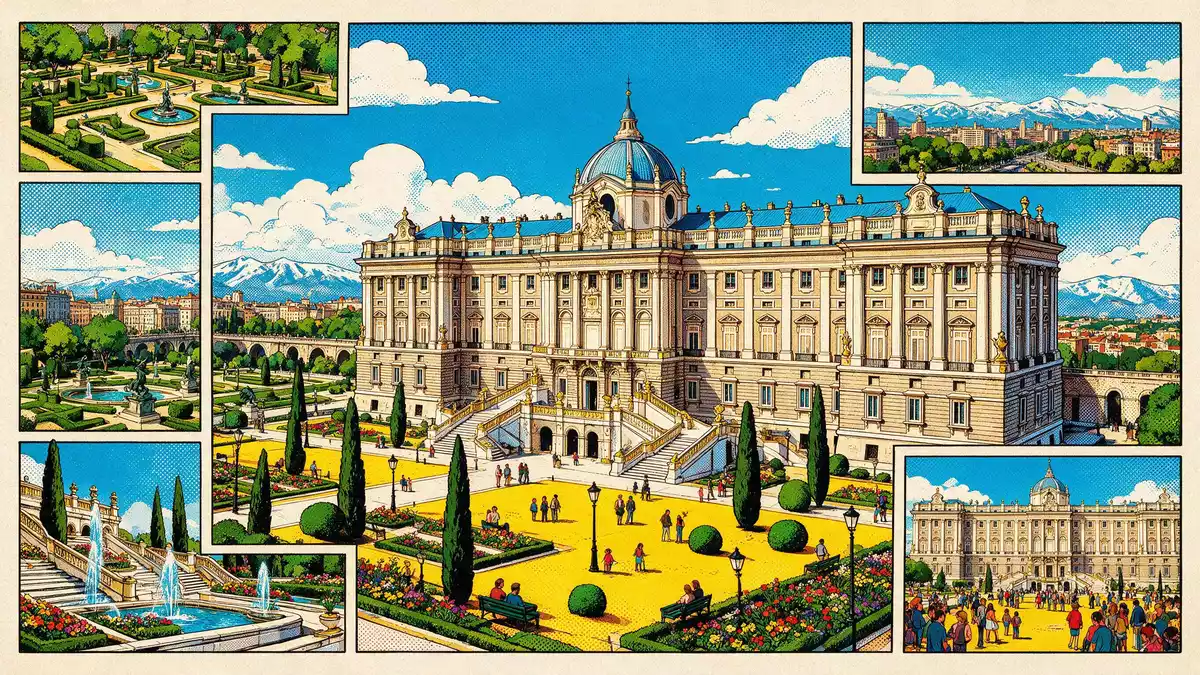
Palacio Real de Madrid rises above the western centre of Madrid as a vast Bourbon palace of stone, marble and gilded interiors. Its ceremonial rooms, formal courtyards and historic collections occupy a building completed in the eighteenth century.
Palacio Real de Madrid after the Alcázar
The palace belongs to the architectural history of Madrid’s royal hill. Its distant origin reaches back to an Islamic fortress associated with Muhammad I, emir of Córdoba, during the ninth century. Philip II moved the royal court to Madrid in 1561, and the former fortress became the Alcázar used by the Spanish monarchy.
Fire destroyed the Alcázar in 1734. Philip V, the first Bourbon king of Spain, commissioned a replacement on the royal site. Building work began in 1738 and the palace was completed in 1764, creating the structure recognised in Madrid today. the palace’s construction history connects the Bourbon dynasty with the city’s older royal centre.
Baroque massing and Classical order
Palacio Real de Madrid combines Baroque grandeur with Classical discipline. Its exterior uses granite and limestone, while the interior contains marble, stucco, gilded wood and painted decoration. The building presents a strong, regular façade around a central courtyard, with long architectural lines facing the surrounding royal grounds.
Several architects shaped the palace. Filippo Juvarra prepared the first project, while Giovanni Battista Sacchetti developed the building that rose from the site. Francisco Sabatini contributed to its later architectural work and gave his name to the gardens north of the palace. the palace’s Baroque and Classical character remains visible in its ordered façades and elaborate interiors.
Rooms, collections and state ceremony
The palace is the official residence of the Spanish royal family, although the family lives at the Palacio de la Zarzuela. Palacio Real de Madrid serves as a setting for state ceremonies and formal royal occasions, while its historic rooms present the court culture of the Bourbon monarchy.
Among the recognised interiors are the Throne Room, the Hall of Columns, the Royal Chapel and the Gasparini Room. The palace also contains the Royal Armoury, with arms and armour associated with Spanish rulers, and the Royal Pharmacy. Paintings, clocks, textiles, furniture and decorative arts extend across the ceremonial rooms.
Charles III became the first monarch to use the completed palace as a royal residence in 1764. Decoration continued under Bourbon monarchs, including Charles IV and Ferdinand VII. The result is not a single-period interior, but a sequence of rooms shaped by changing court taste, royal ceremony and craftsmanship.
The palace’s historic identity is also connected with its position beside Plaza de Oriente and near Madrid’s Almudena Cathedral. The Campo del Moro gardens extend behind the palace, while the Sabatini Gardens lie to its north. Madrid’s royal palace district brings together royal architecture, gardens, ceremonial spaces and the city’s historic centre.
Visiting Palacio Real de Madrid: what travellers from Western Europe should know
- Palacio Real de Madrid stands on Calle de Bailén beside Plaza de Oriente and Almudena Cathedral. Madrid’s Ópera station and the city’s Metro network provide access to the surrounding district.
- The palace is an urban complex with broad exterior spaces and extensive interiors. The visit includes historic stairways, large ceremonial rooms and several museum collections.
- The official language is Spanish and the currency is the euro.
- The Campo del Moro and Sabatini Gardens lie beside the palace complex, with separate paths, planting and views towards the royal building.
Searching for Palacio Real de Madrid on social platforms
These links open searches for Palacio Real de Madrid on each platform.
Frequently asked questions about Palacio Real de Madrid
Where is Palacio Real de Madrid?
Palacio Real de Madrid stands on Calle de Bailén in central Madrid, beside Plaza de Oriente and Almudena Cathedral. The palace faces historic squares, gardens and the western edge of the city centre.
What can visitors expect inside?
The interior contains ceremonial rooms, royal collections and decorative arts. The Throne Room, Royal Chapel, Royal Armoury and historic pharmacy form part of the palace experience.
What makes the palace distinctive?
Its identity comes from the meeting of Bourbon history, Baroque scale and Classical order. Stone façades surround interiors filled with marble, gilded wood, textiles, paintings and court furnishings.


