
Palacio de La Moneda, neoclassical power block in Santiago de Chile
Published on 09/17/2026 at 12:59 | Editorial responsibility: Rafael Müller, Editor-in-Chief AD HOC NEWS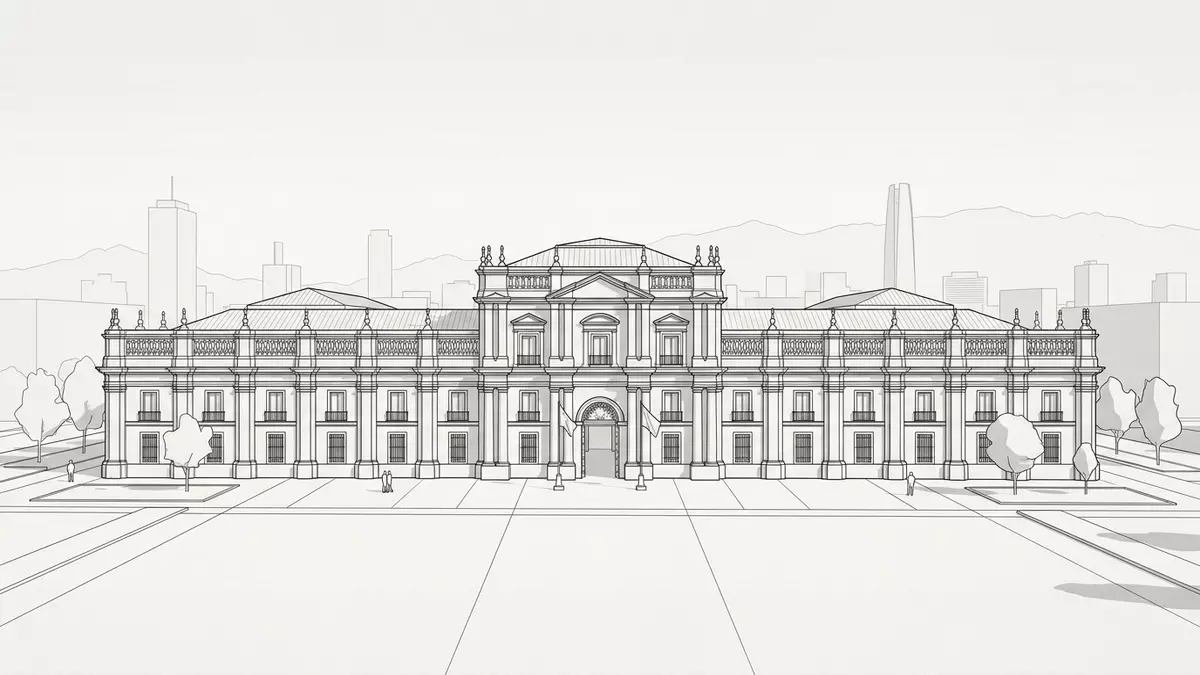
Palacio de La Moneda in Santiago de Chile is a neoclassical palace that occupies an entire city block in the city’s Civic District and serves as the seat of the President of Chile. Designed in the late eighteenth century by the Italian architect Joaquín Toesca and inaugurated as the Royal Mint of Santiago in 1805, it later became the centre of Chile’s executive power in the nineteenth century, giving the building a dual identity as former mint and presidential palace.
A neoclassical palace built for a mint
Palacio de La Moneda began as a specialised complex for coin production in the late eighteenth century, when a mint was established for the Captaincy General of Chile and the commission went to Joaquín Toesca, an architect steeped in European neoclassical traditions.designed by Joaquín Toesca Construction is recorded as having started in the 1780s, and the palace was inaugurated in 1805 as the Royal Mint of Santiago, housing workshops and machinery dedicated to coin production for the Spanish Crown.inaugurated in 1805 as the mint
The palace follows neoclassical principles with a restrained, symmetrical layout, stone façades and ordered courtyards organised around functional wings. In its original configuration, the courtyards framed workspaces and circulation routes connected to mint operations, while the external fronts projected a sober official image onto the surrounding streets. The structural language is closer to European academic classicism than to local adobe townhouses, making Palacio de La Moneda stand out within the historic centre of Santiago de Chile as a formal, masonry-built government block.
From Royal Mint to presidential palace
After Chile achieved independence in the nineteenth century, Palacio de La Moneda changed role: in 1845 it became the official seat of the executive branch and the residence of the President of the Republic, concentrating key offices of the presidency under one roof.seat of the executive since 1845 For a period, minting activity continued in parts of the complex, so workshops and governmental rooms coexisted before coin production was eventually moved elsewhere in the twentieth century.origin as Royal Mint of Santiago
In its present form, Palacio de La Moneda houses the offices of the President of Chile together with ministries linked to the presidency, including the Ministry of the Interior, the General Secretariat of the Presidency and the General Secretariat of Government.offices of president and three cabinet ministers The combination of interior patios, administrative wings and ceremonial rooms reflects this shift from industrial mint to seat of government, and gives the palace an architectural character shaped by state functions over more than two centuries.
A full block at the centre of Chile’s civic life
Palacio de La Moneda occupies a complete block in the Civic District of central Santiago de Chile, bordered by Moneda Street to the north, Morandé to the east, Teatinos to the west and Alameda del Libertador Bernardo O’Higgins to the south.bounded by Moneda, Morandé, Teatinos and Alameda Its main northern façade faces Plaza de la Constitución, while the southern side opens towards Plaza de la Ciudadanía, placing the palace between two formal urban squares that frame processions, ceremonies and everyday governmental activity.between Plaza de la Constitución and Plaza de la Ciudadanía
Within this block, the building presents several façades to the surrounding streets, all following the same neoclassical vocabulary of pilasters, cornices and rhythmically spaced openings. Behind them lie courtyards such as the Patio de los Naranjos, long corridors and staircases serving ministerial offices, and reception rooms used for state events. The palace’s stone mass, aligned with the grid of downtown streets and flanked by civic plazas, makes the building a fixed reference point in Santiago de Chile’s urban landscape and a physical symbol of national political life.
Visiting Palacio de La Moneda: what travellers from Western Europe should know
- Palacio de La Moneda stands in the Civic District of central Santiago de Chile, filling a full block between Moneda, Morandé, Teatinos and Alameda del Libertador Bernardo O’Higgins streets.
- The immediate surroundings are flat city terrain with paved streets and squares; approaching the palace involves walking across open plazas rather than climbing gradients or negotiating rough ground.
- The building lies within the dense downtown grid of Santiago de Chile, with urban transport and several city landmarks clustered around the same civic area.
- The official language is Spanish and the currency is the Chilean peso.
- Entry requirements depend on your nationality; UK travellers can check the FCDO travel advice at gov.uk/foreign-travel-advice, Irish travellers the Department of Foreign Affairs at ireland.ie.
Searching for Palacio de La Moneda on social platforms
These links open searches for Palacio de La Moneda on each platform.Frequently asked questions about Palacio de La Moneda
Where is Palacio de La Moneda located?
Palacio de La Moneda is located in central Santiago de Chile, occupying a full block in the Civic District between Moneda, Morandé, Teatinos and Alameda del Libertador Bernardo O’Higgins streets.
What should travellers expect when visiting the area around the palace?
Travellers encounter a formal civic setting with paved squares, government buildings, monuments and busy downtown streets, with Palacio de La Moneda forming a prominent neoclassical block at its centre.
What makes Palacio de La Moneda distinctive among Santiago de Chile’s landmarks?
The palace’s layered history as an eighteenth-century Royal Mint turned nineteenth-century presidential seat, its neoclassical architecture and its full-block presence between major civic plazas make it a distinctive landmark in Santiago de Chile.


