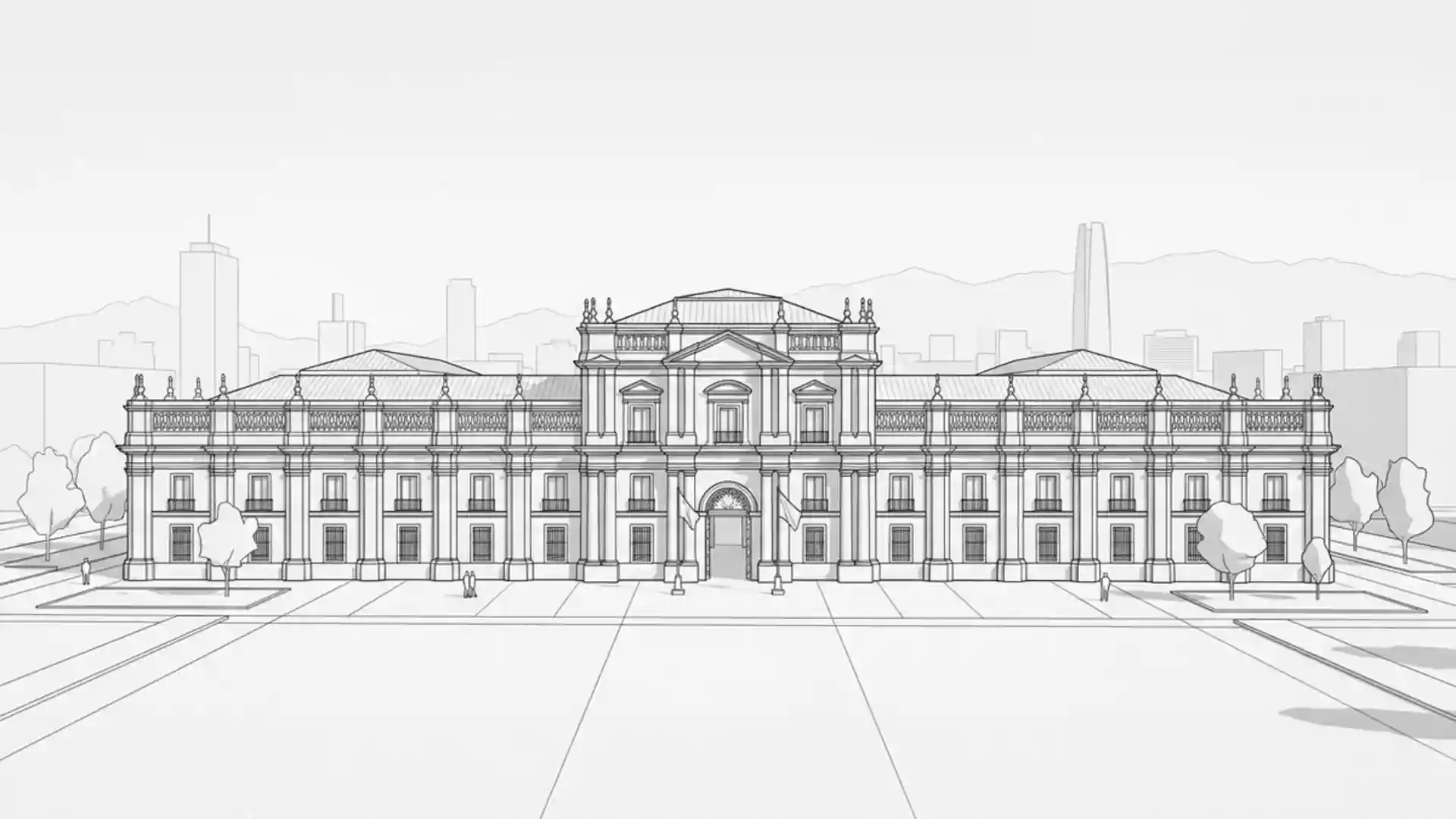
Palacio de La Moneda, a neoclassical block at Chile’s political centre
Published on 09/11/2026 at 20:50 | Editorial responsibility: Rafael Müller, Editor-in-Chief AD HOC NEWS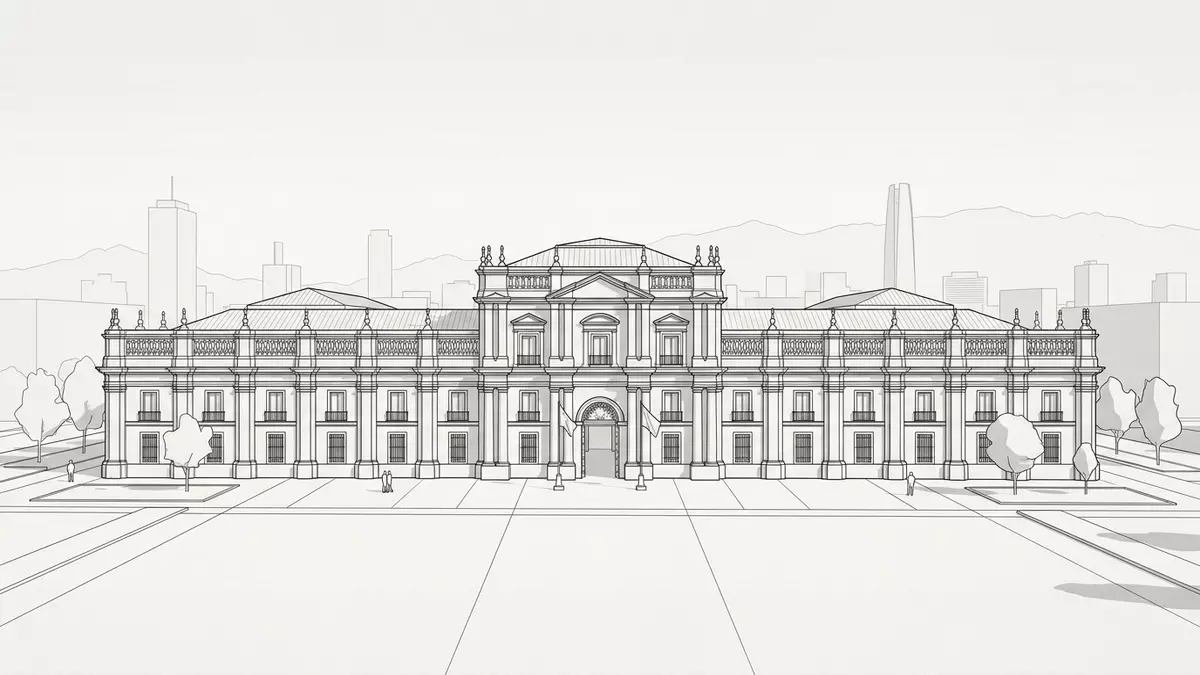
Palacio de La Moneda in Santiago de Chile is a neoclassical government palace occupying an entire city block, laid out around internal courtyards and long façades that frame Chile’s political centre in stone. Completed in the early nineteenth century as the Royal Mint of Santiago, it was designed by the Italian architect Joaquín Toesca and later adapted to serve as the seat of the country’s executive power.
A mint that became a government palace
Palacio de La Moneda began as a specialised building for coin production in the late eighteenth century, when the Spanish Crown ordered a mint for the Captaincy General of Chile and entrusted the project to Joaquín Toesca, an Italian architect trained in European neoclassical traditions.Construction started in 1784 and the complex was inaugurated in 1805 as the Royal Mint of Santiago, housing machinery and workshops for producing coins for the Spanish Crown.It was inaugurated in 1805 as the Real Casa de Moneda The palace’s original function as a mint continued well into the republican era, and for decades the building remained closely associated with monetary production even as Chile’s political landscape changed around it.
The nineteenth century brought a different role for La Moneda. After Chile achieved independence, the building was selected as the seat of the executive branch, and in 1845 it became the official residence of the President of the Republic as well as the government house.It has served as the seat of the executive since 1845 The palace continued to host minting operations for a period, so its courtyards and rooms carried both industrial and political functions before coin production was moved elsewhere in the twentieth century.Minting took place at La Moneda until 1929 This layered history gives the building a dual identity: a former workshop tied to the circulation of money and a long-standing centre of presidential authority.
Neoclassical architecture across an entire city block
Architecturally, Palacio de La Moneda is a clear example of neoclassicism with Roman Doric influences, expressed in a horizontal composition that emphasises symmetry and order across its façades.Its neoclassical style with Roman Doric influences The palace occupies a full urban block in central Santiago, forming a solid volume with two principal floors and additional height at some entrances facing important city streets.It is a horizontal two-storey volume The main elevation presents a measured rhythm of pilasters and evenly spaced openings, arranged around a central doorway that signals the governmental function of the building to anyone approaching along Moneda Street.
Behind the stone façades, La Moneda is organised around internal courtyards that bring light into the surrounding rooms and create enclosed outdoor spaces within the city grid. Among these are courtyards known as Los Cañones and Los Naranjos, each with its own character.The Los Cañones and Los Naranjos courtyards form part of the interior Los Naranjos contains an old fountain once used to supply water to Santiago, preserving a fragment of the city’s colonial infrastructure inside the presidential complex.The old water fountain supplied the city in colonial times The courtyards, together with Toesca’s restrained façades, give visitors a sense of ordered space that contrasts with the traffic on the surrounding streets.
Palacio de La Moneda in the fabric of Santiago de Chile
Palacio de La Moneda stands in the historic centre of Santiago de Chile, set between Plaza de la Constitución and Plaza de la Libertad and aligned with major thoroughfares such as the Alameda and Calle Moneda.It is located between the Alameda and Calle Moneda Its position places the palace within a wider ensemble of civic spaces, where public squares, monuments and administrative buildings form a dense concentration of national institutions. As the seat of the President of Chile and home to ministries linked to the presidency, the palace remains a working centre of government as well as a landmark in the cityscape.Today it houses the offices of the President and several ministries
Within this urban context, visitors encounter Palacio de La Moneda as both an architectural object and a symbol embedded in Chilean history. Its stone walls have witnessed colonial administration, the consolidation of the republic and decisive moments in the twentieth century, and the building has been restored to preserve Toesca’s neoclassical design after episodes of damage.Restoration recovered much of its original neoclassical structure The courtyards and façades make the palace a place where architectural clarity meets political continuity, and the block-sized footprint ensures that La Moneda remains a dominant presence in central Santiago.
Visiting Palacio de La Moneda: what travellers from Western Europe should know
- Palacio de La Moneda stands in the historic centre of Santiago de Chile, between Plaza de la Constitución and Plaza de la Libertad, with façades facing streets such as the Alameda and Calle Moneda.
- The palace occupies a full city block, and the surrounding area consists of paved squares and streets; moving around the complex involves crossing broad urban spaces rather than long approaches on foot over uneven ground.
- The building sits at low altitude in the central valley of Chile, and the immediate terrain is urban and level, without mountain paths or steep natural slopes.
- English is widely used in international contexts, but the official language of Chile is Spanish and the currency is the Chilean peso.
- Entry requirements depend on your nationality; UK travellers can check the FCDO travel advice at gov.uk/foreign-travel-advice, Irish travellers the Department of Foreign Affairs at ireland.ie.
Searching for Palacio de La Moneda on social platforms
These links open searches for Palacio de La Moneda on each platform.
Frequently asked questions about Palacio de La Moneda
Where is Palacio de La Moneda located within Santiago de Chile?
Palacio de La Moneda stands in the historic centre of Santiago de Chile, between Plaza de la Constitución and Plaza de la Libertad, with fronts onto the Alameda and Calle Moneda.
What can visitors expect when they see Palacio de La Moneda?
Visitors encounter a neoclassical stone palace occupying an entire city block, with ordered façades and internal courtyards such as Los Cañones and Los Naranjos forming enclosed spaces within the urban grid.
What makes Palacio de La Moneda distinctive among government buildings?
Palacio de La Moneda is distinctive because it combines Joaquín Toesca’s neoclassical design with its original role as a mint and its long-standing function as the seat of Chile’s executive power.