
Orszaghaz and the neo-Gothic parliament on the Danube
Published on 09/19/2026 at 20:20 | Editorial responsibility: Rafael Müller, Editor-in-Chief AD HOC NEWS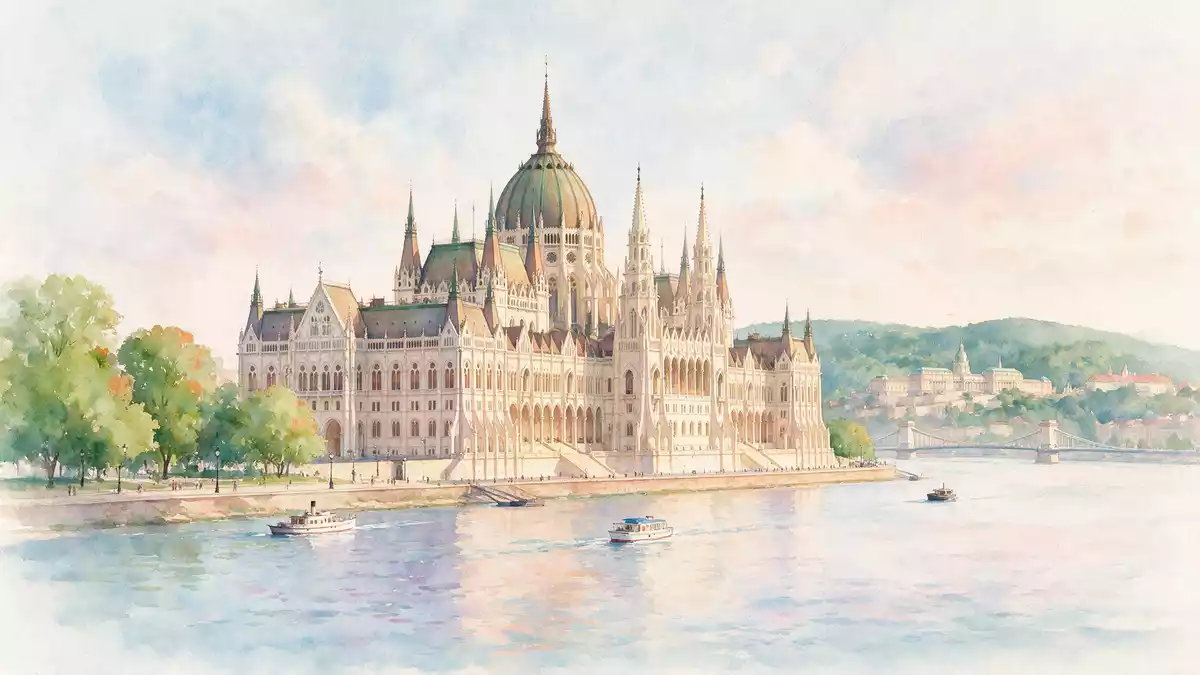
Orszaghaz, the Hungarian Parliament Building in Budapest, turns Hungary’s seat of legislature into a monumental neo-Gothic complex aligned with the Danube embankment. Completed in 1902 to designs by the architect Imre Steindl, it places a tall central dome and long wings of stone along Kossuth Lajos tér on the Pest bank as part of the riverfront panorama recognised as a UNESCO World Heritage site.
A riverfront parliament of stone and dome
Orszaghaz stands on the eastern bank of the Danube in central Budapest, occupying the northern edge of Kossuth Lajos tér in the historic district of Lipótváros on the Pest side of the city. Its main front is aligned parallel to the river, set behind tram tracks and a promenade that follow the embankment and face across to Buda Castle and the hills beyond.stands on the eastern bank of the Danube
The building stretches for hundreds of metres along the waterfront, with a symmetrical composition that combines a high central dome with flanking wings that house parliamentary chambers and offices. The long riverfront façade carries rows of windows, carved tracery and towers in stone, giving Orszaghaz a strongly horizontal presence against the water while the dome rises above as a vertical counterpoint.tall central dome with long side wings
Neo-Gothic design and national symbolism
Construction of Orszaghaz began in 1885 after a design competition and continued into the early twentieth century, reflecting the period when Budapest was developing grand civic architecture along the Danube.construction period 1885–1904 Imre Steindl’s winning design drew on Gothic Revival precedents with pointed arches, pinnacles and an emphasis on vertical lines, while the overall plan and dome echo Baroque and Neo-Renaissance influences.Neo-Gothic architecture with Baroque symmetry
The structure rises to 96 m (315 ft) at the central dome, a height shared in Budapest with St Stephen’s Basilica, and extends roughly 268 m (879 ft) along the riverbank, making it one of the largest parliament buildings in Europe.96 metres tall and 18,000 square metres The extensive interior contains hundreds of rooms, staircases and courtyards, laid out to serve the National Assembly of Hungary and its committees, and also houses the Hungarian Holy Crown under guarded display as a central national symbol.home to Hungary’s legislative body and the Holy Crown
Orszaghaz within Budapest’s Danube panorama
Orszaghaz forms part of the Danube panorama in Budapest that is inscribed on the UNESCO World Heritage List, together with the Buda Castle Quarter and the Chain Bridge.declared a World Heritage Site as a central element in the Danube panorama From the opposite bank and from boats on the river, the long neo-Gothic frontage, the forest of spires and the dome create a distinctive silhouette that anchors the Pest side of the cityscape.
Around Kossuth Lajos tér, government offices and memorials cluster beside Orszaghaz, while streets of the inner city spread south into the wider Lipótváros district. The building’s position beside the river and close to other civic landmarks makes it a focal point in both Hungary’s political life and Budapest’s urban layout, tying national governance to the Danube corridor that links the city with wider Central Europe.seat of the National Assembly of Hungary on Kossuth Square
Visiting Orszaghaz: what travellers from Western Europe should know
- Orszaghaz stands on Kossuth Lajos tér on the Pest side of the Danube in central Budapest, reached by tram routes along the embankment and by metro line M2 at Kossuth Lajos tér station.
- The site consists of extensive stone terraces, steps and paved areas around the building and the square, with level promenades beside the river and broader approaches on the landward side.
- Nearby landmarks include the Buda Castle area across the river and other civic buildings and museums around Kossuth Lajos tér in the Lipótváros district.
- Hungary’s official language is Hungarian and the currency is the forint.
Searching for Orszaghaz on social platforms
These links open searches for Orszaghaz on each platform.Frequently asked questions about Orszaghaz
Where is Orszaghaz located in Budapest?
Orszaghaz stands on Kossuth Lajos tér in the Lipótváros district on the Pest bank of the Danube, facing across the river towards the Buda Castle area.
What can visitors expect when approaching Orszaghaz?
Visitors encounter a broad riverside setting with stone terraces, tram tracks and promenades along the Danube, and large civic spaces around the parliament building and square.
What makes Orszaghaz distinctive among European parliament buildings?
Its combination of a 96 m (315 ft) central dome, long neo-Gothic riverfront wings, Holy Crown display and inclusion in Budapest’s UNESCO-listed Danube panorama gives Orszaghaz a distinctive presence.


