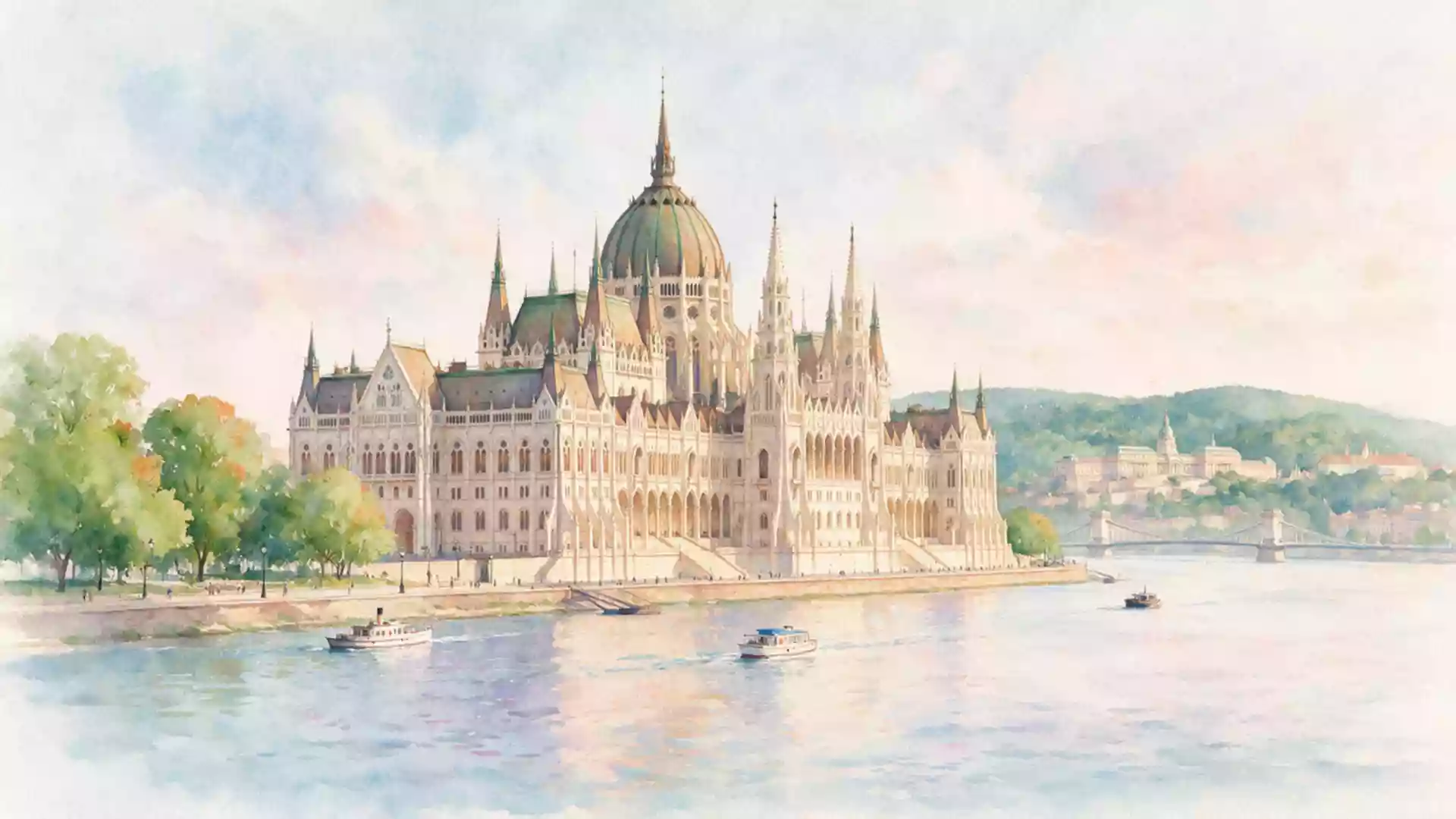
Orszaghaz and the neo-Gothic riverfront of Budapest
Published on 08/28/2026 at 16:15 | Editorial responsibility: Rafael Müller, Editor-in-Chief AD HOC NEWS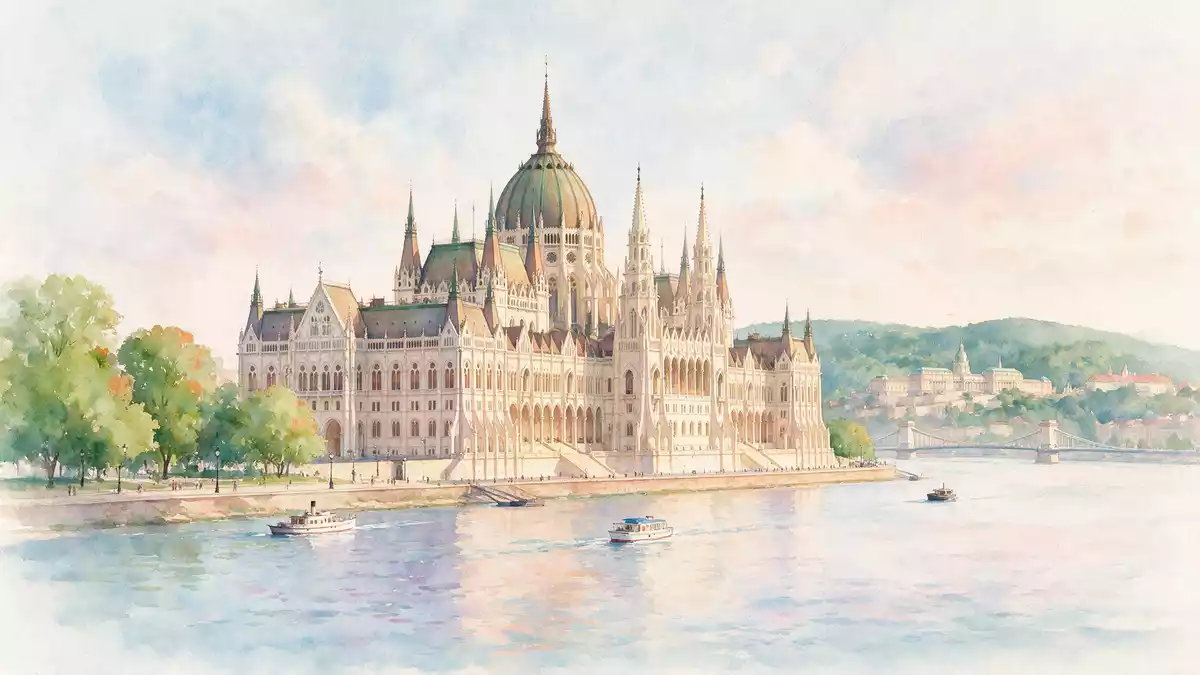
Orszaghaz, the Hungarian Parliament Building on the Danube embankment in Budapest, ties the country’s political centre to a monumental neo-Gothic riverfront crowned by a tall central dome. Built in the late nineteenth century as the seat of the National Assembly and designed by the Hungarian architect Imre Steindl, it stretches along Kossuth Lajos tér on the Pest side of the river as one of the capital’s defining civic monuments.Hungarian Parliament Building
A neo-Gothic palace on the Danube
Orszaghaz stands on the eastern bank of the Danube in Budapest, its long main front aligned parallel to the river and set behind tram tracks and a promenade that follow the embankment.stands on the eastern bank of the Danube The building occupies the northern side of Kossuth Lajos tér in the district of Lipótváros, with government offices and museums around the square and the riverfront opening out towards Buda Castle and the hills beyond.Kossuth Lajos Square in the historic district of Lipótváros
From the river, Orszaghaz reads as a symmetrically composed stone palace, with a rhythm of pinnacled towers, sculpted gables and traceried façades that form a continuous frontage along the water. The tall central dome rises above the roofline, flanked by lower wings that house the parliamentary chambers and offices and give the whole composition a clear axial focus in the middle of its long elevation.maximum width and dome height
Imre Steindl’s Gothic Revival design
Construction of Orszaghaz began in 1885 after a design competition, and the building entered parliamentary use in the early twentieth century, marking a key project of Hungary’s late nineteenth-century architecture.construction years 1885–1904 Imre Steindl, born in Pest in 1839, developed the scheme as a Gothic Revival composition that draws on historic European parliament buildings while asserting its own identity on the Danube embankment.Imre Steindl, designer of Orszaghaz
The façades combine pointed arches, crocketed pinnacles, sculpted figures and elaborate stone tracery with a balanced, axial arrangement based on a Baroque-influenced floor plan. Alongside the neo-Gothic vocabulary, elements of Renaissance and Baroque appear in the massing and interior decoration, producing a hybrid monumental style that has come to symbolise Hungary and its capital.mix of architectural styles
The seat of the National Assembly
Orszaghaz houses the National Assembly of Hungary, with large debating chambers, committee rooms and offices arranged within its extensive wings.home to Hungary’s legislative body The building also keeps the Hungarian Holy Crown under a guarded display in its interior, underscoring its role as both a working seat of legislature and a repository of national symbols.guardian of the Hungarian Holy Crown
Beyond its political functions, Orszaghaz forms part of a wider ensemble recognised as a World Heritage landscape along the Danube, together with the Buda Castle Quarter and Andrássy Avenue, tying the riverfront skyline into an internationally protected panorama.World Heritage Site with the Banks of the Danube The stone terraces, statues and memorials on Kossuth Lajos tér connect the building to its urban surroundings, where trams run along the embankment and river cruise boats pass with views of its long elevation and central dome.
Visiting Orszaghaz: what travellers from Western Europe should know
- Orszaghaz stands on Kossuth Lajos tér on the Pest bank of the Danube in Budapest, in the district of Lipótváros, reached by riverfront tram lines and the M2 metro at Kossuth Lajos tér station.
- The exterior is set on a raised embankment with broad terraces and steps leading up from the riverside and from Kossuth Lajos tér, so moving between the square, the promenade and the building involves stairways and sloping approaches.
- The Danube riverfront beside Orszaghaz links towards the Buda Castle Quarter and Margaret Bridge, making it part of a continuous urban riverside landscape with promenades, statues and views across to the Buda hills.
- Hungary’s official language is Hungarian and the currency is the forint.
- Entry requirements depend on your nationality; UK travellers can check the FCDO travel advice at gov.uk/foreign-travel-advice, Irish travellers the Department of Foreign Affairs at ireland.ie.
Searching for Orszaghaz on social platforms
These links open searches for Orszaghaz on each platform.
Frequently asked questions about Orszaghaz
Where is Orszaghaz located in Budapest?
Orszaghaz stands on Kossuth Lajos tér on the eastern bank of the Danube in the district of Lipótváros on the Pest side of Budapest.
What can visitors expect when approaching Orszaghaz?
The building presents a long neo-Gothic stone frontage with pinnacled towers and a central dome, set above terraces, statues and stairways that connect it to the riverfront and square.
What makes Orszaghaz distinctive among European parliament buildings?
Its combination of Gothic Revival façades, a Baroque-influenced plan and a prominent riverside setting on the Danube embankment, together with its role as Hungary’s legislative seat, gives Orszaghaz a particular character within Europe’s parliamentary architecture.