
Odaiba, Tokyo Bay’s engineered island of entertainment and skyline views
Published on 09/21/2026 at 23:36 | Editorial responsibility: Rafael Müller, Editor-in-Chief AD HOC NEWS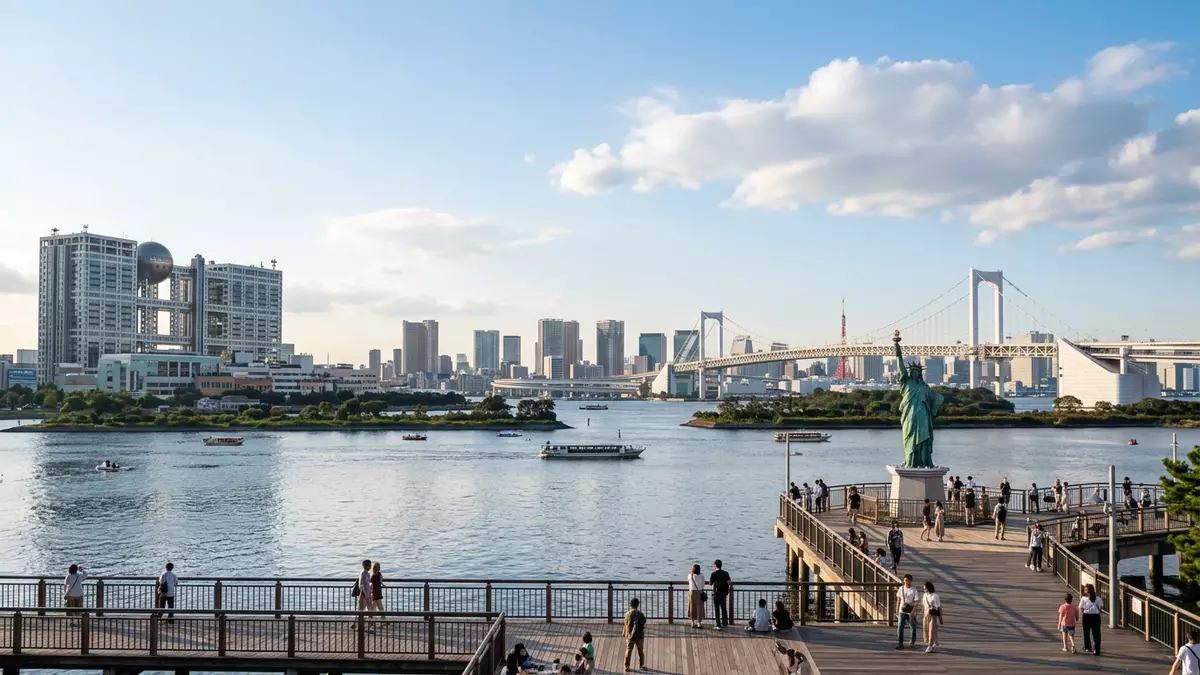
Odaiba is a large artificial island district in Tokyo Bay, south-east of central Tokio, where nineteenth-century sea fortifications and late twentieth-century reclamation form a continuous waterfront cityscape of promenades, towers and leisure complexes.
An artificial island shaped from batteries and harbour works
The name Odaiba derives from defensive batteries first laid out in Tokyo Bay in 1853 under the Tokugawa shogunate as part of Edo’s response to foreign naval pressure, and the modern island incorporates some of these early fort sites into its urban fabric.defensive batteries During the twentieth century the Port of Tokyo expanded across the bay through infill, gradually connecting formerly separate installations into larger platforms that could host harbour facilities and, later, urban districts.Port of Tokyo expanded In the late twentieth century this reclaimed ground was consolidated and planned as a waterfront extension of the metropolis, with straight embankments and engineered shorelines enclosing a single artificial island in the northern part of Tokyo Bay.
Administratively, Odaiba spans parts of Minato, K?t? and Shinagawa wards, reflecting how the island bridges older municipal boundaries while presenting itself visually as one engineered landmass.Minato, K?t? and Shinagawa Wide boulevards, serviced plots and elevated transport lines give the district the character of a planned waterfront quarter, distinguishable from the denser, older neighbourhoods on the mainland. The result is an island cityscape where the historical origin in fort islands is legible in name and layout, yet the prevailing impression is of modern engineering and large-scale urban design on reclaimed land in the bay.
Rainbow Bridge, driverless trains and a ring of waterfront promenades
Odaiba links to central Tokio across the Rainbow Bridge, a long multi-level suspension bridge that carries road traffic and rail tracks between Shibaura on the mainland and the island’s northern edge, framing views back towards districts such as Shimbashi and Shiodome.Rainbow Bridge The automated Yurikamome line, a driverless elevated train running from Shimbashi Station, curves over the bay and through the island, its tracks threading between office towers, shopping complexes and open spaces.Yurikamome line A second rail route, the Rinkai Line, approaches from the Shinagawa side of the bay, giving Odaiba multiple fixed-rail connections in addition to road links.
Along the waterfront, promenades and parks trace the engineered shoreline, with Odaiba Seaside Park offering an artificial sandy strip and open views towards the Rainbow Bridge and the inner bay.Odaiba Seaside Park The island’s sub-areas, including Daiba, Ariake and Aomi, together form what the Tokyo Metropolitan Government designates as the Tokyo Waterfront Secondary City Centre, giving official recognition to the district’s role as an extension of the city’s core.Tokyo Waterfront Secondary City Centre Visitors moving along these seafront walks encounter vantage points where high-rise blocks, transport infrastructure and expanses of water align, emphasising Odaiba’s character as a modern waterfront reached by bridges and elevated trains.
Futuristic architecture, entertainment complexes and urban resort character
Within Odaiba, large-scale entertainment and commercial complexes punctuate the grid of streets, giving the island a reputation as a place for shopping, exhibitions and leisure as much as for offices and housing.entertainment island The Fuji TV Building is one of the most distinctive structures, its steel and glass volume rising above the waterfront with an elevated spherical observation room that looks out across Tokyo Bay and the mainland skyline.Fuji TV Building Nearby, complexes such as DiverCity Tokyo Plaza house retail floors and a full-scale RX-0 Unicorn Gundam statue, while the former Palette Town area has been associated with indoor attractions and event spaces.
Public spaces echo this entertainment focus. Symbol Promenade Park links key buildings with landscaped routes, and along one of its promenades stands a replica Statue of Liberty, a compact monument that aligns with Rainbow Bridge and the high-rises behind, creating a layered urban tableau.replica Statue of Liberty Cultural venues, including the National Museum of Emerging Science and Innovation (Miraikan), add an exhibition dimension to the district, while digital art spaces such as teamLab Borderless have contributed immersive installations to the island’s portfolio of attractions.teamLab Borderless Across Daiba, Aomi and Ariake, this mixture of landmark buildings, indoor entertainment and open waterfront areas gives Odaiba the character of an urban resort within metropolitan Tokio.
Visiting Odaiba: what travellers from Western Europe should know
- Odaiba lies in Tokyo Bay to the south-east of central Tokio and is connected to mainland districts such as Shimbashi and Shibaura by the Rainbow Bridge as well as the Yurikamome elevated train line.
- The island’s promenades and parks are interwoven with major roads, elevated railways and large complexes, so visiting on foot involves crossing broad streets and moving between multi-level structures.
- The official language is Japanese and the currency is the yen.
- Entry requirements depend on your nationality; UK travellers can check the FCDO travel advice at gov.uk/foreign-travel-advice, Irish travellers the Department of Foreign Affairs at ireland.ie.
Searching for Odaiba on social platforms
These links open searches for Odaiba on each platform.
Frequently asked questions about Odaiba
Where is Odaiba in relation to central Tokio?
Odaiba is an artificial island district in Tokyo Bay south-east of central Tokio, linked to mainland areas such as Shimbashi and Shibaura by the Rainbow Bridge and rail lines.
What kind of place does a visit to Odaiba reveal?
A visit reveals a planned waterfront quarter with wide streets, promenades and large complexes, combining offices, shopping centres, cultural venues and parks along the bay.
What makes Odaiba distinctive among Tokyo districts?
Its setting on reclaimed land in the bay, its combination of fort-era origins and engineered shoreline, and its cluster of futuristic buildings and entertainment spaces make Odaiba distinctive.


