
Museo Nacional Centro de Arte Reina Sofia and the art of space in Madrid
Published on 09/01/2026 at 07:19 | Editorial responsibility: Rafael Müller, Editor-in-Chief AD HOC NEWS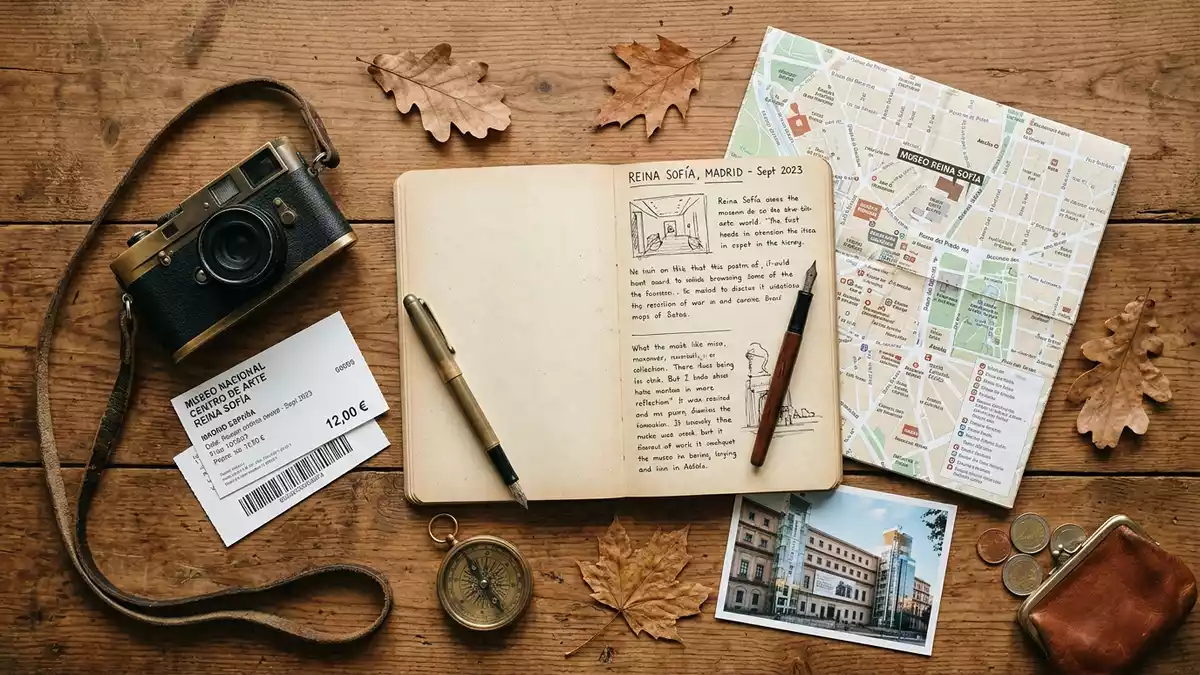
Museo Nacional Centro de Arte Reina Sofia in Madrid brings Spain’s national collection of twentieth-century art into a former eighteenth-century hospital, expanded by a striking contemporary wing. Opened as a museum in 1990 and named for Queen Sofía, it anchors modern and contemporary art beside Madrid’s historic core and major rail hub.
From royal hospital to national museum of modern art
The main structure of Museo Nacional Centro de Arte Reina Sofia is the Sabatini Building, originally founded as the Hospital de San Carlos in the eighteenth century and later known as the Hospital General de Madrid.Hospital de San Carlos Designed by the Italian architect Francisco Sabatini, who worked extensively for the Bourbon monarchy, it presents long, austere façades and an ordered plan typical of late Baroque and early Neoclassical institutional architecture.Francisco Sabatini
By the late twentieth century the former hospital complex had been adapted for culture, first as an art centre and then, in 1990, as Museo Nacional Centro de Arte Reina Sofia, Spain’s national museum of twentieth-century art.national museum of 20th-century art The museum is named in honour of Queen Sofía and completes Madrid’s “Golden Triangle of Art” alongside the Museo del Prado and the Museo Thyssen-Bornemisza on and around the Paseo del Prado.Golden Triangle of Art
The Sabatini courtyards and Jean Nouvel’s contemporary annex
One of the defining experiences at Museo Nacional Centro de Arte Reina Sofia is the contrast between the enclosed courtyards of the Sabatini Building and the bold forms of the Nouvel Building to its side. Inside the historic fabric, exhibition rooms line broad corridors around interior courtyards, with stone and plaster surfaces framing the works and external glass lifts rising against the façades.Sabatini Building The permanent collection is largely housed in these wings, integrating paintings, sculptures and installations into spaces shaped by the building’s former medical function.
To the west, the Nouvel Building extends the museum with expansive exhibition halls, a large library and documentation centre, a bookshop, café-restaurant, offices and two auditoriums with seating for around 200 and 400 people.Nouvel Building complex Designed by French architect Jean Nouvel and inaugurated in June 2005, this annex uses glass, steel and red panels to mark a clear architectural shift from the masonry hospital while remaining physically interwoven with it.inaugurated in June 2005 Together, the two structures give visitors a sense of moving between centuries as they cross from one wing to the other.
Collection highlights and Spain’s twentieth century on the walls
Museo Nacional Centro de Arte Reina Sofia holds an extensive collection of twentieth- and twenty-first-century Spanish and international art, including major works by Pablo Picasso, Salvador Dalí and Joan Miró.Pablo Picasso, Salvador Dalí and Joan Miró Picasso’s “Guernica” is among the most closely associated works with the museum, and its display is accompanied by drawings, documents and paintings that situate the canvas within the violence of the Spanish Civil War and the broader history of European modernism.Guernica
The galleries trace movements such as Cubism, Surrealism and abstract art, and follow Spanish cultural life into the late Franco period and the democratic transition, using painting, sculpture, photography, film and installation. International artists appear alongside Spanish figures, positioning Madrid within wider twentieth-century networks. Temporary exhibitions, largely hosted in the Nouvel Building, introduce further perspectives and media, while the library and documentation centre give researchers and interested visitors access to catalogues, archives and specialised publications related to modern and contemporary art.library and documentation centre
Visiting Museo Nacional Centro de Arte Reina Sofia: what travellers from Western Europe should know
- Museo Nacional Centro de Arte Reina Sofia stands on Calle Santa Isabel in central Madrid, a short walk from Atocha railway and metro station on the southern side of the Paseo del Prado.
- The museum occupies the historic Sabatini Building and the contemporary Nouvel Building, and visiting the collection involves moving between staircases, lifts, long corridors and large exhibition halls.
- The official language is Spanish and the currency is the euro.
Searching for Museo Nacional Centro de Arte Reina Sofia on social platforms
These links open searches for Museo Nacional Centro de Arte Reina Sofia on each platform.Frequently asked questions about Museo Nacional Centro de Arte Reina Sofia
Where is Museo Nacional Centro de Arte Reina Sofia located in Madrid?
The museum stands on Calle Santa Isabel in central Madrid, near Atocha railway and metro station at the southern end of the Paseo del Prado.
What can visitors expect on a visit to Museo Nacional Centro de Arte Reina Sofia?
Visitors move between historic hospital wings and a contemporary annex, exploring extensive twentieth- and twenty-first-century art galleries, temporary exhibitions and public spaces such as the library and café.
What makes Museo Nacional Centro de Arte Reina Sofia distinctive among Madrid’s museums?
It is Spain’s national museum of twentieth-century art, combining major works such as Picasso’s “Guernica” with the spatial dialogue between the eighteenth-century Sabatini Building and Jean Nouvel’s modern extension.


