
Museo Nacional Centro de Arte Reina Sofia and Spain’s modern imagination
Published on 09/19/2026 at 13:35 | Editorial responsibility: Rafael Müller, Editor-in-Chief AD HOC NEWS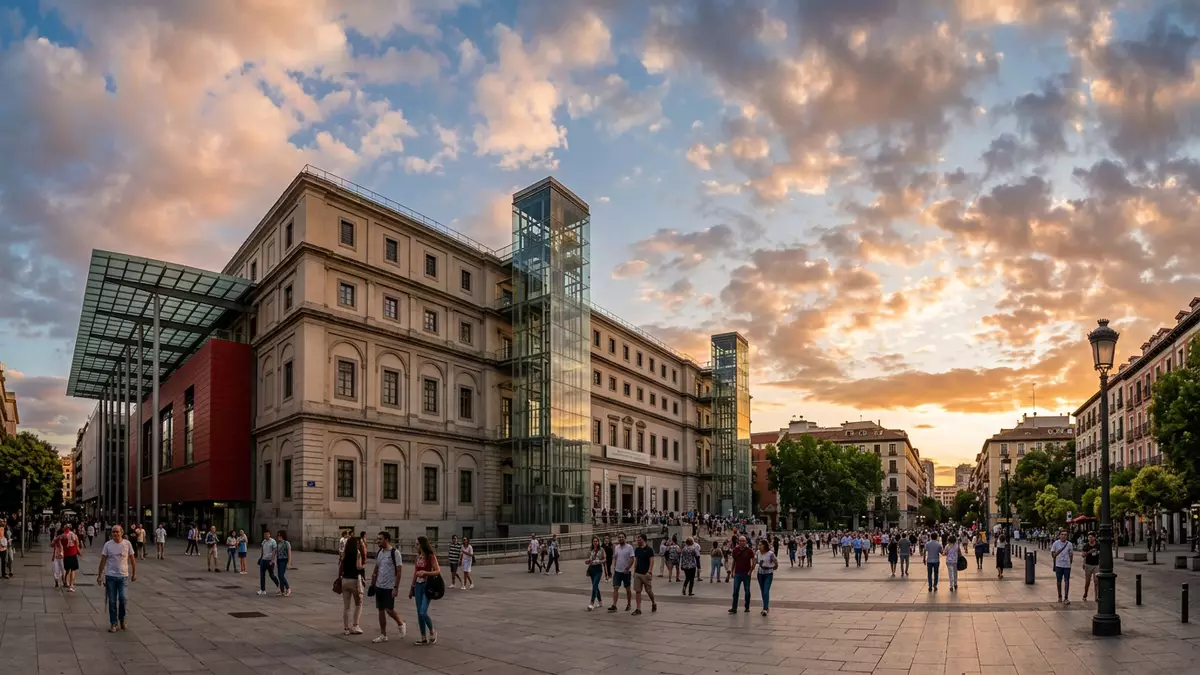
Museo Nacional Centro de Arte Reina Sofia in Madrid is Spain’s national museum dedicated to twentieth?century and contemporary art, housed within a former eighteenth?century hospital that has been expanded into a large cultural complex.Spain’s national museum of 20th?century art occupies a site near the Atocha rail hub and anchors the southern end of the Paseo del Arte, Madrid’s celebrated art axis.
From royal hospital to national museum of modern art
The heart of Museo Nacional Centro de Arte Reina Sofia lies in the Sabatini Building, an imposing quadrangular structure originally developed as the Hospital de San Carlos in the eighteenth century.A former royal hospital from the eighteenth century gives the museum its austere courtyards, elongated façades and long internal corridors, reworked to serve galleries rather than wards. The conversion of this historic complex into a dedicated museum for modern and contemporary art was completed in the late twentieth century, with the institution inaugurated as a national museum in 1992.The museum was officially inaugurated in September 1992
The Sabatini Building retains its stone walls and classical proportions, but glass?fronted lifts and steel walkways signal the shift from hospital to museum. Above the central courtyard, transparent elevator towers rise beyond the roofline, connecting the ground with the upper floors while leaving the long façades exposed. Within the old wings, galleries line up one after another, framing paintings, sculptures and installations along polished floors where the trace of an earlier institutional layout remains legible in the repeating rhythm of rooms.
Architecture of expansion: Sabatini and Nouvel buildings
Museo Nacional Centro de Arte Reina Sofia extends beyond the restored hospital into the more recent Nouvel Building, an expansion set along Ronda de Atocha that introduces a different architectural language.The Museo’s description of its buildings highlights the way modern forms join the historic core. In contrast to the long masonry façades of Sabatini, the Nouvel complex deploys large panes of glass, projecting volumes and wide overhangs that shelter outdoor areas. Together, the two main buildings create a sequence of enclosed galleries, outdoor terraces and connecting passages between Calle de Santa Isabel and Ronda de Atocha.Entrances on Calle de Santa Isabel and Ronda de Atocha
The historic courtyards of the Sabatini Building offer enclosed open air at the centre of the complex, framed by arcades and regular window openings in the surrounding walls. In one of these spaces, sculptural works and temporary installations interact with the strict geometry of the courtyard plan. Moving towards the Nouvel Building, the atmosphere shifts as wide internal volumes appear, suitable for large?scale pieces and multimedia work. Overhead, structural elements span expanses without closely spaced supports, leaving broad areas of floor clear for visitors and artworks.
Collection and Spain’s twentieth?century art
Museo Nacional Centro de Arte Reina Sofia holds a major collection of twentieth? and twenty?first?century Spanish art, complemented by international works, distributed across permanent displays and rotating exhibitions.Spain’s national museum of 20th? and 21st?century art concentrates on the period in which Spanish modernism, avant?garde movements and post?war experimentation emerged. Central within this narrative is Pablo Picasso’s “Guernica”, the large?scale painting that has become the institution’s emblematic work and occupies a prominent gallery within the museum’s layout.Picasso’s “Guernica” as its most emblematic work
Alongside Picasso, the permanent collection showcases pieces by Salvador Dalí and Joan Miró, as well as artists linked to movements such as surrealism, constructivism and informal abstraction.A guide to must?see paintings describes the breadth of work spanning painting, sculpture, photography and installation. The galleries weave Spanish art into wider international dialogues, presenting works by European and Latin American artists whose practices intersect with themes of war, memory, urban change and experimentation with new materials. In the museum’s library and documentation centre, thousands of volumes and archival items support research into these artistic currents, reinforcing the institution’s role as both exhibition space and knowledge hub.
Setting within Madrid’s Paseo del Arte
Museo Nacional Centro de Arte Reina Sofia stands on Calle de Santa Isabel in the Atocha district of central Madrid, close to Estación del Arte and Madrid Atocha mainline and metro stations.Calle Santa Isabel, 52 in Madrid Its location forms the southern anchor of the Paseo del Arte, the art walk that links the museum with the Prado and Thyssen?Bornemisza along the tree?lined avenues of Paseo del Prado.At the southern end of the Golden Triangle of Art From the museum’s upper levels, views extend over nearby streets and railway infrastructure, emphasising how closely art and transport sit together in this part of the city.
The surroundings mix civic buildings, residential blocks and transport nodes, with the museum’s long façades providing a clear visual marker within the urban fabric. Approaches from the Prado area bring visitors along the Paseo del Prado before turning towards Atocha, where the Sabatini Building presents its classical frontage to Calle de Santa Isabel. Approaching from Ronda de Atocha, the Nouvel Building’s contemporary lines and canopies indicate the museum’s expanded footprint and the presence of additional galleries and public spaces.
Visiting Museo Nacional Centro de Arte Reina Sofia: what travellers from Western Europe should know
- Museo Nacional Centro de Arte Reina Sofia stands on Calle de Santa Isabel in central Madrid, near Estación del Arte metro and Madrid Atocha rail station at the southern end of the Paseo del Arte.
- The museum complex combines the historic Sabatini Building and the modern Nouvel Building, and a visit involves moving between long internal corridors, staircases, lifts and open courtyards.
- The official language is Spanish and the national currency is the euro.
Searching for Museo Nacional Centro de Arte Reina Sofia on social platforms
These links open searches for Museo Nacional Centro de Arte Reina Sofia on each platform.Frequently asked questions about Museo Nacional Centro de Arte Reina Sofia
Where is Museo Nacional Centro de Arte Reina Sofia located in Madrid?
Museo Nacional Centro de Arte Reina Sofia is located on Calle de Santa Isabel in the Atocha district, near Estación del Arte and Madrid Atocha rail and metro stations.
What should visitors expect on a visit to Museo Nacional Centro de Arte Reina Sofia?
Visitors encounter extensive galleries of twentieth? and twenty?first?century art distributed across the historic Sabatini Building and the modern Nouvel Building, with internal routes, lifts and courtyards linking different exhibition spaces.
What makes Museo Nacional Centro de Arte Reina Sofia distinctive among Madrid’s museums?
The museum combines an eighteenth?century hospital complex with contemporary architectural additions while concentrating on modern and contemporary art, including Pablo Picasso’s “Guernica” as a central work within its collection.


