
Museo Nacional Centro de Arte Reina Sofia and its two architectural lives
Published on 09/23/2026 at 23:08 | Editorial responsibility: Rafael Müller, Editor-in-Chief AD HOC NEWS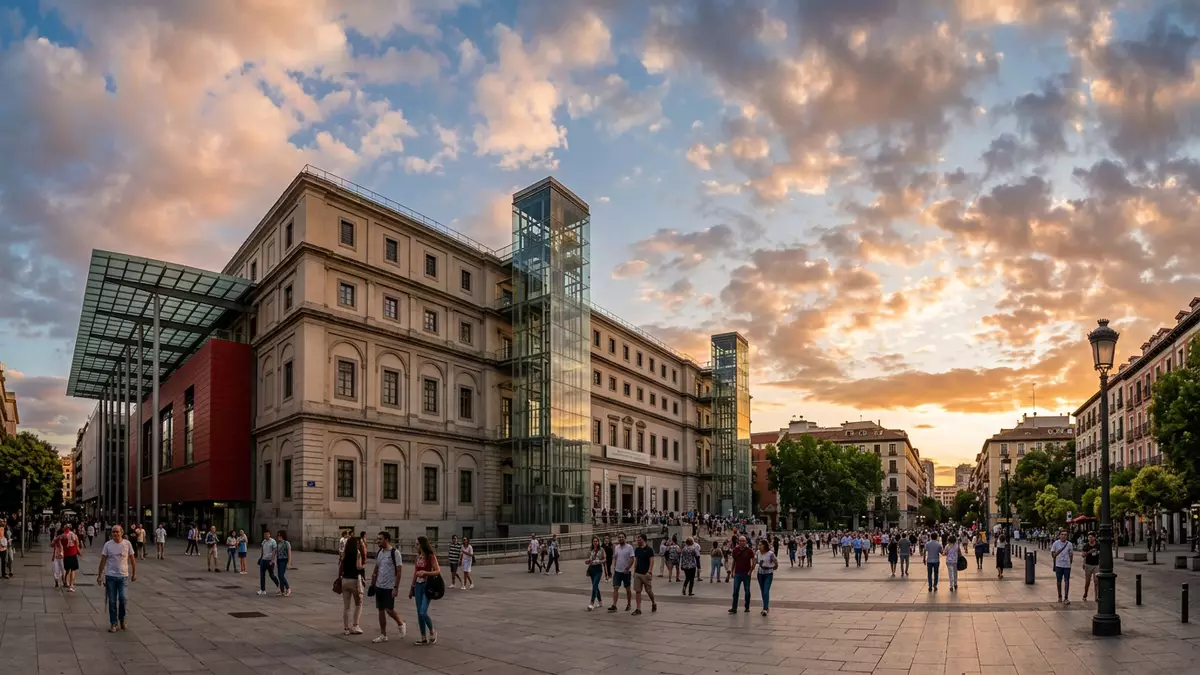
Museo Nacional Centro de Arte Reina Sofia occupies two architectural worlds in Madrid. The neoclassical Sabatini Building, once the Hospital de San Carlos, stands beside Jean Nouvel’s steel-and-glass extension, while Pablo Picasso’s Guernica gives the museum its most recognised work.
Sabatini Building: an eighteenth-century hospital in Madrid
The museum’s principal historic building is the former Hospital de San Carlos on Calle de Santa Isabel. Its origins reach back to a hospital foundation associated with Felipe II in the sixteenth century, while the surviving building belongs chiefly to the eighteenth century.
José de Hermosilla and Francisco Sabatini shaped the hospital complex. Sabatini’s name is attached to the building because his work forms much of its architectural identity. Long masonry wings, courtyards and restrained classical façades define the historic part of the museum.
The building’s medical use belongs to its earlier history. Its museum life began in the late twentieth century, when the former hospital became an art centre before the national museum took its present institutional form.
From hospital architecture to a national art museum
Museo Nacional Centro de Arte Reina Sofia opened as an art centre in 1986. A royal decree of 1988 established it as a national museum, and the permanent collection was inaugurated on 10 September 1992.
The museum’s collection focuses on Spanish and international art from the twentieth century onwards. Works by Pablo Picasso, Salvador Dalí, Joan Miró and Juan Gris appear alongside exhibitions that connect Spanish art with wider European and international movements.
The modern part of the complex arrived through an extension by French architect Jean Nouvel. The Nouvel Building, opened in 2005, adds galleries, a library, an auditorium and broad steel-and-glass surfaces beside the older hospital structure. the museum’s two buildings express this meeting of historic architecture and contemporary design.
Guernica and the museum’s twentieth-century collection
Pablo Picasso painted Guernica in 1937. The large canvas was first shown at the Spanish Pavilion in Paris and reached Spain in 1981 after many years abroad.
Guernica entered Museo Nacional Centro de Arte Reina Sofia in 1992. Its subject, monochrome palette and fractured figures place it within the political and artistic history of the Spanish Civil War, while its scale gives the work a distinct presence among the galleries.
The surrounding collection extends beyond one painting. Picasso’s work is shown with art by Dalí, Miró and other Spanish artists, alongside pieces representing abstraction, Surrealism, Cubism and later experimental practices. The museum therefore combines a single celebrated canvas with a much broader account of twentieth-century art.
The relationship between the painting and the building is also part of the visit. Guernica hangs inside a former hospital, while the galleries extend into a twenty-first-century building by Nouvel. Guernica’s museum history connects the artwork with the institution’s formation and its permanent collection.
Visiting Museo Nacional Centro de Arte Reina Sofia: what travellers from Western Europe should know
- The museum is in Madrid’s Atocha district, with the Sabatini Building on Calle de Santa Isabel and the Nouvel Building on Ronda de Atocha.
- Madrid’s Atocha railway station and the Atocha transport interchange are close to the museum. Metro and urban rail services connect the district with other parts of the city.
- The visit combines historic courtyards, long gallery passages, lifts and modern exhibition rooms. The site is an urban museum complex rather than a single compact gallery.
- The official language is Spanish and the currency is the euro.
Searching for Museo Nacional Centro de Arte Reina Sofia on social platforms
These links open searches for Museo Nacional Centro de Arte Reina Sofia on each platform.Frequently asked questions about Museo Nacional Centro de Arte Reina Sofia
Where is Museo Nacional Centro de Arte Reina Sofia?
It is in Madrid’s Atocha district, with entrances on Calle de Santa Isabel and Ronda de Atocha.
What can visitors expect inside?
The museum contains modern and contemporary art galleries, historic hospital architecture, courtyards and a modern extension by Jean Nouvel.
What makes the museum distinctive?
Its collection includes Picasso’s Guernica, while the museum itself combines an eighteenth-century hospital with a steel-and-glass building.


