
Musee du Louvre, a royal palace shaped into a vast museum
Published on 09/15/2026 at 18:33 | Editorial responsibility: Rafael Müller, Editor-in-Chief AD HOC NEWS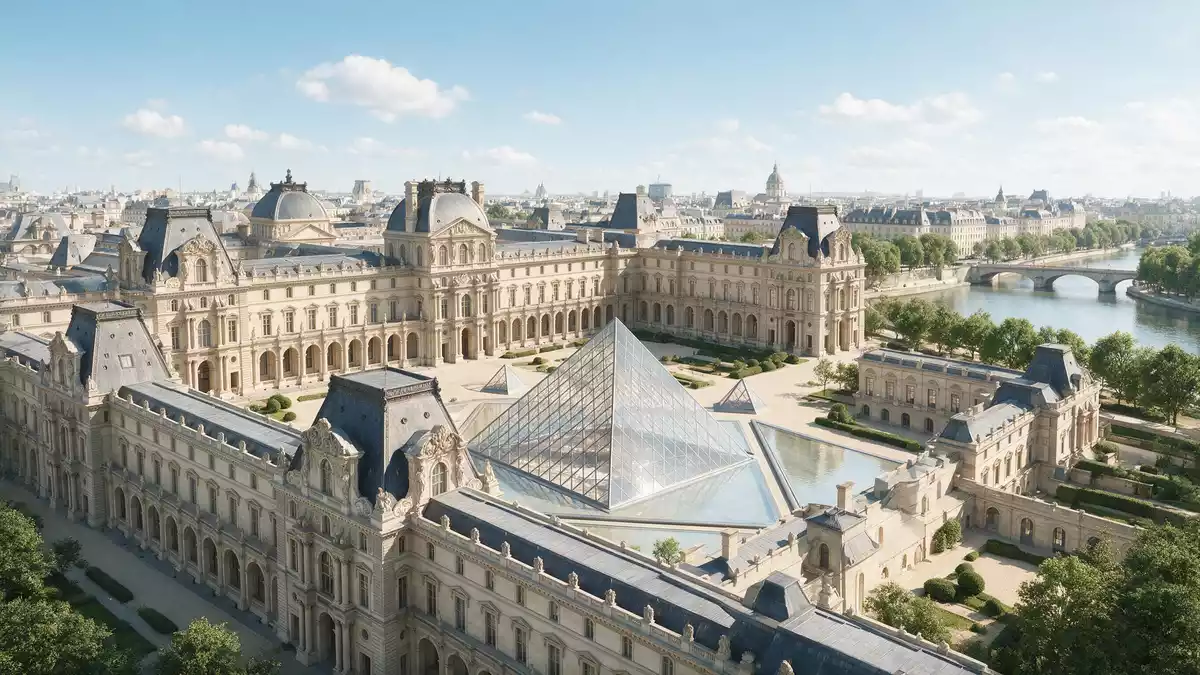
Musee du Louvre in Paris brings together a medieval fortress, a Renaissance royal palace and a vast art museum beneath a glass pyramid in the palace courtyard. The complex stands on the right bank of the Seine, and the museum in its present form grew out of a royal residence that became a public collection in 1793 during the French Revolution.
From fortress on the Seine to royal residence
The story of Musee du Louvre begins in the late twelfth and early thirteenth century, when a stone fortress was built on the right-bank riverside under King Philip II to guard the western approaches to medieval Paris.a fortress of Philip Augustus Parts of its underground foundations and a defensive ditch remain visible in the museum’s lower levels, giving a sense of the compact scale of the original stronghold compared with the palace above. Over the following centuries the fortified complex evolved into a royal residence, with enclosed courtyards and new wings replacing the medieval structures.
A major turning point came in 1546, when King Francis I ordered the construction of a Renaissance palace on the site, drawing on Italian models and classical ornament.construction was begun by Francis I in 1546 The architect Pierre Lescot designed early sections of the new residence, and his wing, with sculpted façades and arcaded courtyard fronts, still forms one of the palace’s defining elements.the Lescot Wing of the Louvre Subsequent French monarchs extended the palace eastwards towards the city and westwards towards what later became the Tuileries, so that the complex grew into a long sequence of wings and courtyards aligned with the river.
A palace turned museum of art and antiquities
The change from royal residence to public museum took place in 1793, when a collection of paintings from the former royal holdings opened to visitors in the Grande Galerie as the Muséum Central des Arts.a public museum in 1793 From this starting point the museum gradually occupied more of the palace, and the institution now presents works from ancient civilisations, European art up to the mid-nineteenth century and objects from Islamic and Near Eastern cultures arranged in departments across hundreds of rooms.collections spanning nearly 10,000 years The permanent galleries are set within grand halls, smaller rooms and long corridors, and the palace spaces themselves form part of the visit.
The museum’s collection runs from Egyptian statues and sarcophagi to Greek sculpture, Roman reliefs and decorative arts. Paintings include Italian Renaissance works, French canvases from the seventeenth to nineteenth centuries and Dutch and Flemish pictures. Icons such as Leonardo da Vinci’s “Mona Lisa” and the ancient Greek sculpture “Venus de Milo” form only a fraction of the works on show, with many more in reserve or recorded in the museum’s online database.Louvre Collections database For visitors, the combination of art and architecture means that crossing a courtyard or walking a staircase often reveals carvings, ceiling paintings or views into other wings as part of the same experience.
The glass pyramid and the Cour Napoléon
In the 1980s a major reorganisation of the museum introduced a new entrance in the Cour Napoléon through a glass and metal pyramid designed by architect I. M. Pei and completed in 1989.Louvre Pyramid completed in 1989 The main pyramid rises to about 21.6 m (71 ft) and has a square base, composed of rhombus-shaped and triangular glass segments held in a metal framework that drops light into the underground lobby.about 21.6 metres tall From the courtyard level, the transparent sides frame views of the surrounding palace façades, which show classical orders, sculpted reliefs and long rooflines bordering the courtyard. Smaller glass pyramids nearby echo the main entrance and sit alongside pools and stone paving.
Below the pyramid an expansive lobby links the museum’s Denon, Richelieu and Sully wings, providing access to different parts of the collection through escalators, staircases and passages.lobby connecting the three pavilions From the courtyard outside, visitors can look across to the Arc de Triomphe du Carrousel and further along the historical axis that leads towards the Champs-Élysées. In the opposite direction, the older palace courtyards reveal details from different building phases, such as sculpted pediments and stone balustrades, that contrast with the crisp geometry of the glass structure. Together, the palace and pyramid set up a direct encounter between pre-modern stone architecture and late twentieth-century engineering within a single museum complex.
Visiting Musee du Louvre: what travellers from Western Europe should know
- Musee du Louvre stands in central Paris on the right bank of the Seine, between the river and Rue de Rivoli, with the glass pyramid entrance in the Cour Napoléon.
- The complex consists of extended palace wings and large courtyards; moving between galleries involves long corridors, broad staircases and occasional changes of level.
- Paris is served by international rail and air connections, and urban transport brings visitors to stations and stops within walking distance of the museum’s perimeter.
- The official language is French and the currency is the euro (EUR).
Searching for Musee du Louvre on social platforms
These links open searches for Musee du Louvre on each platform.
Frequently asked questions about Musee du Louvre
Where is Musee du Louvre located in Paris?
Musee du Louvre occupies the former royal palace complex on the right bank of the Seine, between the river and Rue de Rivoli in central Paris.
What can visitors expect during a visit to Musee du Louvre?
Visitors encounter palace courtyards, long galleries and a diverse art collection ranging from ancient Egyptian and Greek works to European paintings up to the nineteenth century.
What makes Musee du Louvre distinctive among museums?
Musee du Louvre combines surviving medieval foundations, a Renaissance palace and I. M. Pei’s glass pyramid entrance, creating a museum where the architecture and the collection are closely intertwined.


