
Musee du Louvre, a royal palace turned great museum
Published on 09/01/2026 at 06:13 | Editorial responsibility: Rafael Müller, Editor-in-Chief AD HOC NEWS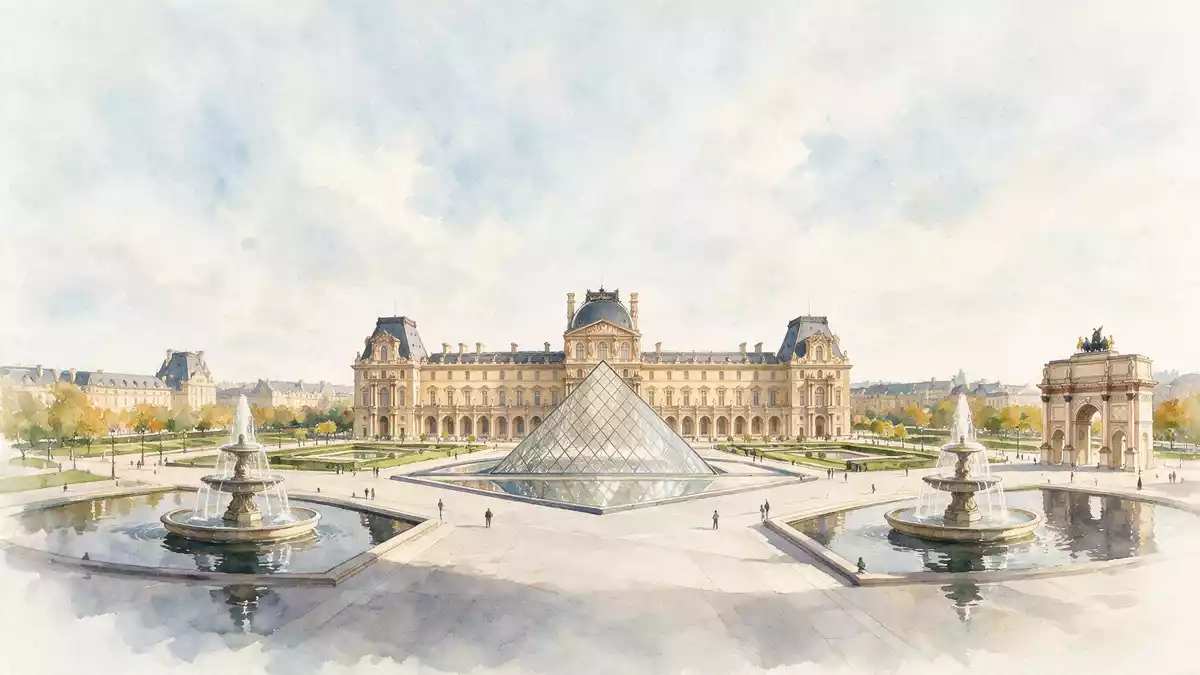
Musee du Louvre in Paris is both an art museum and a former royal palace, stretched along the right bank of the Seine with courtyards, wings and a glass pyramid at its heart. The building traces its origins to a fortress begun in 1190 under King Philippe Auguste, and became a public museum in 1793 during the French Revolution, a transformation that still shapes how visitors experience its galleries and historic halls.
From medieval fortress to royal residence
The story of Musee du Louvre begins with a stone castle guarding the western edge of medieval Paris in the late twelfth century, built under Philippe II to reinforce the new city wall on the right bank of the Seine.begins with a fortress Parts of this defensive structure survived beneath later work and remain visible in the underground levels, where thick foundations and former walls anchor the museum in its medieval past.defending the western front
In the fourteenth century the fortress evolved into a royal residence, and in 1546 King Francis I ordered a major rebuilding that replaced much of the medieval castle with a Renaissance palace inspired by classical antiquity and Italian architecture.construction was begun by Francis I in 1546 The oldest above-ground wing of the Louvre, designed by architect Pierre Lescot in the late 1540s, still shows this early phase, with sculpted façades and arcaded courtyards that marked a shift from fortress to palace.its palatial Lescot Wing
A palace extended over centuries
Over the following centuries almost every French monarch added something to the Louvre, creating an irregular ensemble of courtyards and galleries that reflect changing styles from Gothic fragments to French Renaissance, Baroque and Second Empire architecture.bears witness to eight centuries One defining feature is the Cour Carrée, a vast square courtyard enclosed by richly ornamented façades, which took shape between the sixteenth and nineteenth centuries and became the architectural core of the palace.square courtyard, the Cour Carrée
Along the river, the Grande Galerie runs parallel to the Seine, initially built between 1595 and 1610 under Henri IV as an elongated wing linking the Louvre with the former Tuileries Palace.The Grande Galerie was built between 1595 and 1610 Later work under Napoleon III in the nineteenth century completed the long-envisioned unification of the palace wings, giving the Louvre much of its present outline around the Cour Napoléon and opening its façades towards the Tuileries Garden.form actuelle, ouverte sur le jardin des Tuileries
A public museum framed by a glass pyramid
The palace became a museum during the French Revolution, when the Muséum Central des Arts opened to the public in 1793 with paintings from the former royal collections displayed in the Grande Galerie.became a public museum in 1793 Over time the museum expanded across the palace, with collections of Western art up to 1848, antiquities from ancient Egypt, Greece and Rome, and works from Islamic and Near Eastern civilisations arranged in departments inside hundreds of rooms and kilometres of corridors.ordonnées en neuf départements
A late twentieth-century transformation added a new focal point: the Louvre Pyramid, designed by architect I.M. Pei, rising from the centre of the Cour Napoléon as a glass and metal structure that serves as the main entrance to the museum.addition of I.M. Pei’s Pyramid The pyramid stands about 21 m (69 ft) high and is composed of hundreds of glass segments, bringing daylight into the underground concourse and juxtaposing modern geometry with the surrounding classical façades.The Pyramid
Visiting Musee du Louvre: what travellers from Western Europe should know
- Musee du Louvre stands on Rue de Rivoli in the 1st arrondissement of Paris, on the right bank of the Seine between the river and the Tuileries Garden.
- The museum occupies a large multi-storey palace with extensive galleries, long corridors and staircases, so visiting involves substantial walking across stone floors and between levels.
- The nearest major public transport hub is Châtelet–Les Halles, and several Métro stations, including Palais Royal – Musée du Louvre, sit within walking distance of the palace.
- The official language is French and the currency is the euro.
Searching for Musee du Louvre on social platforms
These links open searches for Musee du Louvre on each platform.
Frequently asked questions about Musee du Louvre
Where is Musee du Louvre located in Paris?
Musee du Louvre stands in the 1st arrondissement on Rue de Rivoli, on the right bank of the Seine between the river and the Tuileries Garden.
What should visitors expect inside Musee du Louvre?
Visitors encounter extensive collections of Western art up to the mid-nineteenth century, antiquities from ancient civilisations and Islamic art displayed across hundreds of rooms and long corridors.
What makes Musee du Louvre distinctive among museums?
Musee du Louvre combines an eight-century royal palace with a major public art museum, centred on the Cour Carrée, the Grande Galerie and the modern glass pyramid in the Cour Napoléon.


