
Musee du Bardo and the palace behind its mosaics
Published on 09/16/2026 at 22:35 | Editorial responsibility: Rafael Müller, Editor-in-Chief AD HOC NEWS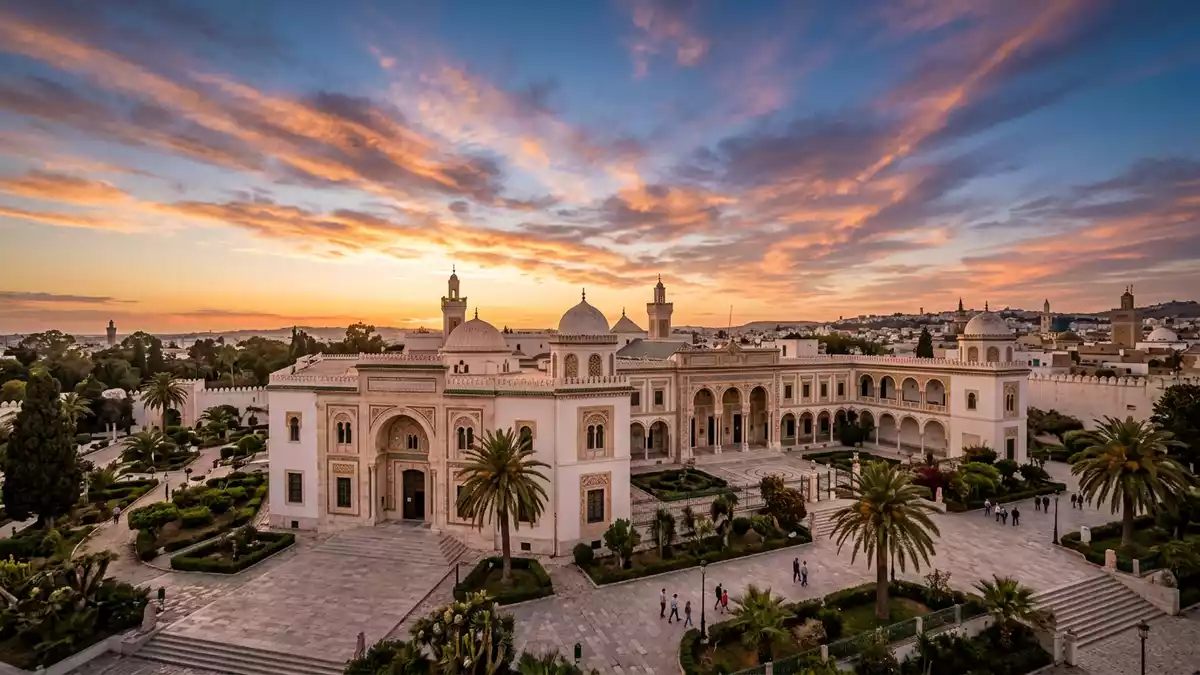
Musee du Bardo in Tunis is a 19th-century Bey palace turned archaeological museum, with a layered interior that still reads as a palace. Its name is tied to Ali Bey III and the opening of 7 May 1888.
Musee du Bardo and the Bey palace setting
The museum occupies a palace in Le Bardo, a district of Tunis, and its rooms preserve the feel of a court residence. The building combines Andalusian-Moorish, Ottoman and Italian influences, a mix that gives the galleries and former palace spaces their distinctive character. 19th-century Bey palace
Its official inauguration took place on 7 May 1888, under the designation of the Aloui Museum. The museum later took the name Bardo National Museum in March 1956, and the institution remains one of Tunisia's central archaeological repositories. 7 May 1888 Ali Bey III
The collections that define the museum
The museum's collections cover Tunisia from prehistory to the Islamic period, with major sections for Punic, Roman, Numidian and mosaic material. That breadth gives the building a series of distinct rooms, each anchored by different forms of relief, stone, bronze and tile work. collections are of a great diversity
The best-known gallery group is the mosaic collection, which ranges from mythological scenes to rural estates, marine imagery and domestic life. Alongside those floors and walls are sculpture rooms and sections devoted to Punic offerings, Numidian inscriptions and the Mahdia wreck, making the museum feel less like a single hall than a sequence of historical layers. mosaic-lined galleries three levels
The palace rooms and the modern wing
The palace remains legible in the layout of vestibules, patios, staircases and ceremonial rooms. A later wing adds a more contemporary museum frame, but the older sections still provide the strongest sense of scale and ornament, with carved ceilings, tiled surfaces and reception spaces in sequence.
The museum's expansion almost doubled its surface area and added a modern entrance hall for major displays. Even so, the older palace rooms keep the institution tied to Tunisian royal architecture rather than turning it into a neutral white-box museum. renovation and extension project
Visiting Musee du Bardo: what travellers from Western Europe should know
- The museum is in Le Bardo, in Tunis. It sits within a palace complex, so the visit combines archaeological displays with historical architecture.
- The building has multiple levels and interior passages. Some rooms open off patios and staircases rather than a single central hall.
- The collection includes mosaics, sculpture, inscriptions and objects from Punic, Roman, Numidian and Islamic contexts. The variety is part of the experience of moving through the palace.
- The official language is Arabic and the currency is the Tunisian dinar.
- Entry requirements depend on your nationality; UK travellers can check the FCDO travel advice at gov.uk/foreign-travel-advice, Irish travellers the Department of Foreign Affairs at ireland.ie.
Searching for Musee du Bardo on social platforms
These links open searches for Musee du Bardo on each platform.
Frequently asked questions about Musee du Bardo
Where is Musee du Bardo?
It is in Le Bardo, a district of Tunis in Tunisia. The museum occupies a former palace complex.
What does a visit involve?
The route moves through palace rooms and museum galleries across several levels. Expect mosaics, sculpture, inscriptions and material from different periods of Tunisia's past.
What makes Musee du Bardo distinctive?
The distinction lies in the building itself as much as in the collections. A Bey palace provides the setting for one of Tunisia's broadest archaeological ensembles.


