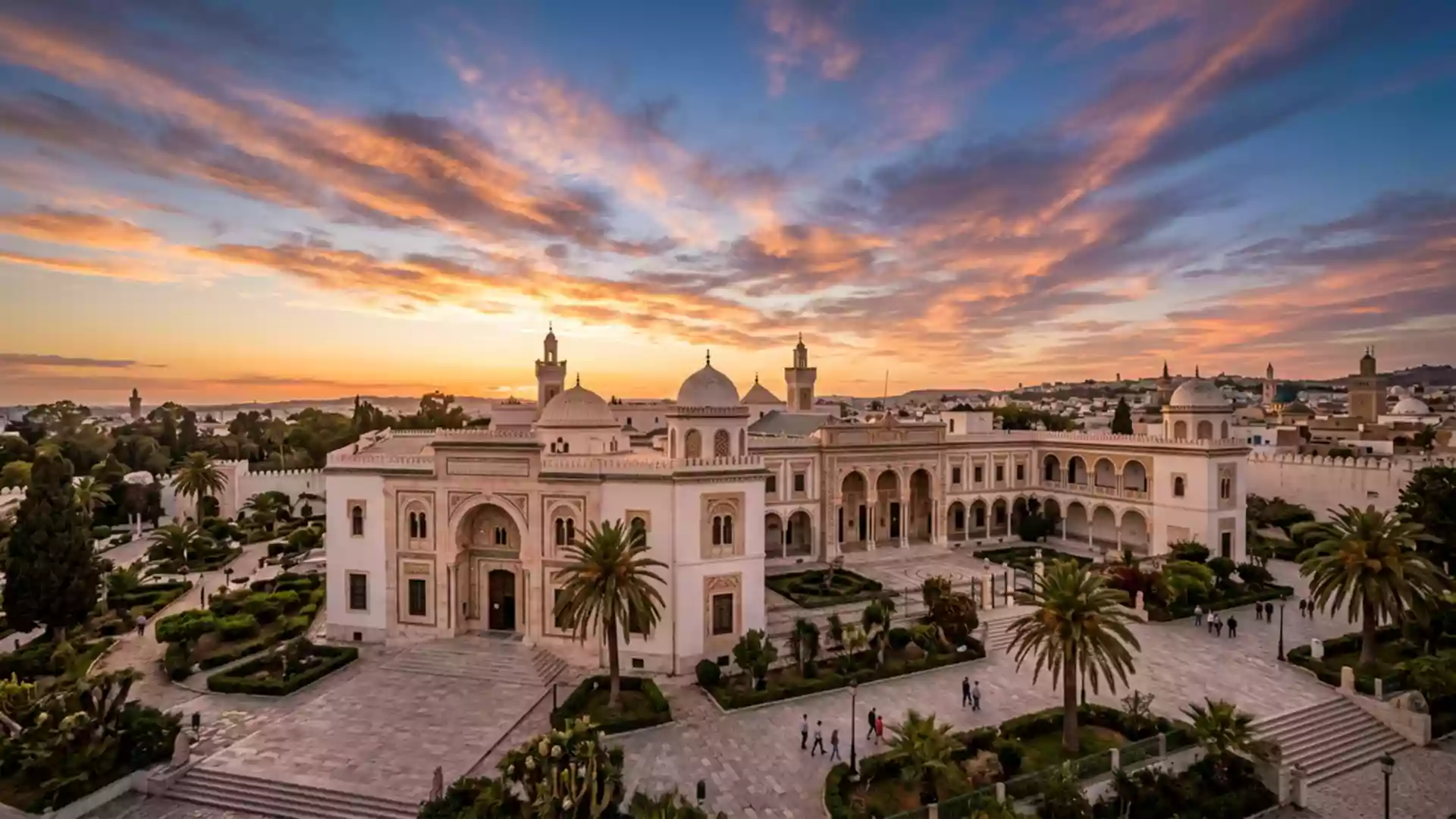
Musee du Bardo and its palace of mosaics in Tunis
Published on 09/03/2026 at 12:48 | Editorial responsibility: Rafael Müller, Editor-in-Chief AD HOC NEWS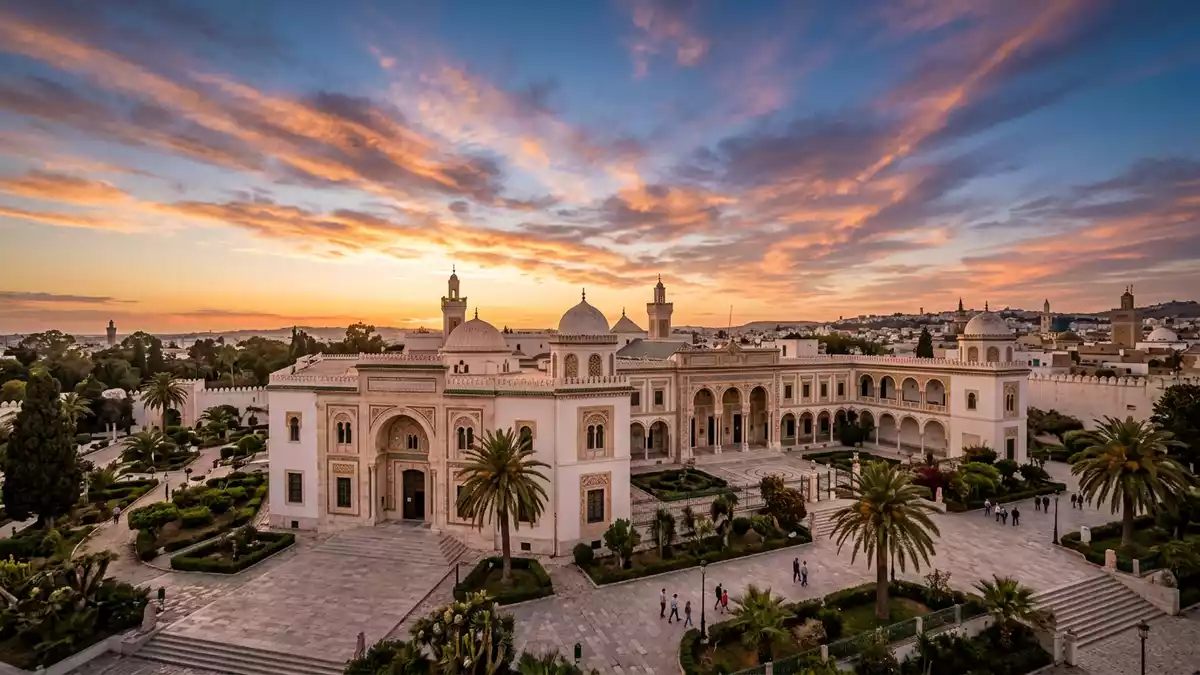
Musee du Bardo in Tunis brings together a former beylical palace and one of North Africa’s most substantial archaeology collections, with mosaic-lined galleries charting Tunisia’s ancient Mediterranean past. Housed in the Le Bardo district, the museum was inaugurated as a national institution in 1888 and occupies a palace long associated with Husaynid rulers and their court.
A palace museum in the Le Bardo district
Musee du Bardo stands in Le Bardo, a district west of central Tunis that grew around a palace complex used by beys during the nineteenth century. The museum occupies buildings that formed part of a beylical residence, an ensemble enlarged under rulers including Mohamed Bey and Mohamed Es-Sadok in the period between 1855 and 1882.beylical residence The palace setting gives the museum a layered character: ornate reception rooms and courtyards coexist with galleries adapted to display archaeological finds.
The decision to create a museum at Bardo was taken in the 1880s, when decrees in 1882 and 1885 assigned the former palace to house archaeological collections and led to its official opening on 7 May 1888.official opening on 7 May 1888 It was initially known as Musée Alaoui, named after Ali Bey, and later took on the title Bardo National Museum after Tunisia’s independence in 1956, underlining its role as a national repository for the country’s history.
Roman mosaics and Tunisia’s archaeological spectrum
The heart of Musee du Bardo is its collection of ancient Roman mosaics, assembled from sites across Tunisia such as Carthage, Dougga, Utica and Hadrumetum, the last corresponding to present-day Sousse.sites across Tunisia These mosaics cover walls and floors in large rooms, forming a continuous visual record of daily life, mythological scenes and religious imagery in Roman Africa. The density and scale of the mosaic display have made the museum a reference point for Roman art in the Mediterranean.
Beyond the mosaics, Musee du Bardo presents artefacts spanning prehistory, Libyco-Punic culture, Ancient Egyptian contacts, Numidian and Roman sculpture, late antique Christian pieces, Byzantine material and Islamic art from the Ottoman period and the Kingdom of Tunisia.artefacts spanning prehistory One gallery holds Punic jewellery, another displays sarcophagi and Christian baptisteries, while Islamic sections show ceramics and inscriptions that illustrate the region’s later history.Punic jewellery and baptisteries
Layers of architecture and exhibition space
The museum’s architecture reflects its origin as a palace adapted for public display. Older wings show carved ceilings, decorative tiles and formal reception halls, while later additions provide larger volumes where mosaics can be hung vertically or laid out across broad floors.mosaics hung vertically The result is a sequence of spaces where visitors move from intimate rooms into expansive galleries, each taking advantage of the building’s varied dimensions.
Musee du Bardo’s layout also reflects its role as Tunisia’s national archaeology museum, with sections organised by period and theme. Prehistoric finds mark the entrance to the historical route, followed by Punic and Roman rooms, while later galleries focus on Christian and Islamic material.Tunisia’s national archaeology museum The palace courtyards and corridors tie these sections together, maintaining the sense of a historic residence while accommodating extensive displays.
Visiting Musee du Bardo: what travellers from Western Europe should know
- Musee du Bardo is in Le Bardo, a district north-west of central Tunis, reached by local transport including métro léger line 4 to the Bardo stop or by taxi.
- Inside the museum, some galleries occupy upper levels reached by staircases, and the mosaic rooms extend over long routes on foot through wide interior halls.
- The museum sits in an urban district with streets and administrative buildings nearby, so combining a visit with time in central Tunis is straightforward by public transport.
- The official language is Arabic and the currency is the Tunisian dinar.
- Entry requirements depend on your nationality; UK travellers can check the FCDO travel advice at gov.uk/foreign-travel-advice, Irish travellers the Department of Foreign Affairs at ireland.ie.
Searching for Musee du Bardo on social platforms
These links open searches for Musee du Bardo on each platform.
Frequently asked questions about Musee du Bardo
Where is Musee du Bardo located?
Musee du Bardo is in Le Bardo, a district of Tunis in Tunisia, north-west of the city’s historic centre and accessible by métro léger line 4 and local taxis.
What can visitors expect inside Musee du Bardo?
Visitors encounter palace rooms adapted as galleries, extensive Roman mosaic displays from sites such as Carthage and Dougga, and collections covering Punic, Roman, Christian and Islamic Tunisia.
What makes Musee du Bardo distinctive among museums?
Its combination of a nineteenth-century beylical palace with one of the Mediterranean’s most extensive Roman mosaic collections gives Musee du Bardo a distinctive blend of architecture and archaeology.