
Murano’s glass island in the Venetian Lagoon
Published on 09/04/2026 at 06:04 | Editorial responsibility: Rafael Müller, Editor-in-Chief AD HOC NEWS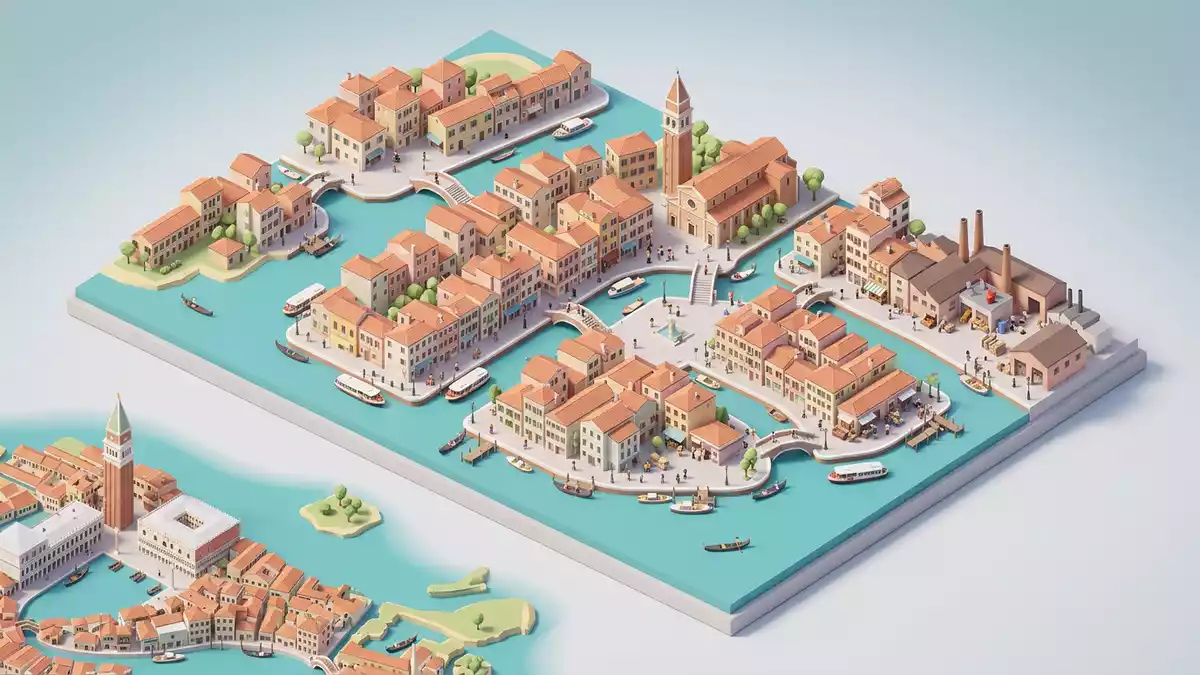
Murano, a substantial island in the Venetian Lagoon north of Venedig, is defined by glassmaking as much as by its canals and terraced houses. The move of Venice’s furnaces to Murano in 1291 turned this low-lying island into a specialised glass district that still shapes its streets and waterfronts.Production has been concentrated on Murano since the thirteenth century
An island built around glass furnaces
Murano lies in the northern part of the lagoon, separated from Venedig by open water and linked by waterbus routes that thread between its canals. It forms a cluster of islands connected by bridges, giving it a compact, walkable scale where boat landings, glass workshops and small squares sit close together.Murano is described as a group of islands linked by bridges
Murano’s documented story runs deep into the Middle Ages, with early references under the name Amorianas in agreements between Venice and the Carolingian Empire.The Pactum Lotharii of 840 mentions Murano Its transformation began in the thirteenth century, when the Great Council of Venice confined the city’s glassmaking to Murano in a decree of 8 November 1291.The Republic ordered the relocation of furnaces in 1291
From medieval industry to refined glass art
By concentrating furnaces on one island, Venice created an early industrial district where master glassmakers, or maestri, could refine techniques under close control. Murano’s workshops developed clear cristallo glass in the fifteenth century, attributed to Angelo Barovier, which changed European tastes for tableware and mirrors.Angelo Barovier developed cristallo around 1450 Over the following centuries, Murano became associated with enamelled pieces, aventurine glass containing fine metallic threads, lattimo milk glass and millefiori patterns built from coloured canes.Murano glassmakers refined these named techniques
These innovations made Murano one of Europe’s main centres for luxury glass during the late Middle Ages and the Italian Renaissance.Venetian glass was a leading luxury product Glassmaking on the island was both an art and a guarded trade, with regulations that restricted masters from leaving without permission. The result is a place where glassworks are embedded in the urban fabric: furnaces near canals, showrooms opening onto narrow calli, and chimneys rising over tiled roofs.
Churches, canals and everyday Murano
Although glass defines Murano to visitors, the island also carries older layers of lagoon life. Fishing and salt trading formed part of its early economy, and its churches reflect long connections with Byzantine and early Venetian history.Murano’s early activities included fishing and salt The basilica dei Santi Maria e Donato stands out for its Byzantine features and mosaic floor, showing how religious architecture took root alongside craft workshops.The basilica of Santi Maria e Donato stands on Murano
Murano’s canals form linear spaces edged with low houses, warehouses and glass factories, with small bridges folding streets from one bank to another. Compared with the denser historic centre of Venedig, the island feels more open in places, with wider waterfronts and courtyards that break the line of buildings. Glassmaking remains a visible industry, from chimneys and stacks to signs for furnaces and galleries, making it easy to see how work and everyday life share the same compact ground.
Visiting Murano: what travellers from Western Europe should know
- Murano lies north of Venedig in the Venetian Lagoon and is reached by public boats that run from central landing stages to the island’s main canals.
- Walking on Murano involves short bridges over canals and paved lanes between workshops, with some routes passing through working industrial yards and along waterfront quays.
- The island is part of Italy, where the official language is Italian and the currency is the euro.
- Entry requirements depend on your nationality; UK travellers can check the FCDO travel advice at gov.uk/foreign-travel-advice, Irish travellers the Department of Foreign Affairs at ireland.ie.
Searching for Murano on social platforms
These links open searches for Murano on each platform.Frequently asked questions about Murano
Where is Murano in relation to Venedig?
Murano sits in the Venetian Lagoon north of Venedig and forms a separate island cluster connected by bridges and served by public boats.
What can visitors expect on a visit to Murano?
Visitors encounter active glass workshops, canals lined with houses and factories, and religious buildings such as the basilica dei Santi Maria e Donato.
What makes Murano distinctive among lagoon islands?
Murano’s long-established concentration of glass furnaces and its role in developing techniques like cristallo and millefiori give it a specialised character within the lagoon.


