
Mosque of Muhammad Ali: Cairo’s alabaster landmark above the citadel
Published on 08/29/2026 at 21:52 | Editorial responsibility: Rafael Müller, Editor-in-Chief AD HOC NEWS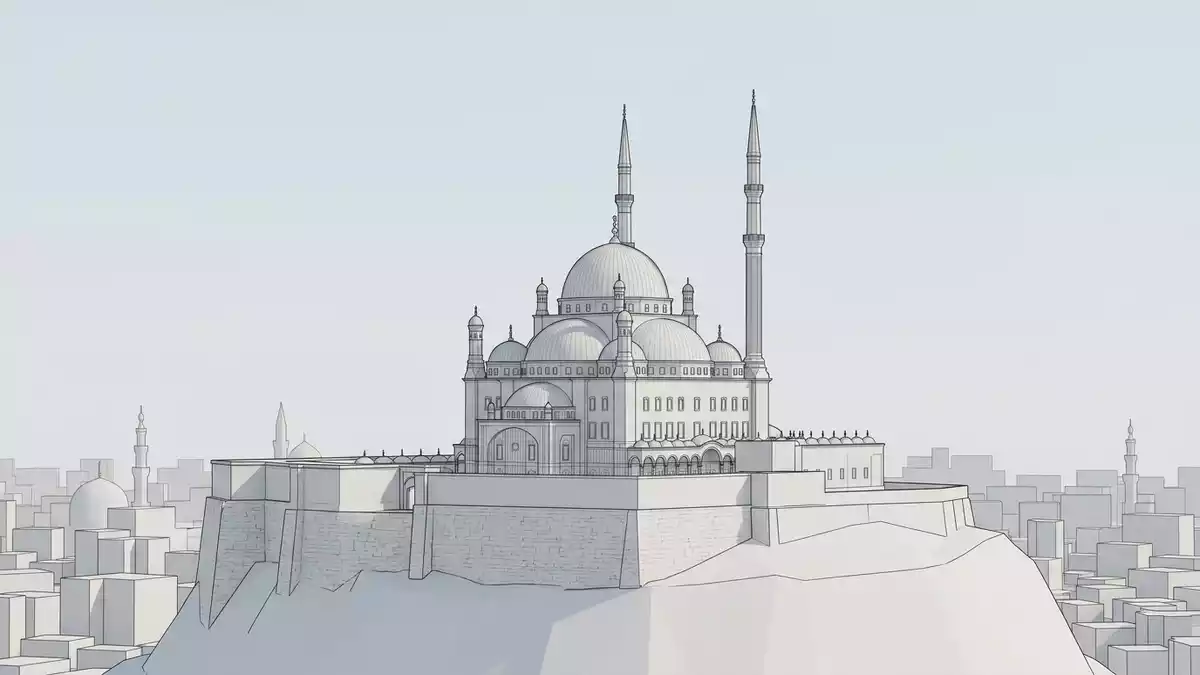
The Mosque of Muhammad Ali rises over the Cairo skyline from the crest of the historic citadel, its cluster of domes and twin minarets forming one of the city’s most recognisable silhouettes. Built in the nineteenth century for Muhammad Ali Pasha, the Ottoman governor whose dynasty ruled Egypt for almost 150 years, it combines Ottoman-inspired architecture with extensive alabaster panelling that has given it the enduring nickname of the “Alabaster Mosque”.Muhammad Ali Pasha’s nineteenth-century mosque
An Ottoman-style mosque overlooking Cairo
The Mosque of Muhammad Ali stands within the Citadel of Salah al-Din al-Ayyubi, on elevated ground east of central Cairo, with its main mass occupying the north-western corner of the fortress complex.Citadel of Salah al-Din location From the streets below, the mosque’s central dome and surrounding semi-domes form a tiered composition that recalls Ottoman imperial mosques in Istanbul, particularly the seventeenth-century Mosque of Sultan Ahmed, which served as a model for its design.Design derived from Sultan Ahmed Mosque
Construction of the mosque began in 1830 under Muhammad Ali Pasha and continued through his lifetime, with the building dated to AH 1265 / AD 1848 in Islamic and Gregorian chronology.Construction between 1830 and 1848 The architect is identified as Yousif Boushnaq, a Turkish designer who drew directly on Ottoman prototypes.Yousif Boushnaq as architect The mosque’s two pencil-thin minarets rise high above the domes, reaching a height recorded as 84 m (276 ft), and are among the tallest of any mosque in Egypt.Twin minarets of 84 metres
Alabaster surfaces and interior space
One of the defining physical features of the Mosque of Muhammad Ali is its extensive use of alabaster and other polished stone to line both interior and exterior surfaces, a treatment that distinguishes it from the largely stone-built Mamluk mosques elsewhere in Cairo.Alabaster-clad walls The prayer hall is organised as a single large volume beneath the central dome, with semi-domes supporting the main structure and creating a sequence of high, curved ceilings above the space.
Inside, the floor is covered with carpets and the walls carry painted decoration and gilded inscriptions, with large chandeliers suspended to illuminate the hall.Interior decoration of the mosque The mosque also contains the tomb of Muhammad Ali Pasha himself in the south-western part of the building, linking the structure directly to its patron and to the dynasty he founded.Tomb of Muhammad Ali Pasha inside the mosque
Nineteenth-century reforms and later restoration
Muhammad Ali Pasha ruled Egypt from 1805 to 1848 and is widely regarded as the founder of a ruling dynasty that remained in power until the mid-twentieth century.Muhammad Ali’s dynasty from 1805 to 1952 The mosque, established during his lifetime, reflects the nineteenth-century phase of Egyptian history in which Ottoman forms and local ambitions intersected above the older medieval fortifications of the citadel.
By the end of the nineteenth century the mosque showed structural problems, and a major restoration campaign ran between 1931 and 1939 during the reign of King Fuad I, involving demolition and reconstruction of the main dome and semi-domes in line with the original design.Restoration between 1931 and 1939 These works stabilised the building while maintaining its nineteenth-century Ottoman character above the citadel’s walls.
Visiting Mosque of Muhammad Ali: what travellers from Western Europe should know
- The Mosque of Muhammad Ali is located within the Citadel of Salah al-Din in eastern Cairo, reached by road up the citadel hill from the surrounding city districts.
- The site sits on elevated terrain above the city, and visiting the mosque involves walking within the citadel complex and climbing exterior and interior staircases.
- The official language in Egypt is Arabic and the currency is the Egyptian pound.
- Entry requirements depend on your nationality; UK travellers can check the FCDO travel advice at gov.uk/foreign-travel-advice, Irish travellers the Department of Foreign Affairs at ireland.ie.
Searching for Mosque of Muhammad Ali on social platforms
These links open searches for Mosque of Muhammad Ali on each platform.
Frequently asked questions about Mosque of Muhammad Ali
Where is the Mosque of Muhammad Ali located in Cairo?
The Mosque of Muhammad Ali stands within the Citadel of Salah al-Din al-Ayyubi on elevated ground in the eastern part of Cairo, overlooking the city.
What should visitors expect when entering the mosque?
Visitors encounter a large Ottoman-style prayer hall beneath a central dome, alabaster-clad walls, carpets, chandeliers and an interior that includes Muhammad Ali Pasha’s tomb.
What makes the Mosque of Muhammad Ali distinctive among Cairo’s mosques?
Its combination of Ottoman domes, twin minarets, alabaster surfaces and hilltop position within the medieval citadel gives it a character distinct from earlier Mamluk mosques in Cairo.


