
Monserrate, Bogota’s highland sanctuary above the city
Published on 08/28/2026 at 11:47 | Editorial responsibility: Rafael Müller, Editor-in-Chief AD HOC NEWS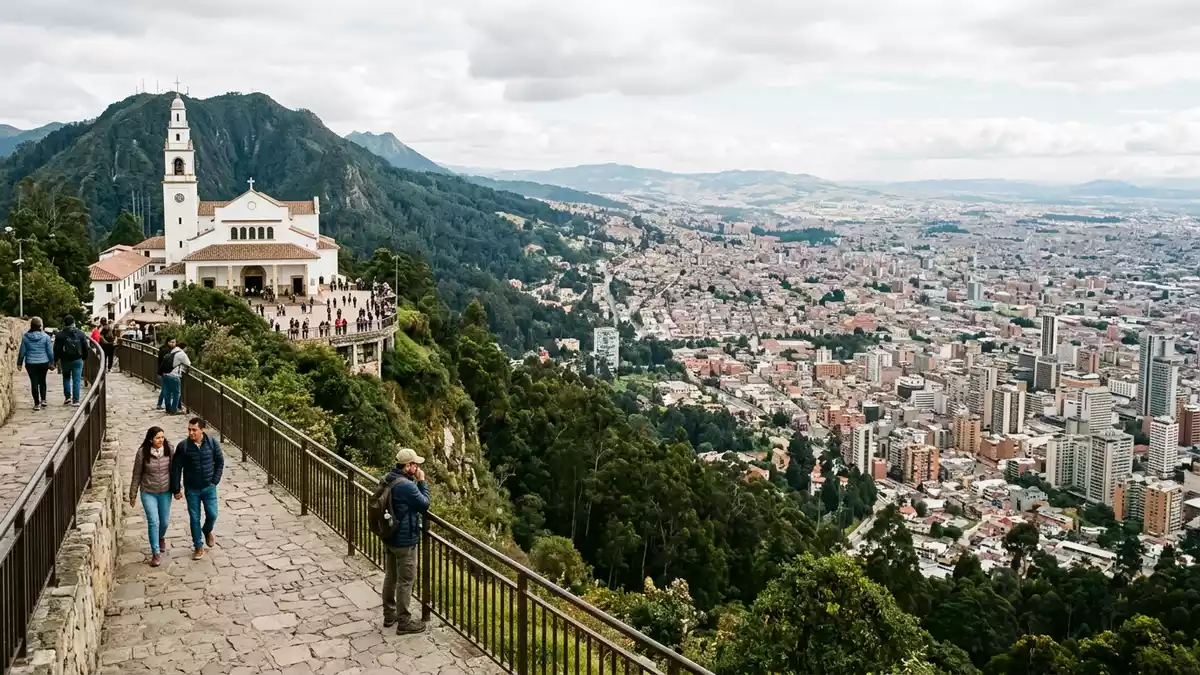
Monserrate is the steep Andean mountain that rises directly above central Bogota, crowned by a Catholic sanctuary and terraces more than 3,100 m (around 10,300 ft) above sea level. At its summit stands the Basilica Sanctuary of the Fallen Lord and Our Lady of Monserrate, a shrine whose origins lie in the seventeenth century and whose white walls form a constant landmark on the city skyline.Basilica Sanctuary of the Fallen Lord
Monserrate and the Eastern Hills of Bogota
The hill of Monserrate forms part of the Eastern Hills that frame Bogota and climbs to an elevation recorded at around 3,152 m (10,341 ft) above sea level, significantly higher than the plateau on which the city stands.3,152 m above sea level Its slopes rise steeply from neighbourhoods close to the historic centre, with forest and scrub giving way to paved terraces and gardens near the crest.cordillera oriental setting
From the summit forecourts the view stretches across cathedral towers, office blocks and distant suburbs, with the wider savannah and the line of the surrounding Andes enclosing the city. The sanctuary complex includes plazas with stone paving, devotional sculptures and planting that reflects the highland climate, all arranged along the ridge that forms the mountain’s crest.terraces overlooking Colombia's capital
The sanctuary and its devotion
Monserrate takes its name from the Catalan mountain Montserrat, reflecting the early dedication of the site to the Virgin associated with that shrine.named after Montserrat In the seventeenth century a hermitage and chapel were established on the hill, and a Catholic church later grew into the sanctuary complex recognised today.ermitas del cerro The present basilica is a neo-Gothic building inaugurated in 1920, its long nave and tower aligned along the ridge and facing broad viewing terraces.neo-Gothic building inaugurated in 1920
Inside the church the principal image is El Señor Caído de Monserrate, “The Fallen Lord”, a representation of Christ that has drawn pilgrims for generations and given the sanctuary its distinctive identity.statue of El Señor Caído Around the sanctuary runs a Way of the Cross marked by devotional stations, while chapels and statues line the paths and plazas. The combination of high altitude, religious structures and open terraces makes Monserrate both a place of worship and one of the clearest viewpoints over Colombia’s capital.traditional site of religious pilgrimage
Paths, cable car and funicular to the summit
The ascent of Monserrate follows three main routes: a steep walking path, a funicular railway and a cable car that rises above the forested slopes.hiking trail, aerial tram and funicular The funicular climbs from near the Paseo Bolívar area of Bogota to the summit complex, using a line that dates from the mid-twentieth century and still forms a direct connection between the city and the hill.Teleférico de Monserrate cable car
The walking trail ascends a substantial height from its starting point on the city edge, with sections of stone paving and flights of steps that reflect the altitude gain between Bogota and the summit terraces.gain of some 400 metres Higher up, the route passes wayside shrines and viewpoints before reaching the church forecourt and the gardens that run along the ridge. Whichever route is chosen, the transition from city streets to mountain sanctuary is marked by the changing slope and the widening views over Bogota.
Visiting Monserrate: what travellers from Western Europe should know
- Monserrate rises on the eastern side of Bogota, close to the historic centre, and is reached from the city via the walking path, the funicular railway or the cable car.
- The ascent involves a marked altitude difference from the city to the summit, and the walking path includes long sections of steps and inclined paving on a steep mountain slope.
- The terrain at the top consists of paved plazas, church interiors and garden paths along the ridge, with exposed viewpoints looking out over the city and the surrounding Andean foothills.
- The official language is Spanish and the currency is the Colombian peso.
- Entry requirements depend on your nationality; UK travellers can check the FCDO travel advice at gov.uk/foreign-travel-advice, Irish travellers the Department of Foreign Affairs at ireland.ie.
Searching for Monserrate on social platforms
These links open searches for Monserrate on each platform.
Frequently asked questions about Monserrate
Where is Monserrate in relation to Bogota?
Monserrate stands on the eastern side of Bogota, rising directly above the historic centre and forming part of the Eastern Hills overlooking Colombia’s capital.
What can visitors expect when they reach the summit?
Visitors find the neo-Gothic basilica, devotional sculptures, gardens along the ridge and broad terraces with views across Bogota and the surrounding Andean landscape.
What makes Monserrate distinctive among city viewpoints?
The combination of high altitude, a seventeenth-century Catholic sanctuary and expansive terraces above a major South American capital gives Monserrate its distinctive character.


