
Monasterio de Santa Catalina, Arequipa’s cloistered city of stone and colour
Published on 09/09/2026 at 21:48 | Editorial responsibility: Rafael Müller, Editor-in-Chief AD HOC NEWS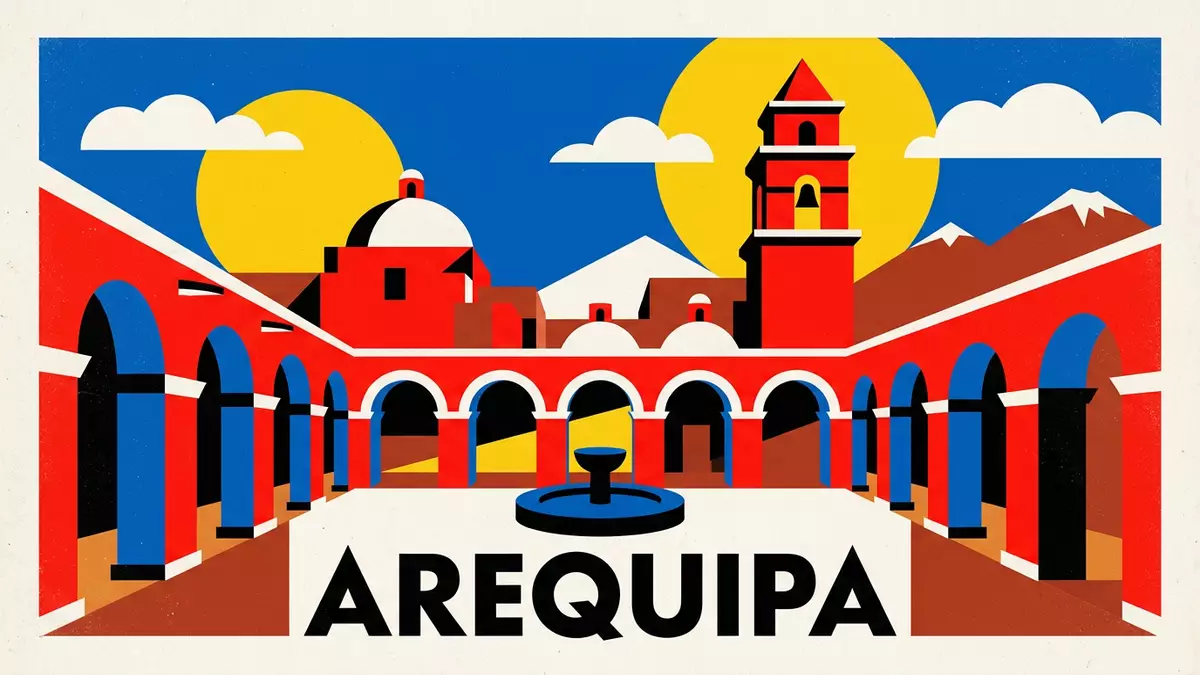
Monasterio de Santa Catalina in Arequipa is a Dominican convent that grew into a cloistered city, with streets, courtyards and chapels enclosed within high stone walls of volcanic stone. Founded in 1579 under Spanish colonial rule and named for Saint Catherine of Siena, it occupies an entire block in the historic centre and mirrors the city around it in miniature.
A walled city within Arequipa
The convent sits inside Arequipa’s colonial core, laid out as a self-contained enclave whose lanes, squares and cloisters form a small city behind the enclosure. Within its perimeter walls, passageways carry the names of saints, open into communal courtyards and lead towards chapels that punctuate the complex, so that monastic life unfolded along streets rather than corridors.self-contained miniature city The overall footprint extends over about 20,000 m² (215,000 sq ft), large enough for the interior layout to resemble a neighbourhood more than a single building.20,000 square metres
High stone walls separate the convent from the surrounding streets of Arequipa, but inside those boundaries the plan is broken down into cloisters, living quarters, small plazas and service areas organise monastic and domestic functions. The sense of a small city is reinforced by the way houses for nuns were grouped around shared patios and by the sequence of communal spaces that connected everyday life with the liturgical calendar.
Colonial stonework and painted surfaces
Architecturally, Monasterio de Santa Catalina reflects the colonial “Arequipa school” of building, characterised by thick walls and a reliance on sillar, a pale, porous stone cut from local volcanic deposits.elaborated primarily with sillar This stone is easy to carve yet robust in the face of earthquakes, and its use ties the monastery firmly to the wider identity of Arequipa, whose historic centre is built largely from the same material.Arequipa founded in 1540 with sillar as key material
Chapels and corridors carry barrel-vaulted roofs or domes resting on stone piers, while cloisters are framed by rhythmic sequences of arches that open towards gardens and paved courts.barrel vaults and cloisters Decorative carving appears on portals, cornices and window surrounds, combining Spanish colonial and mestizo Baroque motifs with local interpretations of vegetal and geometric patterns.Colonial and mestizo Baroque styles Much of the stonework is covered with lime-based plaster and strong pigments, so that walls in some sectors are painted in saturated blues and reds that contrast with the pale stone and sky.
History of a cloistered community
The convent was consecrated in 1579 and formed part of the Dominican network in the Viceroyalty of Peru, offering a cloistered environment for women from elite families in Arequipa and other regions.founded on 10 September 1579 Historical accounts emphasize the role of Doña María de Guzmán, a wealthy widow from Arequipa who donated land and fortune to establish the monastery and became its first prioress; her patronage links the convent closely to the social history of colonial Arequipa.rich widow Doña María de Guzmán
For centuries the monastery functioned as a largely closed citadel of nuns, with life organised around prayer, work and community within its walls.cloistered for about 390 years In the twentieth century a significant part of the complex became accessible to visitors, while a smaller religious community continues to occupy a secluded sector, so that monastic life and public exploration coexist within the same enclosure.
Visiting Monasterio de Santa Catalina: what travellers from Western Europe should know
- Monasterio de Santa Catalina stands in the historical centre of Arequipa in southern Peru, a short walk north of the Río Chili and near other colonial churches and plazas.
- The complex occupies a full urban block with interior streets, cloisters and courtyards, so a visit involves walking over stone paving and negotiating flights of steps between different levels.
- Arequipa lies at an elevation above sea level common to many Andean cities, and the convent’s thick stone walls and enclosed patios reflect the highland climate.
- The official language is Spanish and the currency is the Peruvian sol.
- Entry requirements depend on your nationality; UK travellers can check the FCDO travel advice at gov.uk/foreign-travel-advice, Irish travellers the Department of Foreign Affairs at ireland.ie.
Searching for Monasterio de Santa Catalina on social platforms
These links open searches for Monasterio de Santa Catalina on each platform.
Frequently asked questions about Monasterio de Santa Catalina
Where is Monasterio de Santa Catalina and what surrounds it?
Monasterio de Santa Catalina stands in the historic centre of Arequipa in southern Peru, occupying a full block amid colonial streets, churches and civic squares.
What can visitors expect inside the monastery complex?
Visitors encounter enclosed streets, cloisters, chapels and patios built in sillar stone, with painted walls and monastic rooms arranged around courtyards that recall a small city.
What makes Monasterio de Santa Catalina distinctive among colonial sites?
The combination of its city-like plan, Dominican cloistered history since 1579 and the extensive use of local volcanic sillar stone gives the monastery a character closely tied to Arequipa.


