
Monasterio de Piedra, where stone cloisters meet falling water
Published on 09/14/2026 at 15:56 | Editorial responsibility: Rafael Müller, Editor-in-Chief AD HOC NEWS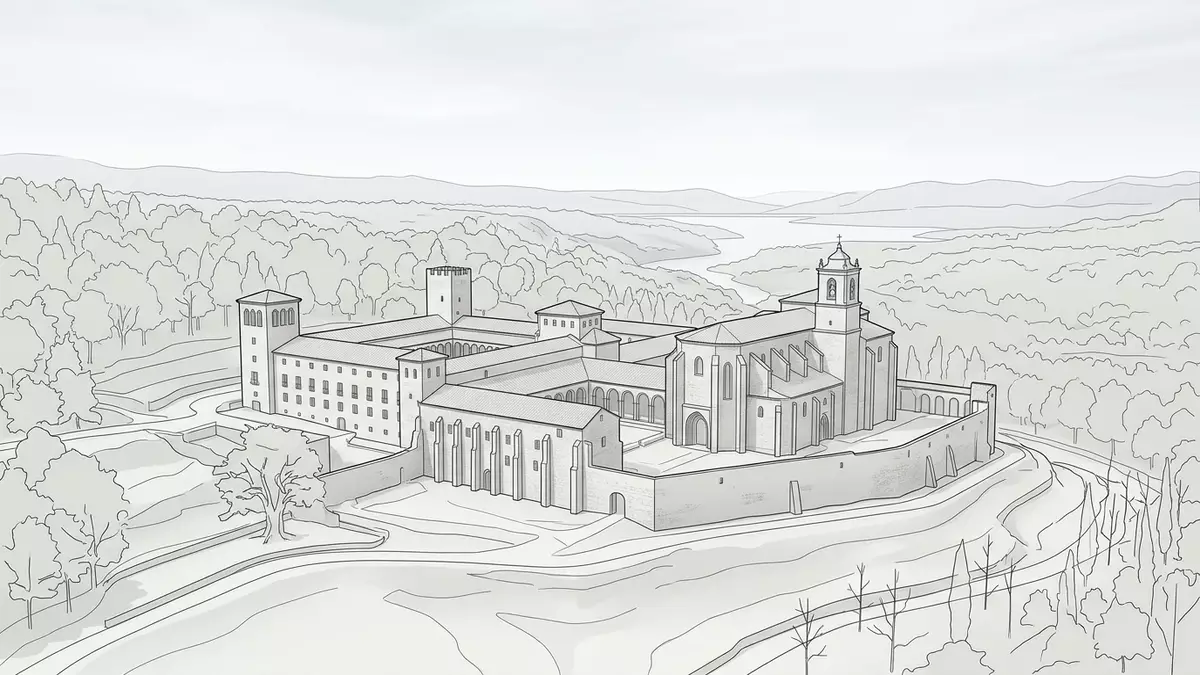
Monasterio de Piedra near Nuevalos in Aragon is a rare combination of Cistercian stone architecture and a river-carved ravine adapted into a garden of waterfalls. Its origins lie in the late twelfth century, when Alfonso II of Aragon and his wife Sancha of Castile granted the Castle of Piedra to monks from Poblet to establish a new monastery beside the Piedra River.
From royal donation to Cistercian cloister
The story of Monasterio de Piedra begins with Alfonso II of Aragon, who donated the Castle of Piedra to the Cistercian community from Poblet in the 1180s, providing both the fortification and surrounding land as the nucleus of a new abbey. The foundation is dated to 1194, when a small group of monks left Poblet to settle at the castle and dedicate the new house to St Mary the White, creating what became known as Santa María de Piedra.donated the Castle of Piedra Construction belongs to the transition from Romanesque to Gothic, and the monastic core follows the Cistercian pattern of a church, cloister and domestic ranges grouped around enclosed courts.transition from Romanesque to Gothic
The abbey church and its adjoining buildings took shape between the late twelfth and early thirteenth centuries, with consecration of the church in 1218 marking the point at which the complex reached a mature form as a Cistercian monastery.consecration of the abbey church in 1218 For centuries, Cistercian monks lived and worked within these walls, organising their days around the abbey church, the cloister walks, the chapter house, refectory and other communal spaces built in austere stonework that reflects their order’s preference for simplicity.
A stone monastery beside a river gorge
What distinguishes Monasterio de Piedra is the way its medieval buildings sit directly beside a narrow river valley cut by the Piedra River, so that cloisters and cloister gardens are only a short walk from wooded slopes, cascades and pools. The site lies in the municipality of Nuevalos in Zaragoza province, and the ravine beneath the monastery has been adapted as a landscaped park where paths wind between rock faces, vegetation and falling water.ravine beneath the monastery has been adapted as a landscaped park The juxtaposition of enclosed stone spaces and a river gorge gives the place a distinctive spatial rhythm, moving from vaulted interiors into open ground shaped by water.
Following the suppression of male religious orders in the nineteenth century, Cistercian life at Monasterio de Piedra ended in 1835 and the monastery’s lands passed into private hands.Cistercian life ended in 1835 In 1840, the industrialist Pablo Muntadas Campeny acquired the complex and maintained agricultural and livestock activity around the former abbey while the ravine began to be reshaped as a place for leisure and spectacle.Pablo Muntadas Campeny acquired the complex in 1840 His son Juan Federico Muntadas developed the park more extensively, cutting tracks and paths into the gorge and planting trees to frame views of the water, turning the once utilitarian valley into a composed landscape that visitors could explore on foot.
Waterfalls, caves and a shaped landscape
The ravine beneath Monasterio de Piedra is known for a sequence of waterfalls and caves created where the Piedra River drops over layers of rock. Named falls such as Cascada Caprichosa, Cascada Iris and Cascada Cola de Caballo punctuate the descent, with water spilling over moss-covered ledges and into basins that reflect the surrounding vegetation.Cascada Caprichosa, Cascada Iris and Cascada Cola de Caballo Paths descend and climb around these features, sometimes entering caves where the river has hollowed the rock, and at other points crossing bridges that span narrow chasms.
In the nineteenth century, the discovery of the Iris cave led to the opening of the ravine to visitors, and a pisciculture centre followed, using the river’s waters to breed species such as trout and crab for release into Aragonese rivers.pisciculture centre using the river’s waters The combination of shaped paths, planted slopes and engineered features such as fish ponds sits alongside the untouched aspects of the gorge, where rock formations and the movement of water remain the primary presence.
Visiting Monasterio de Piedra: what travellers from Western Europe should know
- Monasterio de Piedra stands near the village of Nuevalos in Zaragoza province, Aragon, with the former monastery complex above the ravine of the Piedra River and road access from surrounding towns.
- The terrain in the park section includes stepped paths, bridges and sections of walkway that climb and descend alongside the river, so visiting the waterfalls involves walking on gradients and negotiating stairways carved or built into the rock.
- The historic buildings comprise an abbey church, cloister and associated monastic spaces, many constructed in robust masonry characteristic of late Romanesque and early Gothic architecture, and access between levels often uses internal staircases.
- The official language is Spanish and the currency is the euro.
Searching for Monasterio de Piedra on social platforms
These links open searches for Monasterio de Piedra on each platform.
Frequently asked questions about Monasterio de Piedra
Where is Monasterio de Piedra?
Monasterio de Piedra is in Nuevalos, a municipality in Zaragoza province in the autonomous community of Aragon in north-eastern Spain, beside the Piedra River valley.
What can visitors expect at Monasterio de Piedra?
Visitors encounter a former Cistercian monastery built in stone and a adjoining park where paths follow a ravine with waterfalls, caves and bridges shaped around the course of the Piedra River.
What makes Monasterio de Piedra distinctive among Spanish monastic sites?
The combination of medieval cloisters and a carefully landscaped waterfall-filled ravine at the same site, together with its foundation under Alfonso II of Aragon in the late twelfth century, gives Monasterio de Piedra a particular character.


