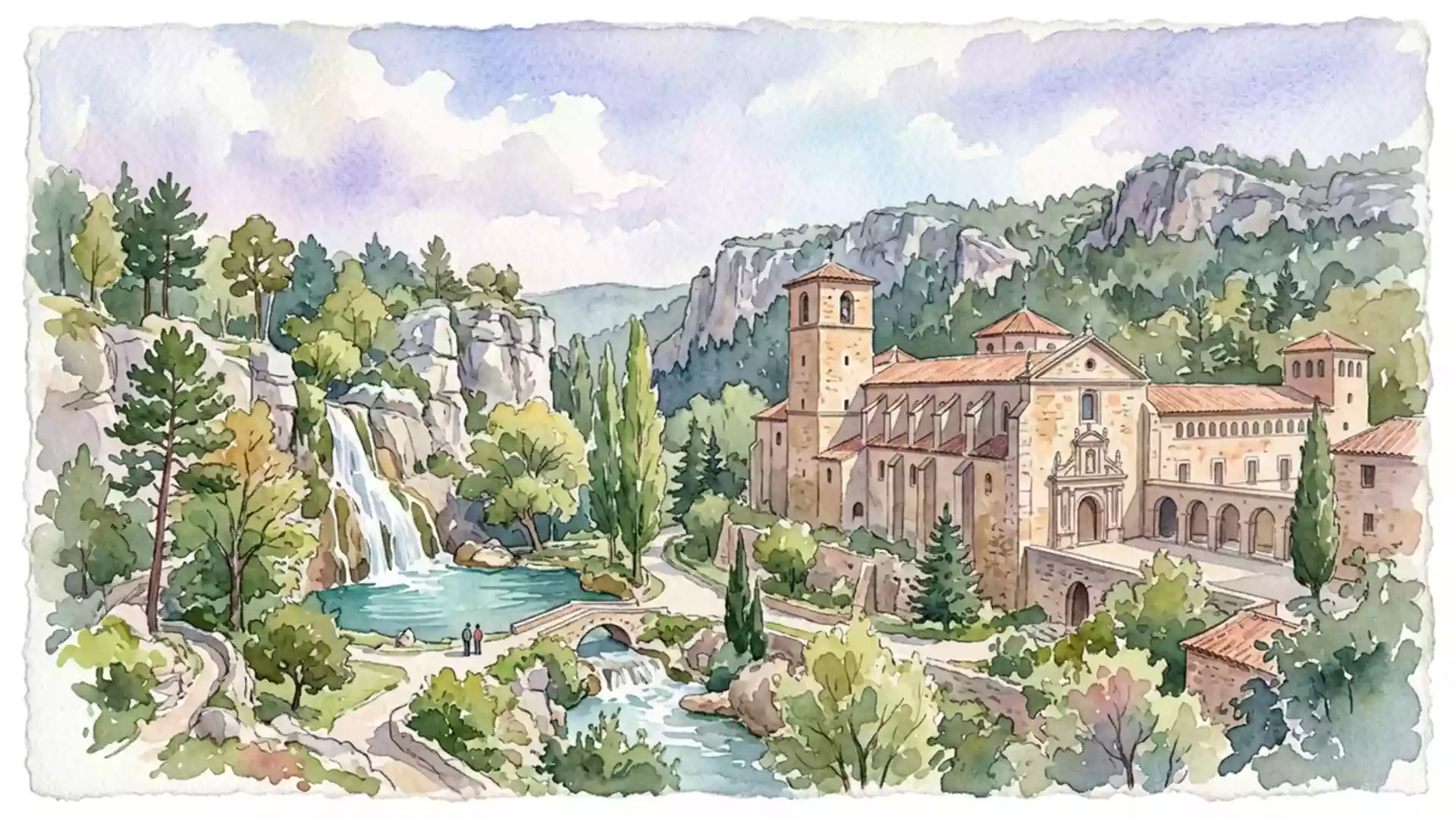
Monasterio de Piedra, where stone cloisters meet cascading water
Published on 08/29/2026 at 17:07 | Editorial responsibility: Rafael Müller, Editor-in-Chief AD HOC NEWS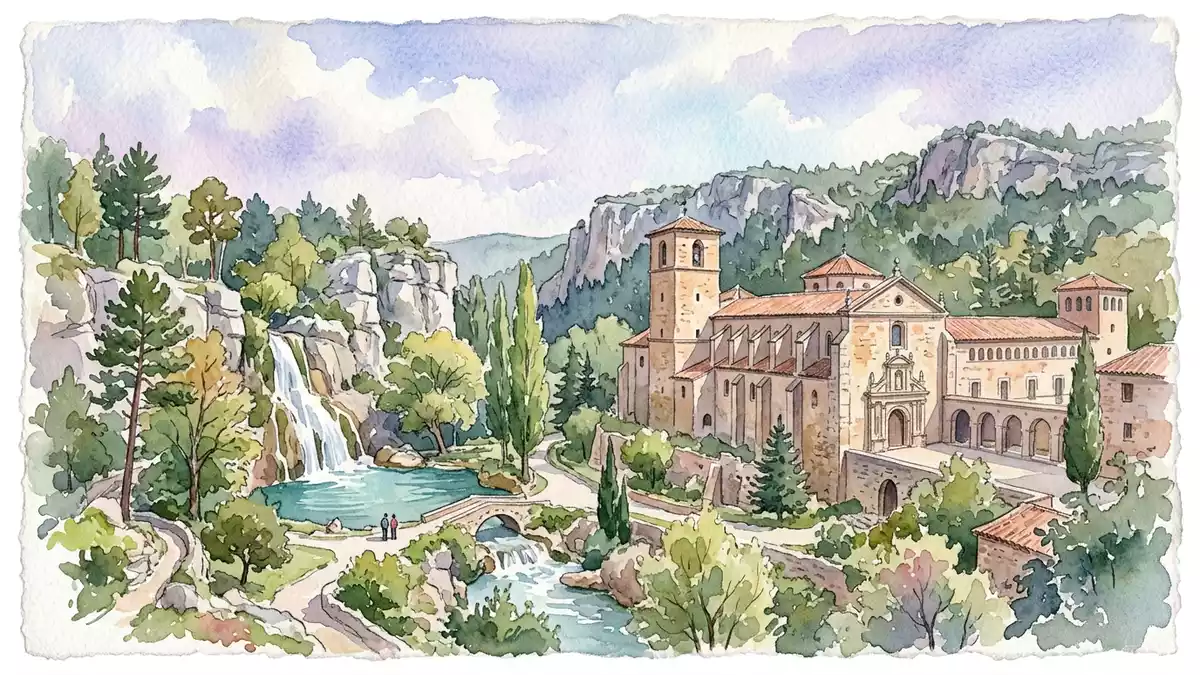
Monasterio de Piedra in Nuevalos, in the Spanish province of Zaragoza, brings together a medieval Cistercian monastery and a dramatic river gorge reshaped into a landscaped park of waterfalls and paths. The complex was founded in the late twelfth century under Alfonso II of Aragon, using an older castle beside the Piedra River as the nucleus for a new monastic community, and the cloistered stone buildings and the wooded ravine still sit side by side. Its combination of austere architecture and constructed cascades gives the site a character that is rare within inland Spain.
From Cistercian foundation to riverside monastery
The origins of Monasterio de Piedra lie in a royal donation at the end of the twelfth century, when Alfonso II of Aragon and his wife Sancha of Castile granted an existing castle at Piedra to monks from Poblet so they could establish a Cistercian house in the region.donated a former Arabic castle The first community comprised thirteen monks, and the new monastery followed the pattern of the Cistercian order, with a church, cloister and domestic ranges grouped around enclosed courts.thirteen Cistercian monks from Poblet Construction is dated by regional heritage records to the period between the late twelfth and early thirteenth centuries, and the consecration of the abbey church took place in 1218, marking the point at which the complex took on its mature form.occupied by the Cistercian order between 1218 and 1835
The architectural language belongs to the transition from Romanesque to Gothic in the Crown of Aragon, with a relatively plain church and functional monastic buildings rather than lavish ornament.built during the transition from Romanesque to Gothic Inside the cloister, the stone arcades frame a simple courtyard, while the refectory, chapter house and cells reflect Cistercian priorities of order and restraint rather than display. The community remained in place for centuries under royal protection, accumulating land and rights from rulers such as Peter II and James I, and the monastery’s plan was adapted and extended during the sixteenth and seventeenth centuries as needs changed.reformed during the sixteenth and seventeenth centuries This long monastic presence gave the complex its layered, but still coherent, architectural character.
Nineteenth?century reinvention and the garden park
Monasterio de Piedra’s monastic life ended in the nineteenth century, when Spain’s disentailment policies led to the suppression of male religious orders and the expropriation of their property; Cistercian occupation of the monastery ceased in 1835 and the buildings were put up for auction.closed down in 1835 In 1840 the Zaragoza industrialist Pablo Muntadas Campeny acquired the complex, retaining agricultural and livestock activities around the site while beginning to look at the wider ravine as something that could be shaped for leisure and spectacle.bought the monastery, retaining agricultural activity His son, Juan Federico Muntadas, drove a more radical transformation of the river valley, carving routes through the rock, cutting paths and planting trees and shrubs to turn the once utilitarian landscape into what was described by mid?twentieth?century officials as a historic scenic garden.
Key interventions in this period combined geology and hydrology with human design. In 1860 the Iris cave, a cavern shaped by the Piedra River, was made accessible by new walkways, and the park was opened to visitors as a destination in its own right.after discovering the Iris cave, it was opened to the public A few years later, in 1867, a pioneering fish farm was created beside the river, using its clear, cool water to raise trout and Iberian crayfish for restocking streams across Aragon; Spanish tourist authorities still note this as the first such pisciculture centre in the country.first fish farm in Spain The garden and its cascades gained formal recognition in 1940, when the park was declared a national picturesque site, anchoring Monasterio de Piedra’s status not just as an architectural monument but as a designed landscape.
Waterfalls, caves and chocolate stories
The park at Monasterio de Piedra is defined by the way the Piedra River drops through the gorge, creating waterfalls of varying heights, plunge pools and damp rock faces that have been threaded with footpaths and stairways. Visitors move from shaded woodland with deciduous planting to narrow passages between rock walls, and then out onto balconies where the view opens to falling water and the wider valley. Sections of the route pass behind curtains of water or enter caves where the sound of the river and the confined space give a sense of enclosure within the cliff.
The historic narrative of the monastery includes a strand that links it to the early history of chocolate in Europe. Travel features and local histories recount that in the sixteenth century, Hernán Cortés presented cocoa beans to a monk of Monasterio de Piedra, Fray Jerónimo de Aguilar, together with instructions for preparing a sweetened drink, and that this recipe was then transmitted to the abbot and the community.first place in Europe where chocolate was prepared and consumed The story presents the monastery as an early European setting for cocoa to be turned into a beverage with sugar, cinnamon and vanilla, and chocolate remains part of the cultural narrative attached to the site. Between the cloister, the river, the fish farm and the chocolate legend, Monasterio de Piedra intertwines religious, ecological and gastronomic histories in one valley.
Visiting Monasterio de Piedra: what travellers from Western Europe should know
- Monasterio de Piedra lies near Nuevalos in Aragon, inland from Zaragoza; the site is reached by road, with regional routes linking it to Calatayud and other towns in central Aragon.monastery 28 km south?west of Calatayud
- The terrain in the park includes uneven forest paths, stairways alongside waterfalls and passages through caves, so walking routes involve gradients, rock steps and damp surfaces that demand steady footing.
- Within the wider complex, the former monastery buildings have been converted for hospitality and visitor use, while the surrounding grounds retain agricultural and livestock activity alongside the garden layout.
- Spain is the official language and the euro is the national currency.
Searching for Monasterio de Piedra on social platforms
These links open searches for Monasterio de Piedra on each platform.
Frequently asked questions about Monasterio de Piedra
Where is Monasterio de Piedra located?
Monasterio de Piedra stands near the village of Nuevalos in the province of Zaragoza, in the Aragon region of inland Spain, south?west of Calatayud.south?west of Calatayud in Aragon
What can visitors expect when exploring the site?
A visit combines stone monastery buildings from the thirteenth century with a riverside park of waterfalls, caves, woodland paths and viewpoints shaped along the Piedra River gorge.
What makes Monasterio de Piedra distinctive among Spanish heritage sites?
The site links a Cistercian abbey founded under Alfonso II of Aragon with a nineteenth?century scenic garden, a historic fish farm and a narrative about early chocolate in Europe, all concentrated in a single valley.