
Monasterio de El Escorial and the power of ordered stone
Published on 09/19/2026 at 16:55 | Editorial responsibility: Rafael Müller, Editor-in-Chief AD HOC NEWS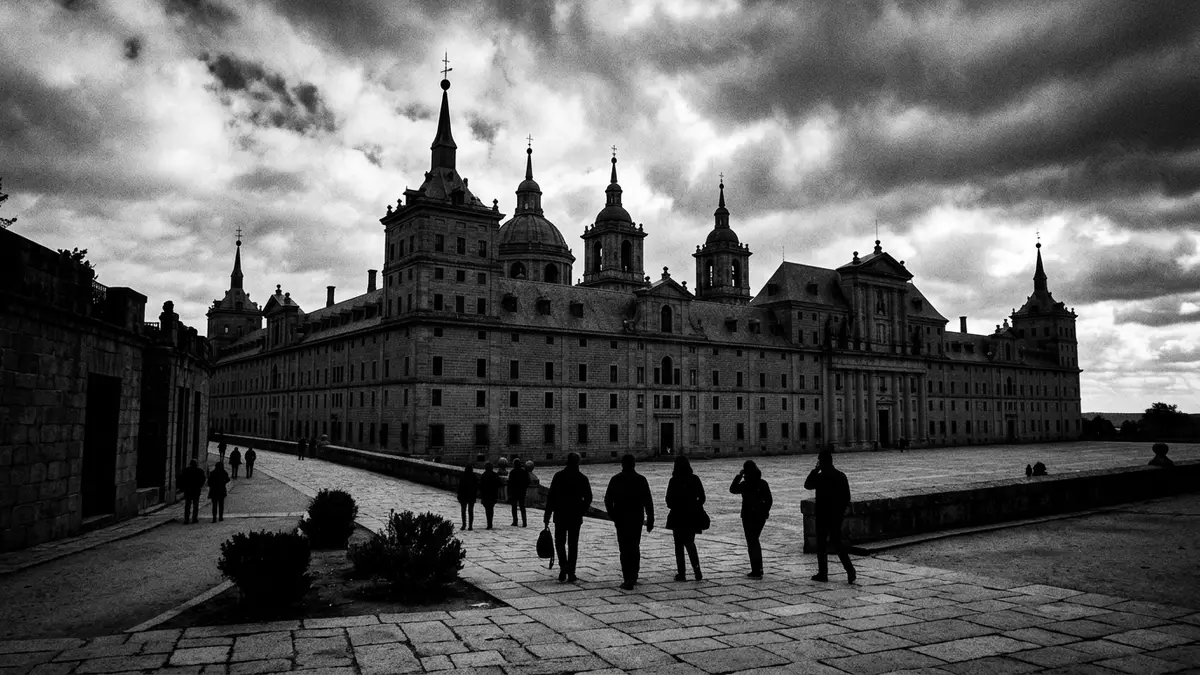
Monasterio de El Escorial in San Lorenzo de El Escorial is a royal monastery and palace complex from the second half of the sixteenth century, laid out in pale granite at the foot of the Sierra de Guadarrama north of Madrid. Conceived under King Philip II of Spain and substantially completed by 1584, it brings monastery, royal residence, basilica and dynastic mausoleum together in one immense structure whose rigorous courtyards and long façades express a deliberate austerity.
A granite monument of the Spanish Renaissance
The formal name Real Monasterio de San Lorenzo de El Escorial reflects the complex’s dual identity as royal foundation and religious house, tying it to the cult of Saint Lawrence that gave the surrounding town its name.Real Monasterio de San Lorenzo de El Escorial It stands in the granite foothills of the Sierra de Guadarrama on Mount Abantos, in the Community of Madrid, with the buildings arranged on a high terrace above the town.Mount Abantos in the Sierra de Guadarrama The setting links stone architecture and rocky landscape, and the complex reads from a distance as a single block of grey masonry punctuated by towers and roofs.
Philip II commissioned the monastery in 1563, after choosing the site and appointing the architect Juan Bautista de Toledo to develop the overall design on Italian Renaissance principles.Philip II commissioned the monastery in 1563 Work began with the laying of the first stone on 23 April 1563, and the main construction phase continued for just over two decades until the complex was substantially complete in 1584.construction between 1563 and 1584 The architects and builders created what is widely described as the largest Renaissance building in Spain, occupying more than 33,000 m² (over 358,000 square feet) of plan area.the site occupies an area of 33,327 m²
Courtyards, basilica and the Herrerian style
Juan Bautista de Toledo developed the initial “Traza Universal”, the general design for Monasterio de El Escorial, before his death in 1567; Juan de Herrera then took over and gave the architecture its defining character.Juan Bautista de Toledo and Juan de Herrera The plan is often described as grid-like, structured around rectilinear courtyards, long corridors and a central basilica whose dome signals the spiritual core of the ensemble.grid-like plan with courtyards and basilica Within this ordered framework lie the monastery buildings, the royal palace apartments, the pantheon of the Spanish monarchs and a historic library, each occupying its own sector yet bound into the same geometry.
The exterior elevations are built in pale, finely cut granite with minimal ornament, straight horizontal cornices and evenly spaced openings, a severe language that later writers grouped under the term Herrerian style.Herrerian architectural style Slate roofs rise above the walls, and towers mark the corners and key points of the composition, giving the whole complex a fortress-like outline while remaining fundamentally monastic in atmosphere. In numbers alone the building is vast: sources record multiple patios, cloisters, staircases and towers, and thousands of doors and windows distributed across the façades.patios, cloisters, stairs and windows Walking inside, visitors move between enclosed courts, long straight galleries and major lit spaces such as the basilica, encountering the strict geometry at every turn.
Royal pantheon, monastery life and world heritage
The basilica at the heart of Monasterio de El Escorial forms the spiritual focus of the complex and doubles as the principal ceremonial space, with the royal pantheon beneath serving as the burial place for Spanish monarchs from Charles V onwards.pantheon to the Spanish monarchs The adjoining palace apartments once housed the royal family, embedding the monarchy directly into the daily rhythm of the religious house. The monastery itself was originally entrusted to the Hieronymite order of monks and is occupied today by members of the Order of Saint Augustine, ensuring continuity of religious life within the same stone walls.Hieronymite order and Order of Saint Augustine
Beyond its courtly and monastic functions, the complex holds a significant historical library, with richly decorated rooms and collections that trace intellectual life across the Spanish kingdoms and their wider territories.historic library at El Escorial Monasterio de El Escorial and its historic surroundings were inscribed as a UNESCO World Heritage Site on 2 November 1984 under the entry “El Escorial, monastery and site”, recognising both the architectural ensemble and its landscape setting as of outstanding universal value.UNESCO World Heritage Site since 1984 The combination of royal residence, monastery, basilica, pantheon and library within one disciplined Renaissance design makes the visit a study in how architecture can materialise power, faith and memory in stone.
Visiting Monasterio de El Escorial: what travellers from Western Europe should know
- Monasterio de El Escorial stands in San Lorenzo de El Escorial in the Community of Madrid, north-west of Spain’s capital, and is reached by road and rail services from Madrid.
- The complex occupies a large, stepped terrace on Mount Abantos, and a visit involves walking across extensive paved courtyards and using long staircases within the monastery and palace sectors.
- The surrounding area forms part of the Sierra de Guadarrama, and weather at the site reflects its elevation compared with central Madrid, with cooler air and more exposure to wind.
- The official language is Spanish and the currency is the euro.
Searching for Monasterio de El Escorial on social platforms
These links open searches for Monasterio de El Escorial on each platform.
Frequently asked questions about Monasterio de El Escorial
Where is Monasterio de El Escorial located?
Monasterio de El Escorial is in the town of San Lorenzo de El Escorial in the Community of Madrid, in the granite foothills of the Sierra de Guadarrama north of Madrid.
What should visitors expect on a visit?
A visit centres on a vast sixteenth-century stone complex with courtyards, basilica, palace rooms, pantheon and library, reached by extensive internal staircases and long galleries.
What makes Monasterio de El Escorial distinctive?
Its fusion of royal monastery, palace, basilica, pantheon and library within one Herrerian granite design, commissioned by Philip II in the 1560s and completed by 1584, makes it distinctive in Spain.


