
Monasterio de El Escorial and the geometry of power
Published on 09/17/2026 at 06:34 | Editorial responsibility: Rafael Müller, Editor-in-Chief AD HOC NEWS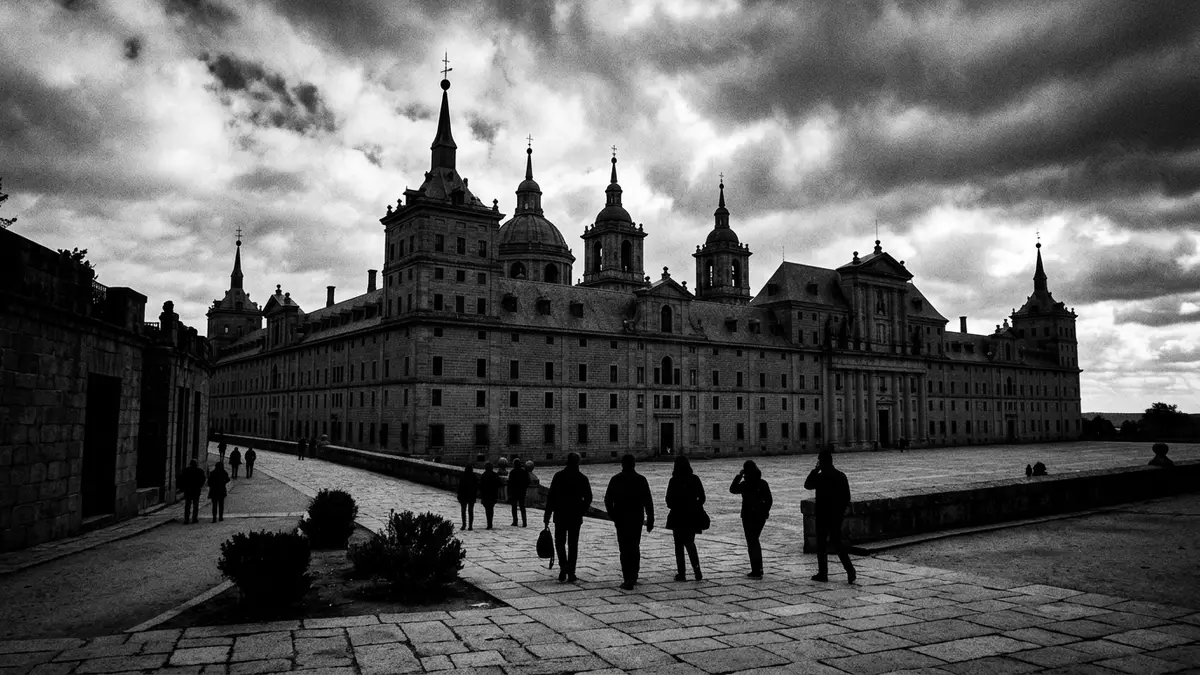
Monasterio de El Escorial in San Lorenzo de El Escorial is a vast sixteenth-century complex where monastery, palace, basilica and royal pantheon are fused into a single granite mass with rigorously ordered courtyards. Conceived under King Philip II in the 1560s and substantially completed by 1584, it stands at the foot of the Sierra de Guadarrama north of Madrid and is recognised as one of Spain’s key Renaissance monuments.
The royal monastery in the Guadarrama foothills
Monasterio de El Escorial lies in the town of San Lorenzo de El Escorial in the Community of Madrid, against the granite foothills of the Sierra de Guadarrama, giving the whole site a clear mountain backdrop that contrasts with its controlled geometry.foothills of the Sierra de Guadarrama From a distance the complex appears as a long horizontal block with towers, slate roofs and a dominant basilica dome rising over the rectangular plan.
The full historical name Real Monasterio de San Lorenzo de El Escorial reflects its dual identity as royal foundation and religious house, established by Philip II in the second half of the sixteenth century.Real Monasterio de San Lorenzo de El Escorial The complex was laid out and built between 1563 and 1584, a period that coincides with Spain’s so-called Golden Age, and its location outside Madrid gave the monarch a retreat with a direct view towards the sierra.
Philip II’s granite grid: plan and Herrerian style
Architects Juan Bautista de Toledo and Juan de Herrera gave Monasterio de El Escorial a plan often described as grid-like, organised around a series of courtyards, long corridors and a central basilica whose dome marks the heart of the composition.Juan Bautista de Toledo and Juan de Herrera The main elevations are built in pale granite with minimal ornament, straight cornices and evenly spaced windows, forming what later writers called the Herrerian style of Spanish Renaissance architecture.
Within this severe framework the basilica, cloisters, royal palace rooms, library and college are arranged so that religious, dynastic and governmental functions intersect under one roof.basilica, monastery, palace, library and college The basilica occupies the central position, flanked by courtyards and residential ranges, while the royal pantheon and burial spaces lie beneath or beside the main church, tying Philip II’s architectural project directly to the memory of the Habsburg dynasty.
Spaces inside the “largest Renaissance building in the world”
Because Monasterio de El Escorial brings together so many elements in one complex, moving through it means passing from monastic cloisters to grand staircases, palace chambers and the vast church interior without leaving the overall grid. The basilica’s high altar and dome give the main space vertical emphasis, while the surrounding cloisters frame gardens and covered walks that relate more closely to monastic life.
The complex has been described as the largest Renaissance building in the world, an assessment that reflects both its footprint and the scale of its integrated functions.largest Renaissance building in the world Beyond the basilica and cloisters, the historic library occupies a prominent gallery, lined with shelves and decorated ceilings, while the royal apartments and ceremonial halls extend along the façades facing the town and the landscape.
Visiting Monasterio de El Escorial: what travellers from Western Europe should know
- Monasterio de El Escorial stands in San Lorenzo de El Escorial in the Community of Madrid, with rail and road connections linking the town to Madrid and other parts of central Spain.
- Within the complex, many of the historic spaces are reached via long stone corridors and staircases, and some routes involve extended walks across large courtyards and cloistered ranges.
- The site lies in the Guadarrama foothills at moderate altitude above the Madrid plain, and the surrounding terrain includes sloping streets between the town and the monastery precinct.
- The official language is Spanish and the currency is the euro.
Searching for Monasterio de El Escorial on social platforms
These links open searches for Monasterio de El Escorial on each platform.
Frequently asked questions about Monasterio de El Escorial
Where is Monasterio de El Escorial?
Monasterio de El Escorial is in the town of San Lorenzo de El Escorial in the Community of Madrid, in central Spain, near the Sierra de Guadarrama.
What should visitors expect inside the complex?
Visitors encounter a large Renaissance monastery and palace, with basilica, cloisters, library, royal apartments and burial spaces arranged around courtyards and long stone corridors.
What makes Monasterio de El Escorial distinctive?
Its scale as a combined monastery-palace, its Herrerian granite architecture and its role as a royal pantheon conceived by Philip II in the sixteenth century make it distinctive among European sites.


