
Mezquita-Catedral de Cordoba and its layered stone interior
Published on 09/16/2026 at 14:21 | Editorial responsibility: Rafael Müller, Editor-in-Chief AD HOC NEWS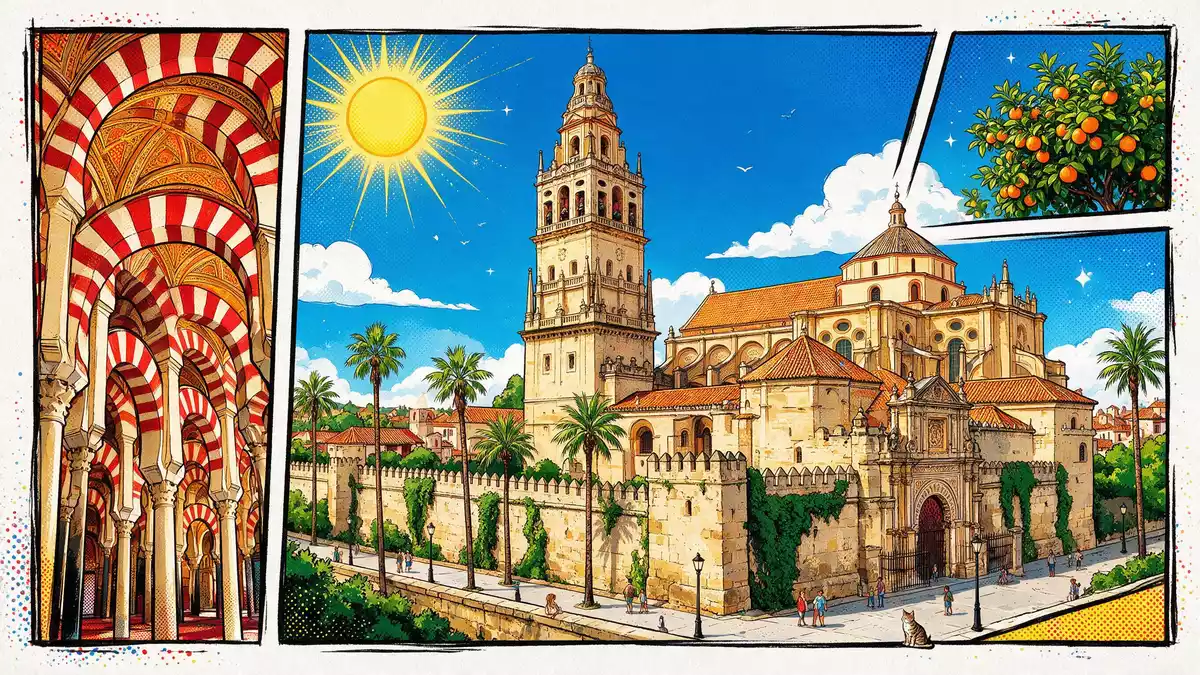
Mezquita-Catedral de Cordoba in Cordoba is a single monument made of contrasting layers, with an Umayyad hypostyle hall and a cathedral core inside the same shell. It stands in the historic centre and is part of the UNESCO-listed Historic Centre of Cordoba, a designation linked to 1984 and 1994.Historic Centre of Cordoba
Umayyad arches and a later cathedral core
The oldest fabric belongs to the age of Abd al-Rahman I, who began the mosque in 785. The building later grew under the Umayyad rulers of al-Andalus, leaving rows of columns and arches that still define the great hall.begun in 785
The Christian phase began in 1236, when the mosque was consecrated as a cathedral after the Castilian conquest of Cordoba. In the sixteenth century, Hernán Ruiz I and later builders inserted a cathedral nave and transept into the middle of the earlier plan, leaving the surrounding Islamic structure visible.turned into a cathedral
A hall of columns around a Christian crossing
The contrast inside is immediate: the long forest of columns gives way to the taller Christian crossing at the centre. The whole complex reads as a stone record of Córdoba under the Umayyad emirate and under the Castilian kingdom after 1236.
That mixture has made the monument one of the clearest surviving examples of layered religious architecture in Europe. The formal UNESCO setting adds another layer, since the building sits within a wider protected historic centre rather than as an isolated monument.wider protected historic centre
Stone, marble and reused columns
The interior uses stone, brick, marble and reused columns, giving the building a dense and varied surface. The mosque hall is organised as a hypostyle space, a type associated with repeated supports and a broad covered interior.
The cathedral insertion adds Gothic and Renaissance forms to that earlier fabric, so the visitor moves between different architectural languages in a few steps. The result is a building where the shape of the room changes with the century, but the older hall remains legible.
Visiting Mezquita-Catedral de Cordoba: what travellers from Western Europe should know
- The monument stands in central Cordoba, close to the Guadalquivir and the Roman bridge. The surrounding streets belong to the historic centre.
- The interior is a large stone hall with rows of columns and a later cathedral core. The change in level and style is visible without leaving the building.
- The official language is Spanish and the currency is the euro.
- Entry requirements depend on your nationality; UK travellers can check the FCDO travel advice at gov.uk/foreign-travel-advice, Irish travellers the Department of Foreign Affairs at ireland.ie.
Searching for Mezquita-Catedral de Cordoba on social platforms
These links open searches for Mezquita-Catedral de Cordoba on each platform.
Frequently asked questions about Mezquita-Catedral de Cordoba
Where is Mezquita-Catedral de Cordoba?
It stands in the historic centre of Cordoba, beside the Guadalquivir and near the Roman bridge. The wider setting is part of the UNESCO-listed Historic Centre of Cordoba.
What should a visit feel like?
The building combines a vast columned hall with a cathedral nave and crossing at its centre. The change from one architectural language to the other is visible inside the same monument.
What makes Mezquita-Catedral de Cordoba distinctive?
Its identity rests on the survival of an eighth-century mosque within a later cathedral. Abd al-Rahman I, 785, 1236 and Hernán Ruiz I are all part of the building’s form and history.


