
Medina of Tripoli between harbour walls and layered streets
Published on 09/15/2026 at 21:33 | Editorial responsibility: Rafael Müller, Editor-in-Chief AD HOC NEWS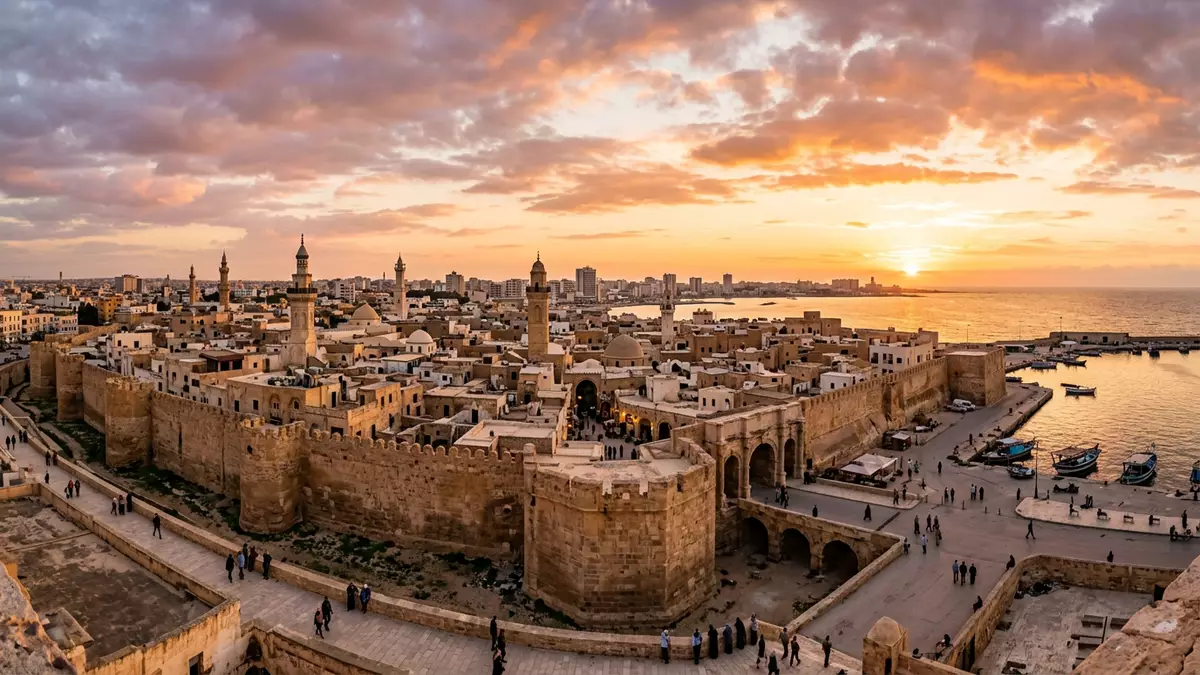
Medina of Tripoli is the historic old city of Tripolis in Libya, a compact walled quarter pressed between the harbour and the newer districts on the Mediterranean coast. Within its confines, ancient monuments, Ottoman-era mosques and tight commercial streets share space in a fabric that reflects centuries of trading and rule.
A coastal walled city between harbour and castle
Tripolis stands on Libya’s Mediterranean shore, and Medina of Tripoli forms the ancient walled centre of the capital along the harbour. The old quarter lies between the waterfront and later urban expansion, its denser street pattern and surviving fortifications marking a clear contrast with the broader routes and blocks around it.ancient walled city At one edge of the Medina, a fortified complex commonly known as the Red Castle dominates the waterfront, recalling the period when defence against naval approaches shaped this coastal town.Tripoli Old City
The walls enclosing Medina of Tripoli took their final recognised form under Ottoman rule in the sixteenth century, when the town was refortified and the overall layout settled into a broadly pentagonal plan.Ottoman period walls Historic gateways such as Bab Hawwara towards the south-east, Bab Zenata to the west and Bab al-Bahr close to the sea mark former controlled entrances into the quarter, and from these, streets lead directly into the maze of lanes inside.historic gates
Layers of history from Oea to Ottoman Tripoli
Long before it became the modern capital of Libya, Tripolis began as the Phoenician city of Oea, and Medina of Tripoli preserves this deep history in its layout and monuments.ancient Oea Roman urban principles influenced the structure of the old city, and later Ottoman and Karamanli rule in the sixteenth century and after gave the Medina much of its present appearance, with religious buildings, markets and houses aligned along narrow routes.Ottoman and Karamanli periods
Among the most striking remnants of the Roman era is the marble triumphal arch dedicated to Emperor Marcus Aurelius, standing near the edge of the old quarter and integrated into surrounding structures.Marcus Aurelius arch Nearby, mosques from later centuries anchor the Islamic phase of the city’s history, including the Gurgi mosque completed in 1883 and the Karamanli mosque dating from the eighteenth century, which is distinguished by its prominent octagonal minaret.Ottoman mosques Together, these monuments show how Medina of Tripoli carries Roman, Ottoman and Karamanli layers within the same confined urban space.
Narrow streets, souks and medina houses
Inside the walls, Medina of Tripoli is characterised by narrow lanes, small squares and streets that pass under arches and overpasses connecting buildings overhead.streets and arches Souks group together stalls selling similar goods, so areas specialising in fabrics, clothing or gold jewellery sit side by side with zones of everyday household items.shops and markets In places, older consular or commercial buildings from past foreign presences punctuate the largely residential and trading fabric.
Traditional houses in the Medina include properties such as the Yusuf Karamanli house, arranged around an interior courtyard with coloured Turkish tile-work and rooms opening onto the central space.Yusuf Karamanli house Religious schools, caravanserais and hammams are also part of the historic fabric, linking daily life to learning, trade and ritual cleansing.archaeological and historical buildings Street names such as Sharia Jamaa ad-Draghut, leading to the Mosque of Draghut and towards the Roman arch of Marcus Aurelius, tie together routes, landmarks and memories of past figures associated with the city.Sharia Jamaa ad-Draghut
Visiting Medina of Tripoli: what travellers from Western Europe should know
- Medina of Tripoli lies along the harbour in central Tripolis on Libya’s Mediterranean coast, enclosed by historic walls and reached from the wider city by road from central squares and streets.
- The quarter stands on level coastal ground, but its lanes are narrow, with uneven surfaces, occasional steps and passages that run under arches, so moving through it involves walking on varied ground.
- The Old City is directly adjacent to prominent city landmarks such as Martyrs’ Square and the Red Castle complex, and from there streets lead through gateways like Bab al-Bahr towards the inner souks.
- The official language in Tripolis is Arabic and the currency is the Libyan dinar.
- Entry requirements depend on your nationality; UK travellers can check the FCDO travel advice at gov.uk/foreign-travel-advice, Irish travellers the Department of Foreign Affairs at ireland.ie.
Searching for Medina of Tripoli on social platforms
These links open searches for Medina of Tripoli on each platform.
Frequently asked questions about Medina of Tripoli
Where is Medina of Tripoli located?
Medina of Tripoli is the historic walled centre of Tripolis, the capital of Libya, along the Mediterranean harbour and beside central city squares and roads.
What should visitors expect inside the Medina?
Visitors encounter narrow streets, arches, souks and historic buildings, including Roman remains, Ottoman mosques and traditional courtyard houses within a compact urban quarter.
What makes Medina of Tripoli distinctive among old cities?
Its combination of a coastal setting, sixteenth-century Ottoman walls, Roman monuments and later Islamic and Karamanli architecture within one confined walled space gives it a distinctive layered character.


