
Medina of Tripoli: a walled old city between harbour and history
Published on 08/28/2026 at 14:27 | Editorial responsibility: Rafael Müller, Editor-in-Chief AD HOC NEWS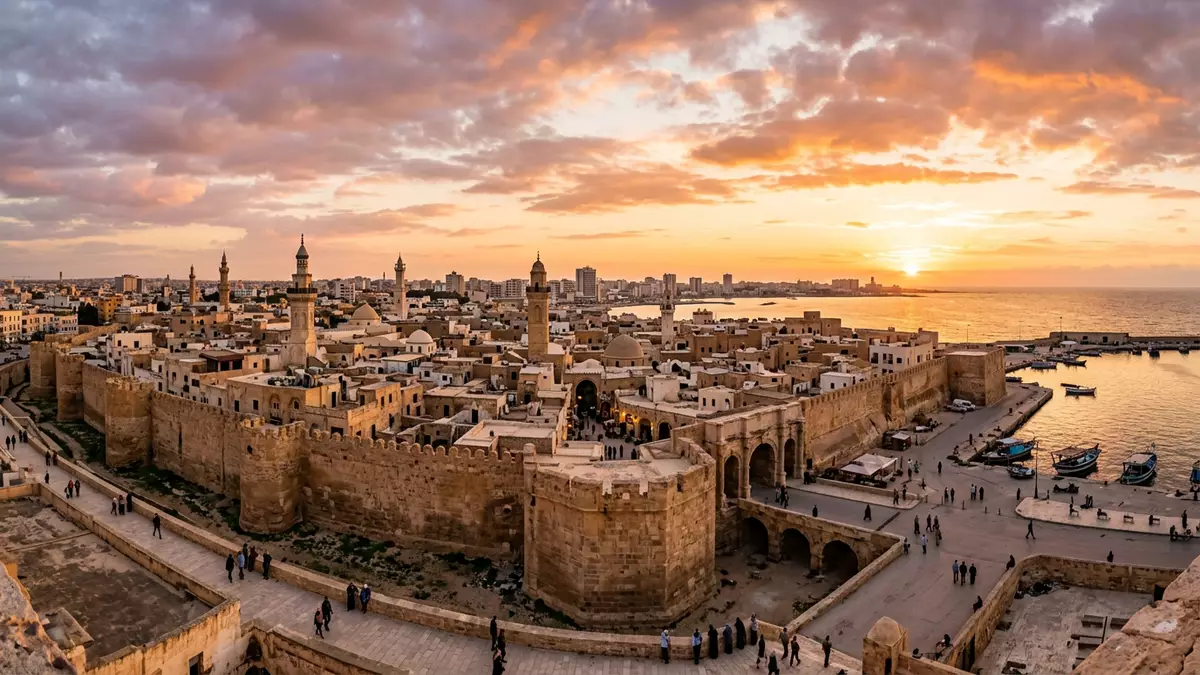
Medina of Tripoli is the historic old city of Tripolis in Libya, a compact walled quarter pressed between the harbour and the newer districts on the Mediterranean coast. Its lanes, mosques and markets preserve the layered history of a port that began as ancient Oea and later grew under Ottoman and Karamanli rule.
Walls, gates and the shape of the old city
The Medina of Tripoli forms the older, enclosed core of Libya’s capital, distinguishable from the surrounding twentieth-century expansion by its tighter street pattern and surviving fortifications near the waterfront. The quarter lies along the harbour and is dominated at one edge by a fortified complex often described as a castle, a reminder that this urban core developed with defence in mind.ancient walled city In plan, the Medina reflects a long urban history: Tripoli began as the Phoenician city of Oea, and the old town’s structure later absorbed Roman principles before taking on its present form during Ottoman control in the sixteenth century.Tripoli began as ancient Oea
The fortification walls around the old city are associated with Ottoman rebuilding after the sixteenth century, when Tripoli was refortified and its Medina developed a pentagonal outline with defined gates facing the sea and inland routes.pentagonal layout of the Medina Within this enclosure, sources identify historical gates such as Bab al-Bahr, Bab Zenata and Bab Hawara, linked to older routes and coastal access.former gates such as Bab al-Bahr The walled character remains visible in stretches of masonry that trace the boundary between the compact quarter and the more open modern streets beyond.
Roman traces and Ottoman mosques in the lanes
Within the Medina of Tripoli, Roman, Islamic and later Ottoman elements coexist in close proximity, making the district one of the clearest places to see how the city’s history accumulated in stone. A Roman arch dedicated to Marcus Aurelius stands near one edge of the old quarter, marking part of the line of a former main street and recalling the period when Tripoli’s core followed a Roman grid with cardo and decumanus aligned across the town.cardo extending from the arch of Marcus Aurelius Elsewhere, mosques from the Ottoman and Karamanli periods express later phases of Islamic rule, with prayer halls and courtyards fitted into plots defined by earlier urban layers.
The religious architecture of the Medina includes complexes and mosques that date to the seventeenth century and after, associated with rulers such as Ahmed Pasha al-Qarahmanli and local patrons who commissioned madrasas and places of worship.Ahmed Pasha al-Qarahmanli Complex Among the named mosques are the Gurgi Mosque and the Karamanli Mosque, both identified in descriptions of Tripoli’s historic Islamic architecture.Gurgi Mosque and the Karamanli Mosque The oldest surviving mosque in the city, the mosque of al-Naqah, is dated to 1610 and lies within this wider ensemble of religious buildings in the old town.mosque of al-Naqah (1610) These structures sit along narrow streets and small squares, their facades facing alleys that carry both local residents and visitors.
Souks, courtyards and a living urban fabric
The Medina of Tripoli is not an isolated monument but a lived urban district, with souks, cafes and residential courtyards embedded in its lanes. Descriptions of the old city refer to souqs selling clothing, traditional jewellery and everyday goods, alongside workshops and hammams that continue long-established patterns of urban life.plenty of shops, cafes Courtyard houses, some with upper levels set above ground-floor shops, line the alleys, forming a fabric where commercial and domestic spaces interlock.
In the broader understanding of Arab cities, the word “medina” refers to the historic core where streets are narrow and buildings often stand close together behind boundary walls.word madinah denotes the original, historical core Tripoli’s Medina fits this description, with its compact scale and mixture of shops, artisan spaces and residences. The district preserves parts of the original Roman street lines, later adapted by Ottoman planners, and this continuity is visible where major lanes still align with the arch of Marcus Aurelius and gates such as Bab al-Hurria.Bab al-Hurria (Liberty Gate) For travellers, this means the Medina can be perceived both as a historical site and as a functioning neighbourhood where daily activity and older stonework coincide.
Visiting Medina of Tripoli: what travellers from Western Europe should know
- Medina of Tripoli lies along the harbour in central Tripolis on Libya’s Mediterranean coast, bounded by the waterfront and newer districts reached by city roads.
- The old quarter consists of narrow streets and uneven surfaces, with some routes passing under arches and through constricted passages that demand steady footing.
- The official language is Arabic and the currency is the Libyan dinar.
- Entry requirements depend on your nationality; UK travellers can check the FCDO travel advice at gov.uk/foreign-travel-advice, Irish travellers the Department of Foreign Affairs at ireland.ie.
Searching for Medina of Tripoli on social platforms
These links open searches for Medina of Tripoli on each platform.Frequently asked questions about Medina of Tripoli
Where is Medina of Tripoli located?
Medina of Tripoli is the historic old city of Tripolis, Libya, lying along the harbour on the Mediterranean coast and enclosed by fortifications near the waterfront.
What can visitors expect when walking through the Medina?
Visitors encounter narrow streets lined with souks, mosques and courtyard houses, with Roman remains such as the Arch of Marcus Aurelius standing near Ottoman and Karamanli-period religious complexes.
What makes Medina of Tripoli distinctive among historic quarters?
The district combines a Roman-based street plan, surviving sixteenth-century fortifications and seventeenth-century Islamic architecture, all within a compact walled core that still functions as a lived neighbourhood.


