
Longmen Shiku and the limestone cliffs of Luoyang
Published on 08/30/2026 at 12:56 | Editorial responsibility: Rafael Müller, Editor-in-Chief AD HOC NEWS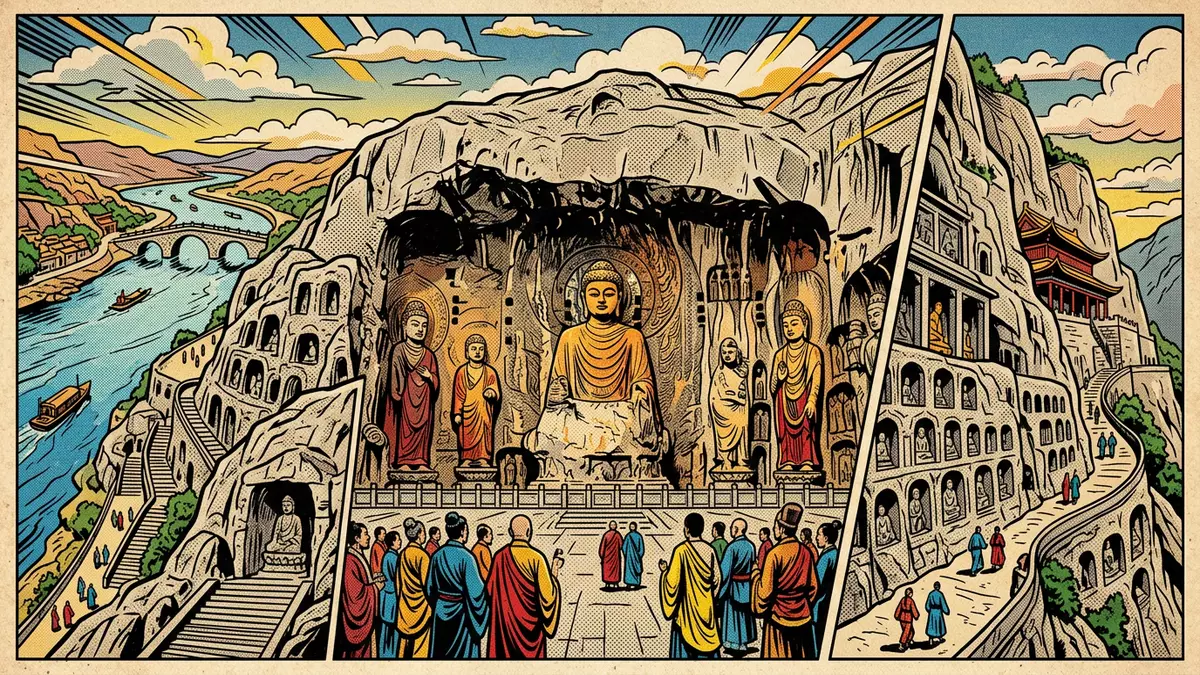
Longmen Shiku in Luoyang is a limestone cliff landscape cut with Buddhist caves, niches and inscriptions. It extends along the Yi River and includes work from the late Northern Wei and Tang dynastieslate Northern Wei and Tang dynasties.
Longmen Shiku along the Yi River
The site stretches across both sides of the river rather than gathering around one enclosed temple court. Its carved surfaces run through steep limestone cliffs, and the rock face carries caves, niches and steles in close successionsteep limestone cliffs.
Longmen Shiku belongs to Luoyang’s long role as an imperial centre in north China. The grottoes preserve a sequence of sculpture that begins in the late fifth century and continues into the Tang periodlate fifth century.
Stone carvings, niches and inscriptions
The most immediate impression is density: the cliffs carry more than 2,300 caves and niches, with almost 110,000 Buddhist stone statues, more than 60 stupas and thousands of inscriptions. The stone itself acts as the display surface, and the carvings spread across a long rocky band above the water2,300 caves and niches.
That variety makes the site read as a carved river escarpment rather than a single monument. Some figures are compact and reserved, while others are larger and more expansive, and the difference reflects the long span of work visible in the rockcarved river escarpment.
Why the Longmen Shiku setting matters
The setting on limestone cliffs gives Longmen Shiku its visual scale. Caves, inscriptions and large figures are cut directly into the rock, so the cliff face remains the dominant element throughout the sitelimestone cliffs.
The carved ensemble was inscribed on the UNESCO World Heritage List in 2000 and is identified with the late Northern Wei and Tang dynasties. Its historical range gives the grottoes their layered appearance, with earlier and later forms sharing the same stone wallsUNESCO World Heritage List.
Visiting Longmen Shiku: what travellers from Western Europe should know
- The grottoes lie in Luoyang, Henan province, beside the Yi River. The site is reached through the Longmen area on the river’s southern side.
- The ground is uneven and the carvings are spread along a long cliff line. Stone steps and open-air viewing areas are part of the setting.
- The main features are outdoor. The caves, niches, statues and inscriptions are exposed to the weather on the limestone face.
- English-language literature and maps often refer to the site as the Longmen Grottoes. Longmen Shiku is the Chinese name in romanised form.
Searching for Longmen Shiku on social platforms
These links open searches for Longmen Shiku on each platform.
Frequently asked questions about Longmen Shiku
Where is Longmen Shiku?
Longmen Shiku lies south of central Luoyang in Henan province, beside the Yi River. The grottoes are carved into limestone cliffs on both banks.
What does a visit involve?
It is an open-air rock-cut landscape with caves, niches, statues and inscriptions spread along the cliffs. The site combines river scenery with stone carving at a large scale.
What makes Longmen Shiku distinctive?
The grottoes preserve a long sequence of Buddhist carving from the late Northern Wei and Tang dynasties. Their limestone setting, density of sculpture and historical layering define the place.


