
London Eye and the great wheel over the Thames
Published on 09/15/2026 at 18:17 | Editorial responsibility: Rafael Müller, Editor-in-Chief AD HOC NEWS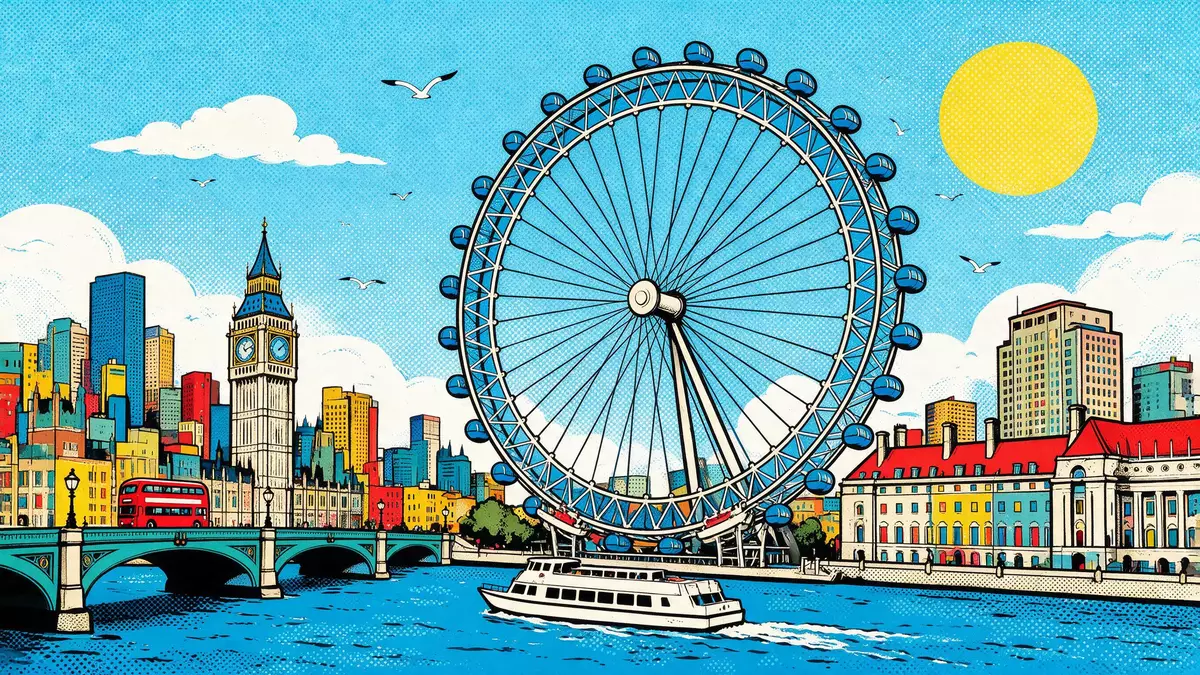
London Eye is a giant observation wheel on the south bank of the River Thames in London, created as a landmark for the turn of the millennium. Conceived by architects David Marks and Julia Barfield and launched in 2000, it lifts enclosed glass capsules above the river so that London’s skyline appears as a continuous panorama around the rim.
A cantilevered wheel beside the Thames
London Eye stands on the South Bank of the Thames in the London Borough of Lambeth, between Westminster Bridge and the railway bridges that carry trains into Charing Cross. The wheel rises beside the former County Hall building, facing the Palace of Westminster and the clock tower that houses Big Ben across the river, so that each rotation traces a view that sweeps from the Houses of Parliament along the riverfront skyline.Completed in 1999 and opened to the public in March 2000, it stands on the South Bank in the borough of Lambeth
The structure is an observation wheel rather than a traditional fairground Ferris wheel, with its steel frame supported on one side only in a cantilevered arrangement that leans out towards the water.The wheel is described as a cantilevered observation structure supported by an A-frame on one side The rim and spokes form a slender lattice of steel that has often been likened to a bicycle wheel placed upright beside the river, and the whole circle turns slowly above the embankment, lifting the capsules clear of the surrounding buildings.
Design, height and engineering
London Eye reaches a height of about 135 m (443 ft), with a wheel diameter of about 120 m (394 ft), figures that made it the tallest Ferris wheel in the world when it was completed in 1999.The structure is 135 metres tall with a wheel 120 metres in diameter The wheel carries sealed passenger capsules on its outer edge, so that the cabins project beyond the rim instead of hanging inside it, and at full height they give clear sightlines over the surrounding rooftops towards central London landmarks. From that upper arc, the Thames can be seen curving through the city and major buildings line both banks in sequence.
The project was designed by Marks Barfield Architects, the practice founded by David Marks and Julia Barfield, working with engineers from Arup and other specialists to turn the giant wheel into a functioning structure.The London Eye is 135 m high and was conceived and designed by Marks Barfield Architects Construction began in the late 1990s and the wheel structure was completed in 1999, with a ceremonial opening by Prime Minister Tony Blair on 31 December 1999.The Millennium Wheel was officially opened by Prime Minister Tony Blair on 31 December 1999 Passenger operations followed in March 2000 after testing of the rotation and boarding arrangements.
From Millennium Wheel to city symbol
When it was launched in 2000, London Eye was widely known as the Millennium Wheel, marking the beginning of the twenty-first century with a new high-level viewpoint over the historic core of the city.The observation wheel originated as a competition entry in 1993 and opened around the year 2000 as a millennium landmark Its height meant that for several years it offered the highest public viewing point in London, until taller observation platforms were opened elsewhere, and it quickly became a fixed part of the skyline when seen from bridges, riverboats and embankment walks.
London Eye’s circular form and slow movement contrast with the more rigid profiles of the riverside buildings around it, so that from many angles the wheel frames fragments of the city in its rim. The enclosed capsules are arranged so that travellers can walk around inside them as the wheel turns, stepping on and off at the riverside platform while the rotation is kept to a gentle pace.The wheel carries 32 sealed and air-conditioned passenger capsules attached to its external circumference Over the years it has appeared in films, television coverage and promotional images as a shorthand for London’s riverside, linking the South Bank with views across to Westminster and beyond.
Visiting London Eye: what travellers from Western Europe should know
- London Eye stands on the South Bank of the River Thames in central London, on the Lambeth side of Westminster Bridge and a short riverside walk from Waterloo station.
- The immediate area around the wheel is paved, with level riverside promenades and steps leading down from the surrounding streets to the embankment and boarding platforms.
- The official language is English and the currency is the pound sterling.
Searching for London Eye on social platforms
These links open searches for London Eye on each platform.Frequently asked questions about London Eye
Where is London Eye located in London?
London Eye stands on the South Bank of the River Thames in the London Borough of Lambeth, close to Westminster Bridge and opposite the Palace of Westminster.
What can visitors expect from a rotation on the wheel?
Visitors ride in enclosed glass capsules that move slowly with the turning wheel, gaining wide views along the Thames and across central London as they rise and descend.
What makes London Eye distinctive among observation wheels?
Its height of about 135 m (443 ft), its cantilevered structure supported on one side and its position beside the Thames together give London Eye a prominent presence on the city skyline.


