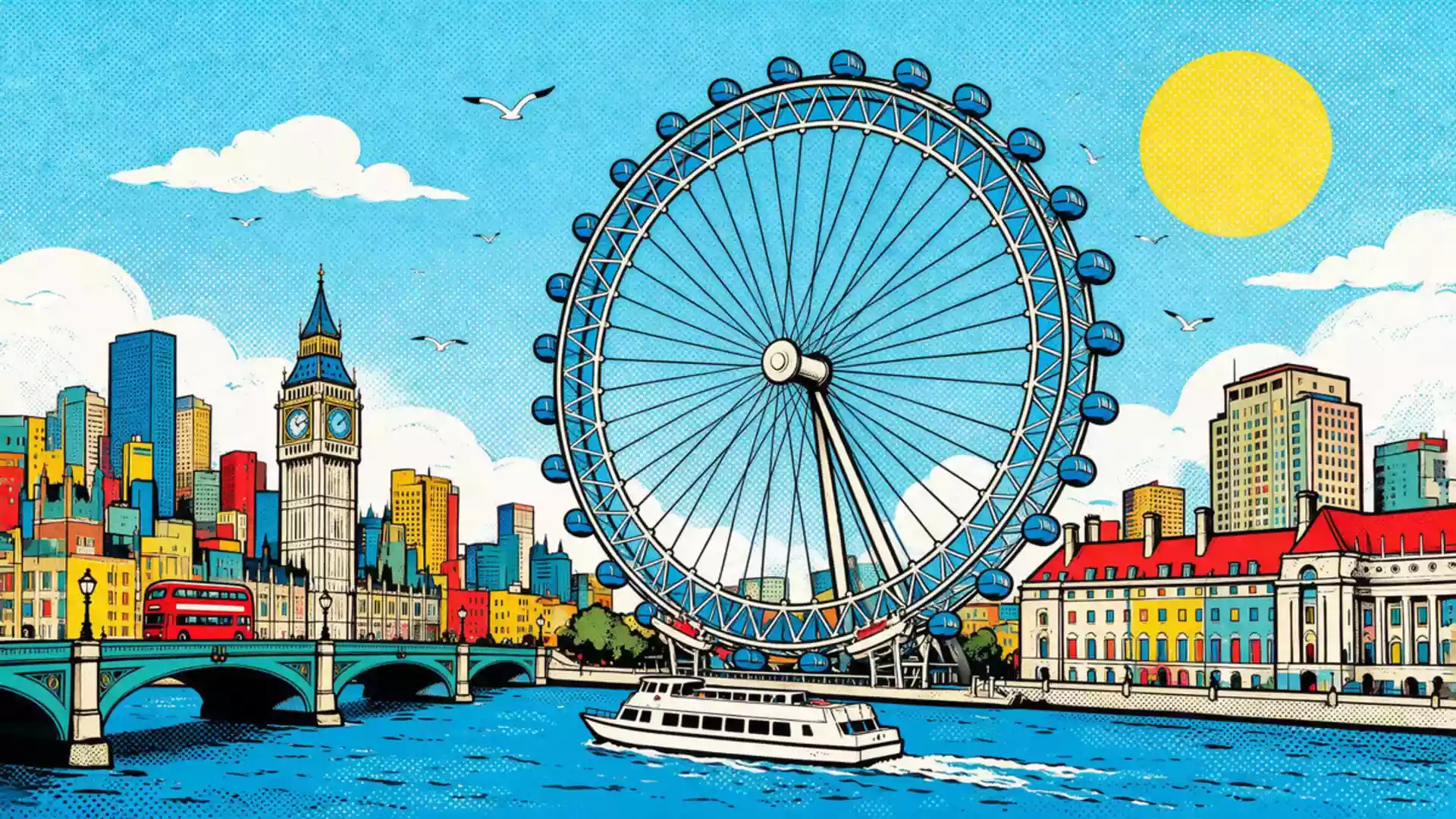
London Eye and the giant wheel on the Thames
Published on 09/09/2026 at 19:52 | Editorial responsibility: Rafael Müller, Editor-in-Chief AD HOC NEWS
Rising above the River Thames in central London, London Eye is a vast steel observation wheel that has become a fixed part of the city’s riverside skyline. Completed in 1999 and opened to the public in March 2000, it stands on the South Bank in the borough of Lambeth, opposite the Palace of Westminster and alongside County Hall, turning slowly above the river as enclosed capsules circle its rim.
A cantilevered wheel on the South Bank
London Eye is a cantilevered observation wheel, meaning the structure is supported on one side by a large A-frame rather than by symmetrical supports on both sides. The wheel rises to an overall height of about 135 m (443 ft), with a diameter of about 120 m (394 ft) that reads as a huge circular form against the riverfront buildings.An overall height of 135 metres makes it one of the tallest observation wheels constructed in Europe, and the steel frame, cables and hub give the impression of an enormous bicycle wheel placed above the Thames.Resembling a giant bicycle wheel, it stands near County Hall between Westminster Bridge and Hungerford Bridge on the river’s south bank.
The wheel carries enclosed, air-conditioned passenger capsules fixed to its outer rim. There are thirty-two capsules, each designed to hold up to twenty-five people, and they remain level as they move, supported by external frames and mounted to keep their floors horizontal while the wheel turns.Thirty two sealed passenger capsules are attached to the circumference, creating a ring of glass pods that encircle the structure. The slow rotation, taking around half an hour for a full turn, means the wheel rarely needs to stop completely for boarding during normal operation.Standing at 135 metres with thirty-two capsules, London Eye forms a bridge between large-scale engineering and public viewing platform.
Millennium landmark and design team
London Eye grew out of a competition in the early 1990s for a landmark marking the start of a new millennium. The concept was developed by architects David Marks and Julia Barfield, a husband-and-wife team who proposed a giant wheel giving panoramic views over central London.David Marks and Julia Barfield developed the concept and then worked with a wider group that included engineers and designers such as Malcolm Cook, Mark Sparrowhawk, Steven Chilton, Nic Bailey and Frank Anatole to realise the structure.The design team behind the wheel combined architectural ideas and detailed engineering to create the cantilevered form.
The wheel was built as part of the city’s response to the millennium, installed flat over the river before being raised into its vertical position and assembled beside Jubilee Gardens. Construction began in 1998 and the structure was completed in 1999, with its public opening following in March 2000 after technical testing.Built in 1999 and opened in 2000, it was for several years the tallest Ferris wheel in the world, before higher wheels were constructed in other cities. The site sits within a line of cultural and riverside attractions on the South Bank, with Jubilee Gardens immediately nearby and views up and down the Thames.
Views over the Thames and London’s skyline
From the upper part of the wheel, the view stretches across central London, taking in the river’s curve, the Palace of Westminster and its clock tower across the water, and further landmarks such as Buckingham Palace and Westminster Abbey visible in the distance.Landmarks like Buckingham Palace and Westminster Abbey can be seen from the peak in clear weather. On days with good visibility, the horizon extends for several tens of kilometres, reaching out towards Windsor and the outer suburbs, and the wheel provides a broad sweep of the city’s varied roofs, spires and towers.
Each capsule offers a 360-degree panorama, with glass on all sides and a central bench, so people can move around the interior and look out in every direction as London Eye turns. Because the wheel moves at a slow and steady pace, the view changes gradually, revealing different alignments of bridges, railway lines and streets along the Thames.Launched in 2000 as a cantilevered observation wheel, it has become an established way of seeing central London from above and of understanding how the city is organised along the river.
Visiting London Eye: what travellers from Western Europe should know
- London Eye stands on the South Bank of the River Thames in Lambeth, directly opposite the Palace of Westminster and close to Westminster Bridge and Hungerford Bridge.
- The wheel is reached on foot from central London streets along the river; the immediate area around the base includes paved walkways, steps and level approaches within Jubilee Gardens.
- The nearest major railway and Underground hubs are at Waterloo on the south side of the Thames and at Westminster across the river, both providing direct access to the riverside.
- The official language is English and the currency is the pound sterling.
Searching for London Eye on social platforms
These links open searches for London Eye on each platform.Frequently asked questions about London Eye
Where is London Eye located in London?
London Eye stands on the South Bank of the River Thames in the borough of Lambeth, near County Hall between Westminster Bridge and Hungerford Bridge.
What should visitors expect during a rotation?
Visitors stand or sit inside enclosed glass capsules that move slowly as the wheel turns, experiencing a continuous 360-degree view over the Thames and central London.
What makes London Eye distinctive among city viewpoints?
The wheel combines large-scale cantilevered engineering with enclosed capsules on its rim, giving elevated views across the river and landmarks such as the Palace of Westminster in a single slow circuit.