
L'Oceanografic and its concrete water-lily form
Published on 09/17/2026 at 19:41 | Editorial responsibility: Rafael Müller, Editor-in-Chief AD HOC NEWS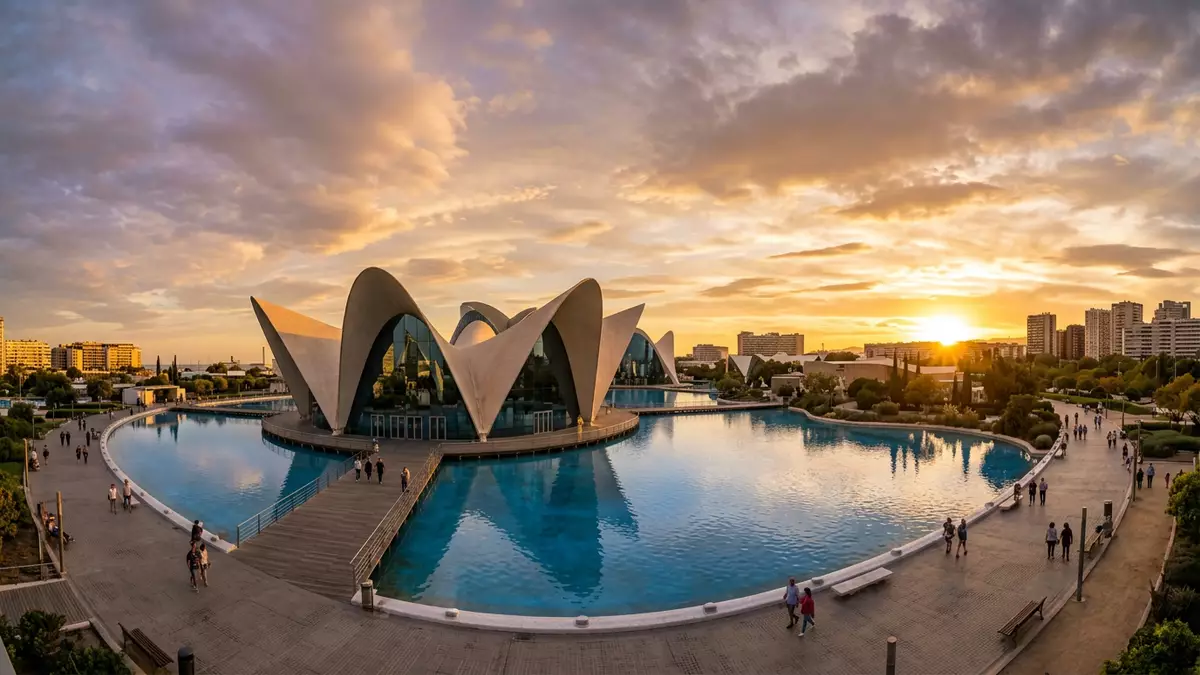
L'Oceanografic in Valencia is an oceanarium in the City of Arts and Sciences, and its broad concrete forms surround a central lake. Designed by Félix Candela and opened on 14 February 2003, it combines marine exhibits with a striking architectural profile.
L'Oceanografic’s water-lily plan in Valencia
The complex takes up a large site in the city’s former Turia riverbed, with pavilions and outdoor water arranged in a loose ring. The architecture is linked to Félix Candela, whose name is tied to thin-shell concrete, and the overall composition is often read as a water-lily figure.
That form gives L'Oceanografic a clear identity before any exhibit comes into view. Sweeping roofs, glazed sections and open water sit together in an ensemble that feels more architectural than zoological at first glance.
opened on 14 February 2003 Félix Candela
Concrete shells and marine spaces
Candela’s concrete roofs are the site’s most recognisable structural element. Their curved surfaces sit above different marine spaces, while the lake remains the visual centre of the complex.
The buildings are not arranged as a single enclosed block. Instead, visitors move between separate pavilions, underwater sections and outdoor areas, with the water and the roofs constantly in view.
The architecture belongs to a wider group of late twentieth-century and early twenty-first-century works in Valencia’s City of Arts and Sciences. That context places L'Oceanografic beside a larger urban ensemble rather than an isolated attraction.
City of Arts and Sciences the biggest aquarium in Europe
Marine habitats and the scale of the complex
L'Oceanografic presents marine habitats from different climates and waters, including Mediterranean, polar and tropical environments. The site also includes a dolphinarium and large tanks that extend the experience beyond a standard aquarium visit.
The scale of the place is part of its character. Water, concrete and glass combine in a sequence of spaces that includes open-air sections, indoor routes and long views across the lake.
Animal life ranges across fish, marine mammals, birds and other aquatic species. The result is an aquarium complex that reads as both a habitat display and a piece of contemporary architecture.
around 110,000 m² 42,000,000 litres
Visiting L'Oceanografic: what travellers from Western Europe should know
- L'Oceanografic stands within Valencia’s City of Arts and Sciences, near the former Turia riverbed. It is reached by city transport and by road from the centre.
- The complex covers a broad area with outdoor paths, pavilions and internal routes. Expect ramps, stairs and long stretches on foot between the different sections.
- The official language is Spanish and Valencian is also used in the city. The currency is the euro.
- The site sits beside other major modern buildings in the same urban ensemble. The surrounding parkland and architecture form part of the approach.
Searching for L'Oceanografic on social platforms
These links open searches for L'Oceanografic on each platform.
Frequently asked questions about L'Oceanografic
Where is L'Oceanografic?
L'Oceanografic is in Valencia, inside the City of Arts and Sciences. The setting is the former Turia riverbed on the south-eastern side of the city.
What should visitors expect?
The visit moves between outdoor water, concrete pavilions and interior marine displays. The route includes large tanks, underwater sections and changing views across the central lake.
What makes it distinctive?
Its identity lies in the combination of Félix Candela’s concrete shells and the lake-based layout. The architecture gives the aquarium a strong profile before the marine exhibits take over.


