
Krasnaja ploschtschad and the red heart of Moskau
Published on 08/28/2026 at 06:13 | Editorial responsibility: Rafael Müller, Editor-in-Chief AD HOC NEWS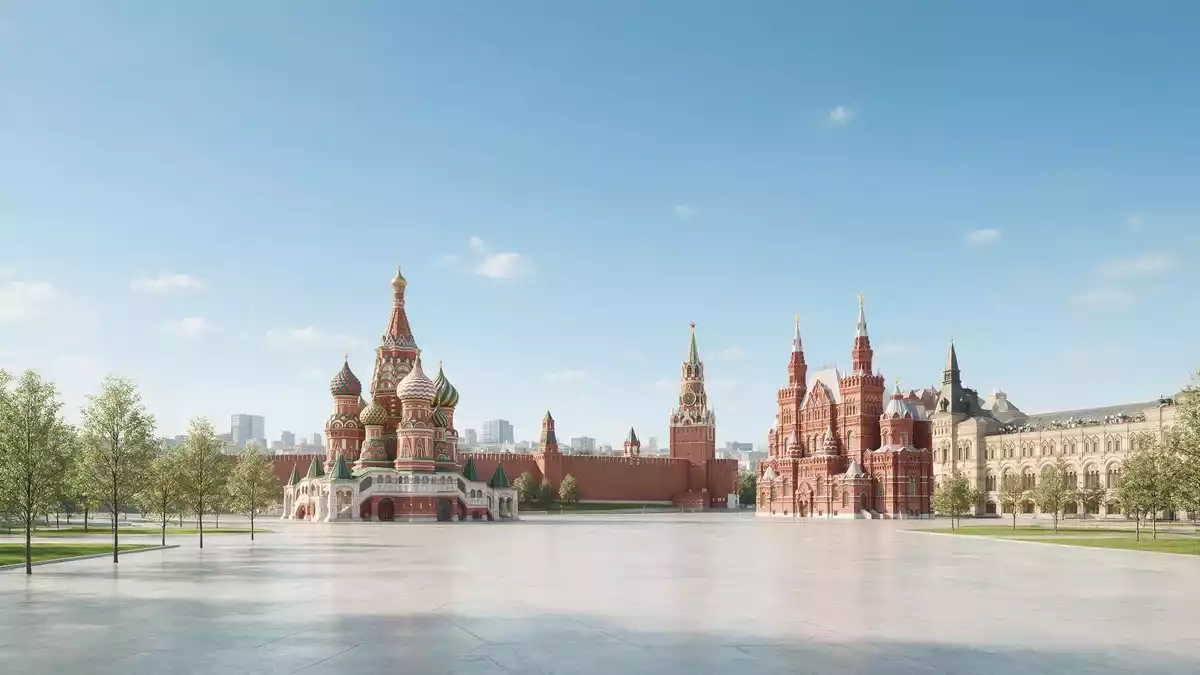
Krasnaja ploschtschad is the open square beside the Kremlin in Moskau, shaped by red brick, granite paving and some of the city’s best-known monuments. The square forms part of the Kremlin and Red Square UNESCO World Heritage property, inscribed in 1990.
Red brick, granite and ceremonial edges
The square is read first as a space, not a single building. Its long edges are set by the Kremlin wall, the State Historical Museum, GUM and St Basil’s Cathedral, with Lenin’s Mausoleum on the western side.
That mix of civic, commercial and ceremonial architecture gives the place its layered character. The Kremlin wall links it to the seat of state power, while GUM and the museum show the late imperial face of Moskau’s centre.
Ivan III, the late fifteenth century and the Kremlin side
The square belongs to the late medieval expansion of Moskau under Ivan III. Its place beside the Kremlin fixes it within the city’s older political core, and the ensemble has long been tied to Russian historical memory.
St Basil’s Cathedral, erected in 1555–1560 for Ivan IV after the capture of Kazan, anchors the southern end. The cathedral’s clustered towers and domes add a strong vertical note beside the square’s broad horizontal expanse.
Lenin’s Mausoleum, completed in 1930 to a design by A. V. Shchusev, adds a severe twentieth-century counterpoint. The contrast between the mausoleum, the Kremlin wall and the ornate church frontages is central to the square’s visual identity.
World Heritage status and changing layers
The UNESCO inscription covers the Kremlin and Red Square as one ensemble, and the square is part of a landscape of buildings from different centuries. The result is a centre where sacred, civic and state architecture stand in close proximity.
Earlier market functions remain part of the historical record, while the present setting is dominated by monuments, paved open space and the city’s ceremonial axis. The square also keeps its link with Moscow’s wider urban plan, which radiates from the historic core.
Visiting Krasnaja ploschtschad: what travellers from Western Europe should know
- Krasnaja ploschtschad lies in central Moskau, beside the Kremlin and close to the Moskva River. The nearest public transport links are the city’s central metro stations.
- The square is an open paved space, with large façades on every side and little shelter from the weather. The paving and broad proportions leave the monuments visually dominant.
- St Basil’s Cathedral, the State Historical Museum and GUM stand around the square’s edges. Their different dates and styles make the ensemble unusually varied.
- Entry requirements depend on your nationality; UK travellers can check the FCDO travel advice at gov.uk/foreign-travel-advice, Irish travellers the Department of Foreign Affairs at ireland.ie.
Searching for Krasnaja ploschtschad on social platforms
These links open searches for Krasnaja ploschtschad on each platform.
Frequently asked questions about Krasnaja ploschtschad
Where is Krasnaja ploschtschad?
It lies in central Moskau, alongside the Kremlin and within the historic core of the city. The square is part of the Kremlin and Red Square World Heritage ensemble.
What can be seen there?
The main setting is a large paved square bordered by the Kremlin wall, St Basil’s Cathedral, the State Historical Museum, GUM and Lenin’s Mausoleum. The architecture ranges from medieval church forms to Soviet monumental design.
What makes it distinctive?
Its strength lies in the dense concentration of state, religious and commercial landmarks around one open space. The contrast between red brick, ornate church domes and austere twentieth-century stone gives the square a clear visual identity.


