
Khan el-Khalili and the Mamluk heart of Kairo
Published on 08/19/2026 at 18:33 | Editorial responsibility: Rafael Müller, Editor-in-Chief AD HOC NEWS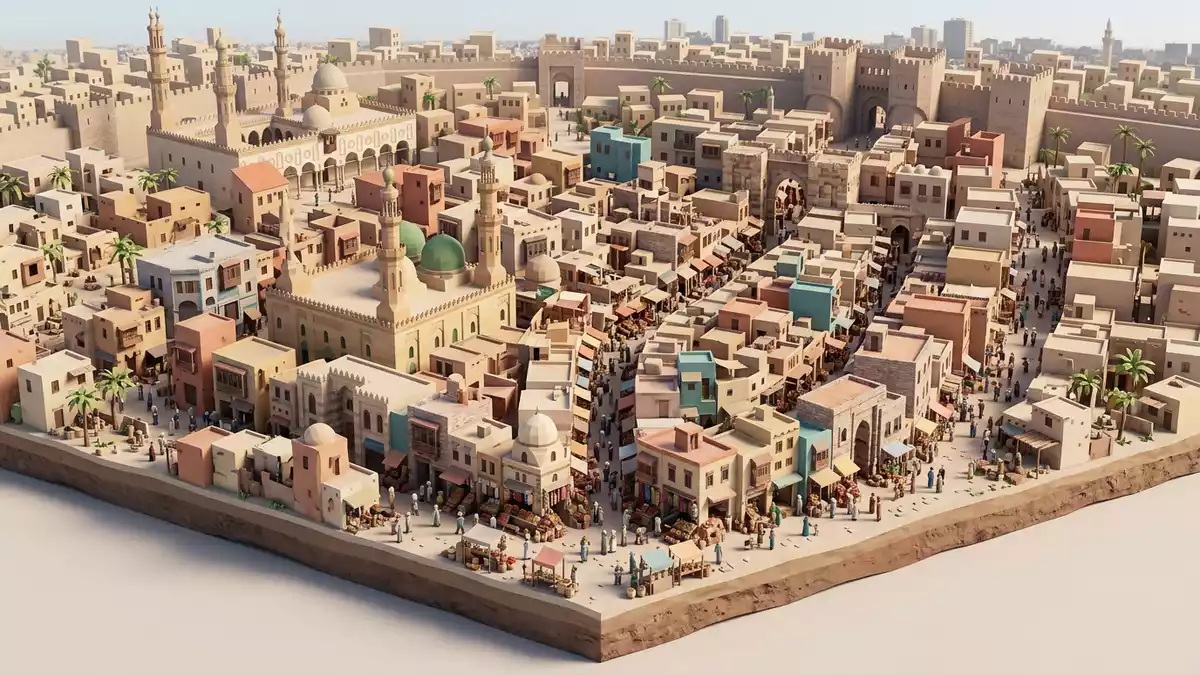
Khan el-Khalili is a bazaar district in historic Kairo, closely tied to the Mamluk period and the city’s Islamic core. Its lanes, gates and shopfronts reflect a market that grew from a caravanserai into a dense urban quarter.
From caravanserai to district
The name is linked to Jaharkas al-Khalili, a Mamluk official under Sultan Barquq. The first khan here was established between 1382 and 1389, and the district later expanded beyond that original building.Khan el-Khalili
That origin matters because the place still reads as a commercial fabric rather than a single monument. Shops, alleys and courtyards sit close together, while the older Mamluk grain remains visible in the street pattern and in surviving structures.historic market
Stone gates and a layered market fabric
The district contains stone gates and commercial buildings from the early sixteenth century, when Sultan al-Ghuri reshaped parts of the area. The surviving ensemble includes the Bab al-Ghuri gate and the Wikala al-Qutn façade, both strong reminders that the bazaar is more than a line of shops.Bab al-Ghuri
Khan el-Khalili also belongs to the wider historic centre of Kairo, near al-Hussein and al-Azhar. That setting places it inside a larger Islamic urban landscape of mosques, markets and streets that developed over centuries.al-Hussein area
Craft, trade and everyday life
Today the district is known for traditional crafts, goldwork, souvenirs and coffeehouses. Workshops and retail spaces share the same tight urban fabric, so the commercial life remains easy to read in the built form.
The setting is shaped by narrow lanes, older masonry fronts and a mix of small-scale shop units. That combination gives the quarter a more layered look than a single-purpose shopping street.
Visiting Khan el-Khalili: what travellers from Western Europe should know
- The bazaar lies in Al Hussein, in the historic centre of Kairo. It is reached through the Islamic Cairo street network, with al-Azhar and al-Muizz forming familiar reference points.
- The terrain is urban rather than rugged, but the lanes are narrow and closely packed. Many streets in the district are better understood as a maze of connected passages than as one broad avenue.
- The area sits amid active religious and commercial quarters. Al-Hussein Mosque and al-Azhar Mosque are nearby, so the market belongs to a mixed historic setting rather than a single enclosed complex.
- The district keeps a strong craft character. Goldsmiths, souvenir sellers and workshop spaces remain part of its identity, alongside cafés and small retail units.
Searching for Khan el-Khalili on social platforms
These links open searches for Khan el-Khalili on each platform.
Frequently asked questions about Khan el-Khalili
Where is Khan el-Khalili?
It sits in Al Hussein, in historic Kairo, within the wider Islamic Cairo district. Nearby landmarks include al-Hussein Mosque and al-Azhar Mosque.
What does a visit involve?
The place is a market district of lanes, shops and courtyards rather than a single enclosed site. Expect crafts, jewellery, souvenirs and cafés within a dense historic setting.
What makes it distinctive?
Its character comes from the overlap of Mamluk commercial history, surviving stone gates and a living market function. The district still reads as an urban palimpsest shaped by trade and architecture.


