
Khan el-Khalili: a medieval marketplace woven into Islamic Cairo
Published on 08/28/2026 at 16:31 | Editorial responsibility: Rafael Müller, Editor-in-Chief AD HOC NEWS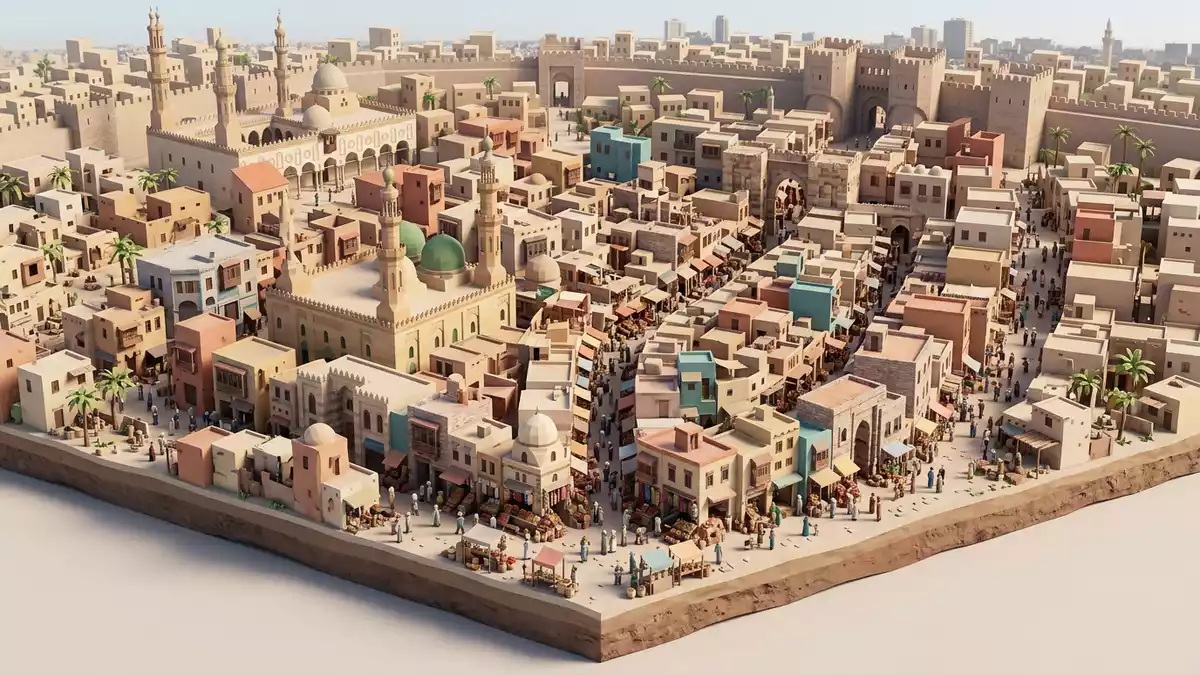
Khan el-Khalili is the historic bazaar quarter of Kairo, a dense marketplace dating back to the late fourteenth century in the heart of Islamic Cairo. Founded under the Mamluk Sultan Barquq by the emir Jaharkas al-Khalili, it grew from a single caravanserai into a whole district of trading lanes and caravan inns.
A bazaar born in the Mamluk era
The story of Khan el-Khalili begins in the Mamluk period, when the ruling elite reshaped the centre of Cairo into a commercial hub. Between 1382 and 1389, the emir Jaharkas al-Khalili established a khan, or caravanserai, here under Sultan Barquq, giving the market its name and setting the pattern for centuries of trade.Established between 1382 and 1389 The bazaar occupies ground that had formed part of the Fatimid palace zone and burial ground, within the older city founded in 969.
What started as one commercial inn evolved into a whole trading district of warehouses, workshops and shopfronts. Mamluk and later Ottoman patrons added gates, covered streets and further caravanserais, creating the labyrinth of lanes visitors see now.Mamluk foundations from 1382 The bazaar’s long history has left a clear imprint in its architecture, which reads as a catalogue of medieval Islamic Cairo.
Architecture and layout of Islamic Cairo’s trading quarter
Khan el-Khalili sits in the historic centre of Cairo’s Islamic quarter, between important religious landmarks such as the Al-Hussein Mosque and the Al-Azhar mosque-university complex.Between Al-Hussein and Al-Azhar The bazaar district spreads through a maze of lanes and passages, some roofed and some open to the sky, with arches spanning between stone buildings and upper levels leaning over the alleys.
The architectural language is that of Mamluk and wider Islamic architecture: carved stone façades, pointed arches, and upper-storey rooms screened by wooden mashrabiya panels.Traditional mashrabiya screens Within the district, caravanserais form inward-facing complexes around courtyards, while market streets carry rows of small shops below warehouses and storerooms. Medieval gateways such as Bab al-Ghuri mark transitions between busier thoroughfares and more intimate alleys, and the narrow streets create constantly shifting views of stone arches, overhanging upper floors and shopfronts.
Trading life and atmosphere in the bazaar
For more than six centuries, Khan el-Khalili has functioned as a trading centre, drawing merchants from Egypt, the wider Middle East, Africa and beyond.A vital trade centre for the Mamluk Empire Goods have long been organised by craft and type, with lanes specialising in jewellery, textiles, brassware, spices or perfumes. Many workshops sit just behind the shopfronts, so that production and sale share the same tight urban fabric.
The bazaar’s scale makes it a self-contained neighbourhood as well as a marketplace, with historic caravanserais providing lodging and storage, and small cafés and restaurants scattered among the shops.A maze of covered and uncovered alleys The mix of long-established craft families, newer traders and nearby religious institutions gives Khan el-Khalili a continuous everyday life that reflects Cairo’s wider history, from the Fatimid era through the Mamluk and Ottoman periods into the present.
Visiting Khan el-Khalili: what travellers from Western Europe should know
- Khan el-Khalili lies in Islamic Cairo, in the El-Gamaleya district north-east of the modern city centre. It is reached by road and local transport along Al-Azhar Street and streets leading to the Al-Hussein Mosque.
- The bazaar district consists of narrow alleys, uneven stone paving and steps between levels, so moving through it involves walking on hard surfaces and negotiating tight corners.
- Nearby landmarks include the Al-Hussein Mosque and Al-Azhar mosque-university complex, whose minarets and domes are visible from many points within the market quarter.
- The official language is Arabic and the currency is the Egyptian pound.
- Entry requirements depend on your nationality; UK travellers can check the FCDO travel advice at gov.uk/foreign-travel-advice, Irish travellers the Department of Foreign Affairs at ireland.ie.
Searching for Khan el-Khalili on social platforms
These links open searches for Khan el-Khalili on each platform.
Frequently asked questions about Khan el-Khalili
Where is Khan el-Khalili in Kairo?
Khan el-Khalili is in Islamic Cairo, within the El-Gamaleya district, between Al-Azhar Street and the Al-Hussein Mosque in the historic city centre.
What should visitors expect on a visit?
Visitors encounter a dense network of medieval alleys lined with shops, workshops, caravanserais and small cafés, with strong Islamic architectural elements and a wide range of goods.
What makes Khan el-Khalili distinctive among Cairo’s markets?
Its origins in the fourteenth century Mamluk era, its surviving medieval architecture and its position between major mosques give it a historic character that few other Cairo markets share.


