
Kawah Ijen’s acid lake and blue fire above Banyuwangi
Published on 09/21/2026 at 07:26 | Editorial responsibility: Rafael Müller, Editor-in-Chief AD HOC NEWS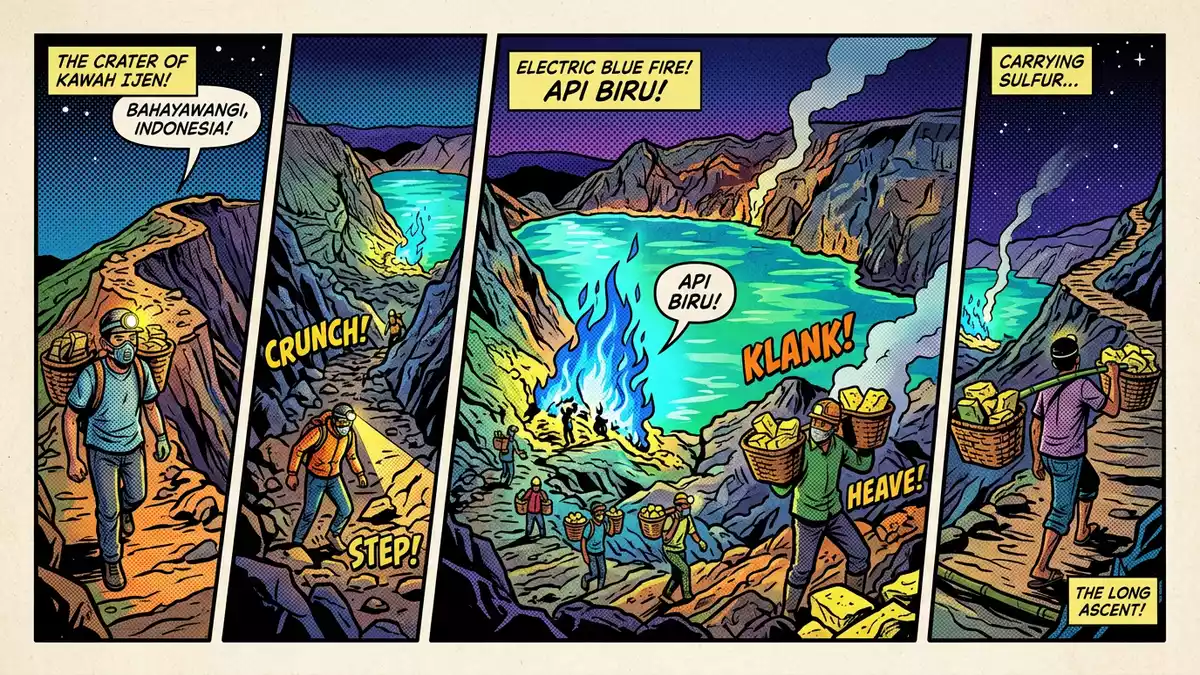
Kawah Ijen in East Java is a volcanic crater where a turquoise acidic lake, sulphur vents and human labour share the same steep basin above Banyuwangi. Rising within the wider Ijen volcano complex, it has become known for a combination of extreme geology and night-time blue flames that is rare on any active volcano.
An acid crater lake on the Ijen Plateau
Kawah Ijen sits inside the Ijen caldera on the border between Banyuwangi and Bondowoso regencies in East Java, Indonesia, forming the active crater of a broader volcanic system on the Ijen Plateau.Ijen volcano complex The crater hosts a strongly acidic lake, coloured an intense turquoise by dissolved minerals and suspended particles in the water.world's largest highly acidic crater lake Measurements have placed the lake’s acidity around pH 0.5, making it one of the most extreme natural acid bodies associated with an active volcano.turquoise-coloured acidic crater lake
The crater itself has been described with a diameter in the range of 700 to 1,000 m, enclosing the lake and a field of fumaroles where volcanic gases reach the surface.intracaldera cone with acid lake Kawah Ijen forms part of the Pacific Ring of Fire, the seismically active belt that runs through Indonesia, and stands as one of more than a hundred active volcanoes across the archipelago.active volcano in Indonesia Its elevation has been given around 2,799 m (9,183 ft) above sea level in several descriptions, placing the crater rim high above the coastal lowlands of Banyuwangi.2,799m active stratovolcano
Blue fire and sulphur at night
One of Kawah Ijen’s most striking features is a blue glow that appears along the fumarole field and down rocky channels in the dark, widely known on site as “blue fire”.blue fire burning sulfur The effect is produced when sulfur-rich gases emerge from vents at temperatures that can reach about 600°C (1,112°F) and ignite on contact with the air, burning with an electric-blue flame.blue fire up to 600°C Some of the sulfur condenses into a molten liquid that runs downslope while still alight, creating the impression of glowing blue streams against the dark crater floor.
Alongside the flames, Kawah Ijen is known for labour-intensive sulphur mining carried out inside the crater basin.sulphur miners in Banyuwangi Miners tap the volcanic gas through pipes, where it cools and deposits elemental sulphur that is then broken into blocks and carried out of the crater. Reports describe several hundred miners working in this environment, loading sulphur into baskets for transport up to the rim and down to collection points on the plateau. The juxtaposition of industrial work, acid lake and active fumes makes Kawah Ijen a rare example of manual mining continuing inside the active part of a modern volcano.large warm acidic crater lake and sulphur mine
Approaching Kawah Ijen from Banyuwangi
Kawah Ijen lies inland from Banyuwangi on Java’s far eastern coast, in a mountainous area reached from the town by road towards the Ijen Plateau.trips start from Banyuwangi Access routes usually lead to a trailhead on the plateau from which the main path climbs to the crater rim. The ascent covers several kilometres and gains significant height, and travellers encounter volcanic ash, gravel and compacted earth underfoot as the path winds upward.
From the rim, a further descent leads into the crater itself, down steep, rocky ground towards the lake shore and the sulphur vents.hyperacidic turquoise lake The terrain inside the basin is uneven, with loose stones and areas of bare rock, and the combination of gradient and altitude can make movement demanding. Kawah Ijen’s position within the volcanic ranges of East Java means that, in clear conditions, views from the rim reach across the surrounding peaks and forests as well as down into the turquoise water and yellow sulphur deposits. The official language in this part of Indonesia is Indonesian and the currency is the Indonesian rupiah.
Visiting Kawah Ijen: what travellers from Western Europe should know
- Kawah Ijen rises on the Ijen Plateau inland from Banyuwangi in East Java, Indonesia, reached by road from the coastal town towards the mountain trailheads.
- The climb from the trailhead to the crater rim runs over a sustained gradient on ash and gravel paths, followed by a steep descent on rocky ground into the crater basin.
- The crater rim stands at high altitude compared with the coastal plain, so the approach involves a noticeable elevation gain and prolonged walking on uneven volcanic terrain.
- The official language is Indonesian and the currency is the Indonesian rupiah.
- Entry requirements depend on your nationality; UK travellers can check the FCDO travel advice at gov.uk/foreign-travel-advice, Irish travellers the Department of Foreign Affairs at ireland.ie.
Searching for Kawah Ijen on social platforms
These links open searches for Kawah Ijen on each platform.
Frequently asked questions about Kawah Ijen
Where is Kawah Ijen located?
Kawah Ijen is an active volcanic crater within the Ijen volcano complex on the border of Banyuwangi and Bondowoso regencies in East Java, Indonesia.
What can travellers expect on a visit to Kawah Ijen?
Travellers encounter a steep mountain path to the crater rim, the turquoise acidic lake, sulphur vents and, in darkness, the blue flames along the fumarole field.
What makes Kawah Ijen distinctive among volcanoes?
Kawah Ijen combines one of the most acidic crater lakes documented on a volcano with visible blue combustion of sulfur gases and ongoing manual sulphur mining inside the crater.


