
Kawah Ijen’s turquoise crater and sulphur miners in Banyuwangi
Published on 09/03/2026 at 18:15 | Editorial responsibility: Rafael Müller, Editor-in-Chief AD HOC NEWS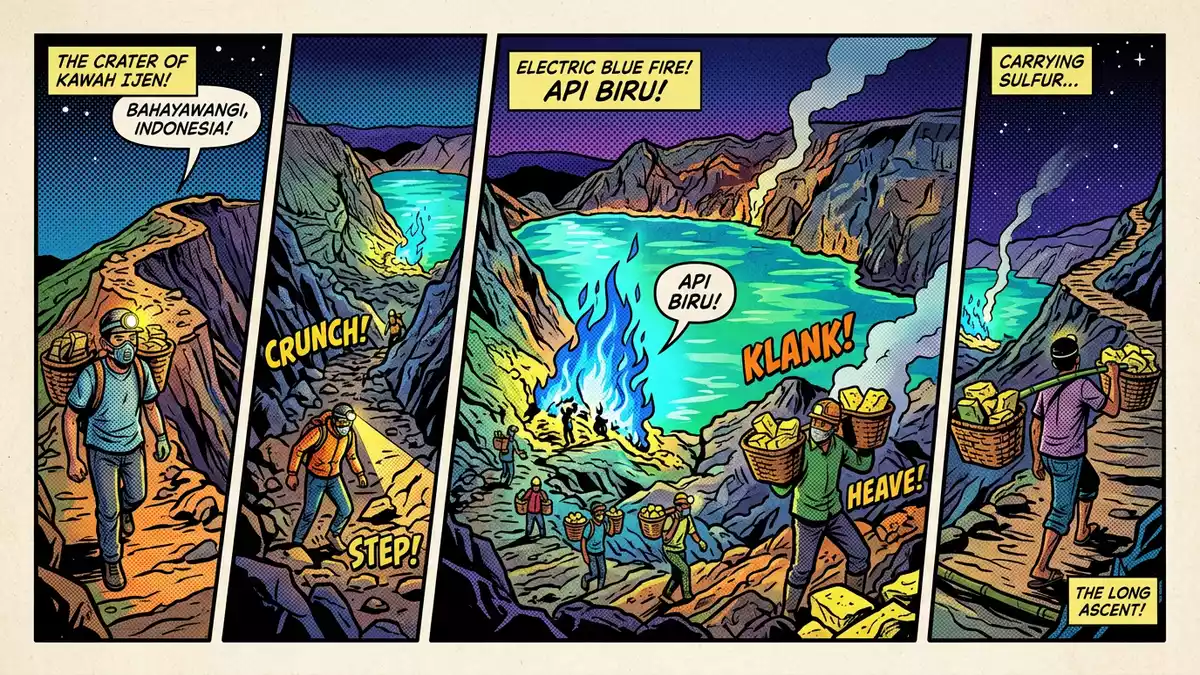
Kawah Ijen in Banyuwangi, East Java, is a volcanic crater where a vivid turquoise acidic lake and hard manual sulphur mining share the same steep basin on the Ijen Plateau. The crater forms part of the wider Ijen volcano complex on the border between Banyuwangi and Bondowoso regencies in Indonesia, with Kawah Ijen as the active crater that draws geologists, hikers and photographers alikeIjen volcano complex. Its combination of colour, chemistry and human labour makes this one of East Java’s most striking volcanic sites.
The volcanic crater and its acidic lake
Kawah Ijen sits within the Ijen Plateau, an area described as a large active crater landscape dominated by several volcanic summits, including Ijen itself at around 2,368 m (7,769 ft) above sea levelIjen Plateau and summit elevations. The active Kawah Ijen crater has a diameter given as 722 m (2,369 ft), containing a striking turquoise lake whose waters are strongly acidicdiameter of Kawah Ijen crater. The lake’s colour contrasts sharply with the pale rock of the surrounding crater walls and the yellow sulphur deposits near the fumaroles.
Mineralogical descriptions note that the crater lake is highly acidic, with measurements around pH 0.5, making it one of the most extreme natural acid bodies associated with an active volcanoturquoise acidic crater lake. The lake occupies much of the crater floor, so paths and sulphur extraction areas cling to the margins close to active gas vents. Standing on the rim, the view takes in the wide basin, the coloured lake surface and, beyond, the higher volcanoes of East Java rising around the plateau.
Blue fire and sulphur gases
Kawah Ijen is widely associated with an unusual phenomenon known as the “blue fire”, a glow produced when sulphur-rich volcanic gases ignite as they emerge from fumaroles on the crater floorblue fire description. The gases burn with an electric-blue flame that can be seen in darkness, particularly on sections of the crater where man-made pipes channel sulphur vapour from vents to condensate zones. In daylight the same areas show bright yellow sulphur against dark rocks and rising white fumes.
Accounts of the site describe how ceramic or metal pipes have been laid to direct sulphur gases to cooler surfaces where they condense, first as a red liquid and then solidifying into yellow sulphurnetwork of ceramic pipes. Around these installations, the blue flames, dense gas clouds and the acid lake form a compact tableau of volcanic chemistry. The combination of continuous gas emission, condensate sulphur and acid water gives Kawah Ijen a distinctive, highly active character compared with many dormant crater lakes.
Sulphur mining and human labour in the crater
Alongside its geology, Kawah Ijen is known for labour-intensive sulphur mining carried out inside the crater basin. Reports describe several hundred miners working here, with figures around 200 to 400 individuals engaged in extracting elemental sulphur from deposits near the gas pipessulphur miners at Kawah Ijen. Working largely with hand tools, they break cooled sulphur into chunks and load them into baskets suspended from wooden poles.
To transport the sulphur, miners carry loads that accounts describe as typically between 60 kg and 90 kg (132–198 lb), first up the steep inner slopes from the mining area to the crater rim and then down the outer mountain paths toward collection pointstypical sulphur loads. This route involves sharp gradients and uneven volcanic ground. The work has been documented by photographers and journalists as an example of physically demanding manual mining that coexists with tourism at the crater.
Visiting Kawah Ijen: what travellers from Western Europe should know
- Kawah Ijen lies in East Java, with the crater closer to Banyuwangi than Bondowoso; road approaches reach the plateau from both towns along routes that include steep, damaged sectionsroad approaches from Banyuwangi and Bondowoso.
- The ascent from the base area on the outer slope to the crater rim follows a mountain track over volcanic ash and rock; inside the crater, paths down to the lake and mining zone are considerably steeper and more exposedsteep plateau terrain.
- Kawah Ijen stands within the Ijen volcano complex in East Java, Indonesia; the official language is Indonesian and the currency is the Indonesian rupiah.
- Entry requirements depend on your nationality; UK travellers can check the FCDO travel advice at gov.uk/foreign-travel-advice, Irish travellers the Department of Foreign Affairs at ireland.ie.
Searching for Kawah Ijen on social platforms
These links open searches for Kawah Ijen on each platform.
Frequently asked questions about Kawah Ijen
Where is Kawah Ijen located?
Kawah Ijen is an active volcanic crater within the Ijen volcano complex in East Java, Indonesia, lying between Banyuwangi and Bondowoso regencieslocation of Ijen volcano complex.
What should visitors expect on a visit to Kawah Ijen?
Visitors encounter a high-altitude volcanic landscape with a steep approach, a turquoise acidic crater lake, dense sulphur fumes and visible manual sulphur mining activity inside the basin.
What makes Kawah Ijen distinctive compared with other volcanoes?
Kawah Ijen combines a strongly acidic turquoise crater lake, visible blue sulphur flames in darkness and intensive hand-worked sulphur mining, all concentrated within a single active crater.


