
Jiuzhaigou: colour and water in a high Sichuan valley
Published on 09/15/2026 at 14:14 | Editorial responsibility: Rafael Müller, Editor-in-Chief AD HOC NEWS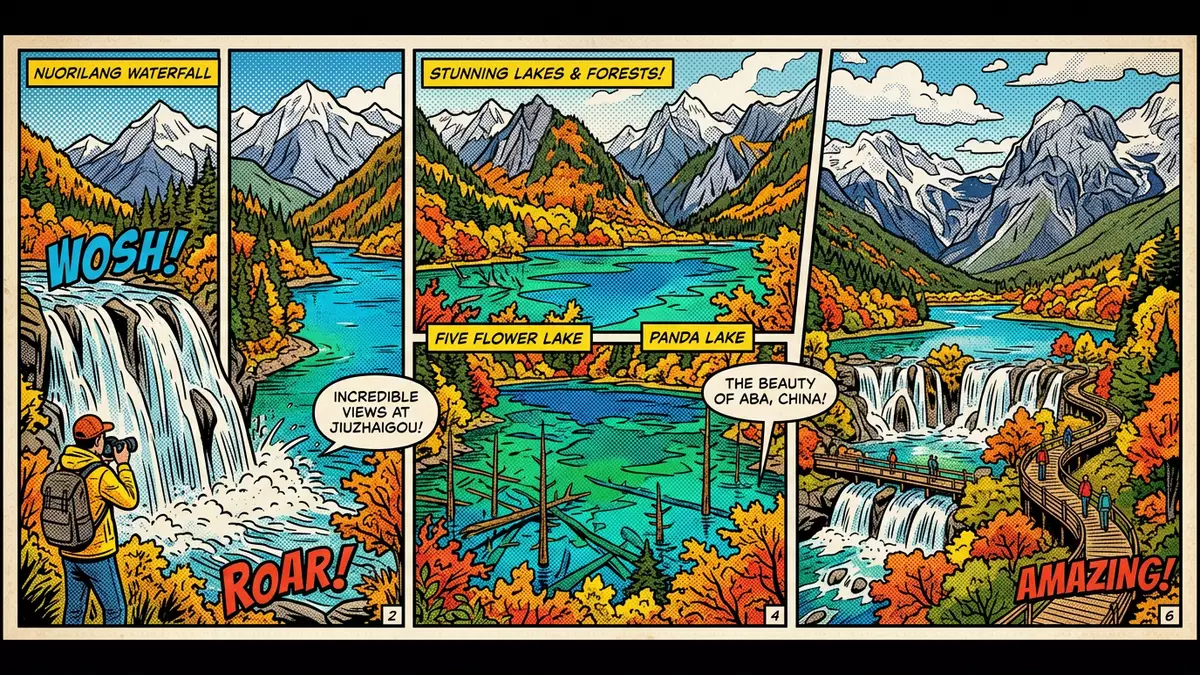
Jiuzhaigou in Aba, northern Sichuan, is a high mountain valley where clear lakes, waterfalls and forested slopes form a protected landscape shaped by mineral-rich water and limestone. Set in the Min Shan Mountains of south-western China, it is officially recognised as the Jiuzhaigou Valley Scenic and Historic Interest Area and has held UNESCO World Heritage status since 1992, reflecting both its geological character and scenic quality.Jiuzhaigou Valley Scenic and Historic Interest Area
A long, branching valley in the Min Shan range
Jiuzhaigou lies in Jiuzhaigou County within the Aba Tibetan and Qiang Autonomous Prefecture in northern Sichuan Province, on the southern slopes of the Min Shan Mountains in west-central China.southern Min Shan Mountains The protected area extends across tens of thousands of hectares of steep terrain, with the main valley running broadly north–south and several side valleys forming a branching basin.
Elevations in Jiuzhaigou range from around 2,000 m to more than 4,700 m (6,562–15,420 ft), a height span that brings montane forest, subalpine slopes and higher peaks into a single scenery.elevations between about 2,000 m and more than 4,700 m Streams gather on the surrounding slopes and descend through narrow corridors, feeding lakes and waterfalls on the valley floor before joining larger rivers beyond the reserve.
Mineral-rich lakes, travertine terraces and waterfalls
The central experience in Jiuzhaigou is the way water, mineral deposits and forest interact, producing lakes and pools that hold strong colours against pale rock. Waters in the valley carry dissolved carbonates that, over long periods, have been deposited as travertine, a soft, porous limestone that hardens when exposed to the air.travertine terraces and dams As these deposits build, they form natural dams across channels, creating stepped basins that hold still water in series along parts of the valley.
Many of Jiuzhaigou’s lakes are described as clear and strongly coloured, with blues and greens reflecting a combination of depth, dissolved minerals and submerged wood, while the travertine structures around them appear pale or creamy in contrast.colourful pools surrounded by diverse forests In places the water spills over broad lips of rock, forming wide waterfalls that hang as curtains across slopes and are framed by dense forest rising towards higher peaks.multi-level waterfalls and coloured lakes
Protection, status and human presence
Jiuzhaigou was designated as a nature reserve in the late twentieth century and later recognised as a national park, before being inscribed on the UNESCO World Heritage List in 1992 under a natural criterion emphasising its lakes, waterfalls and limestone formations.inscribed on the World Heritage List in 1992 In 1997 it entered the UNESCO Man and the Biosphere Programme as a biosphere reserve, extending the protected area and recognising interactions between natural processes and local communities.recognised as a Biosphere Reserve in 1997
The name Jiuzhaigou refers to “Nine Village Valley”, reflecting settlements in and around the area, many of them linked with Tibetan culture and the broader Aba Tibetan and Qiang Autonomous Prefecture.nature reserve and national park in northern Sichuan Forests in the valley provide habitat for a range of species, including birds and mammals associated with the Min Shan range, and the protected status aims to maintain these ecosystems alongside controlled access to lake shores, viewing platforms and paths.
Visiting Jiuzhaigou: what travellers from Western Europe should know
- Jiuzhaigou lies in Jiuzhaigou County in the Aba Tibetan and Qiang Autonomous Prefecture of northern Sichuan, reached overland from larger cities in south-western China and served by roads into the valley.
- The terrain in the scenic area is mountainous, with significant altitude, long stretches on foot along valley floors and slopes, and sections of steps or boardwalks around lakes and waterfalls.
- Forest, water and altitude bring marked seasonal differences; higher sections of the valley can experience cold conditions outside the warmest months, and weather can change during a single day.
- The official language is Chinese and the currency is the renminbi (yuan).
- Entry requirements depend on your nationality; UK travellers can check the FCDO travel advice at gov.uk/foreign-travel-advice, Irish travellers the Department of Foreign Affairs at ireland.ie.
Searching for Jiuzhaigou on social platforms
These links open searches for Jiuzhaigou on each platform.
Frequently asked questions about Jiuzhaigou
Where is Jiuzhaigou?
Jiuzhaigou is a mountain valley in Jiuzhaigou County within the Aba Tibetan and Qiang Autonomous Prefecture of northern Sichuan Province in south-western China, on the southern slopes of the Min Shan range.located in Aba Tibetan and Qiang Autonomous Prefecture
What can visitors expect on a visit?
Visitors encounter a protected landscape where mineral-rich lakes, waterfalls, travertine terraces and forested slopes are accessible along paths and viewing points, with significant altitude and seasonal variation in weather and vegetation.
What makes Jiuzhaigou distinctive?
Jiuzhaigou is distinctive for the combination of clear, strongly coloured lakes, wide waterfalls and travertine formations set within a high mountain valley that has held UNESCO World Heritage status since 1992 and Biosphere Reserve recognition since 1997.World Heritage Site in 1992 and Biosphere Reserve in 1997


