

Jiuzhaigou: colour, water and forest in a high Sichuan valley
Published on 08/21/2026 at 18:42 | Editorial responsibility: Rafael Müller, Editor-in-Chief AD HOC NEWS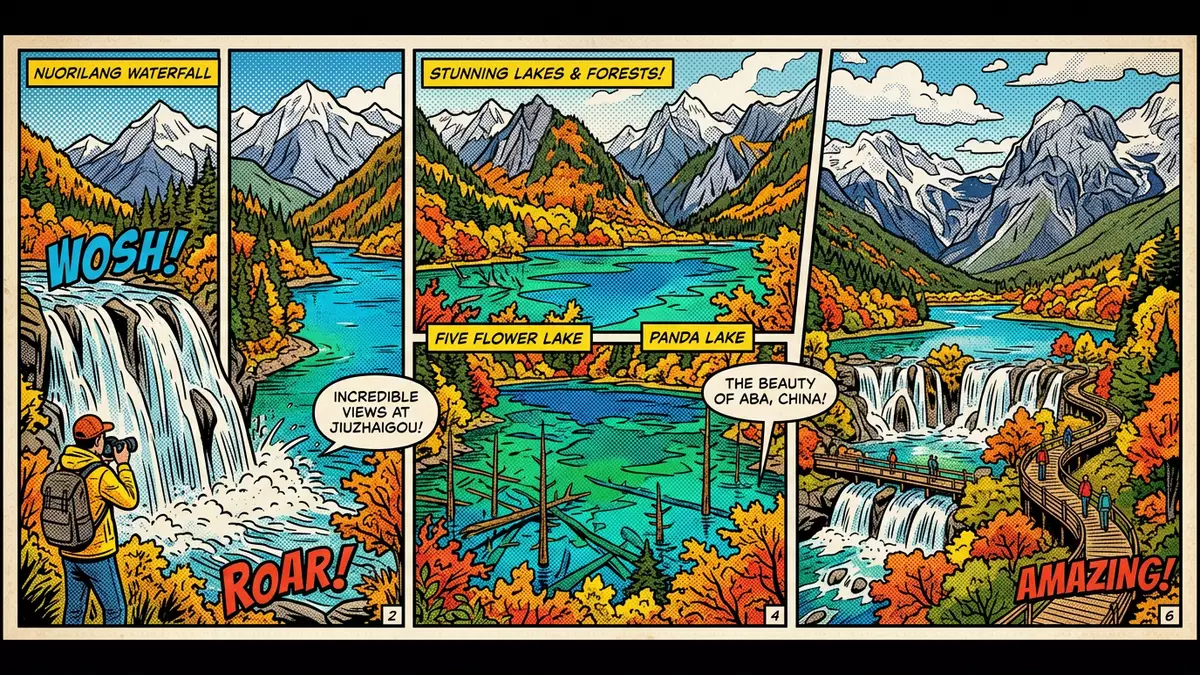
Jiuzhaigou in Aba, northern Sichuan, is a high mountain valley where clear lakes, waterfalls and forest sit together in a protected landscape shaped by travertine terraces. Inscribed as a World Heritage Site in 1992 and recognised as a biosphere reserve in 1997, it is one of China’s best known nature reserves in the Min Mountains.
A valley defined by water and travertine
Jiuzhaigou is a long valley in the Min Mountains of north-west Sichuan, running roughly north–south through Jiuzhaigou County in the Aba Tibetan and Qiang Autonomous Prefecture.Jiuzhaigou County in Aba The reserve lies on the northern side of the Sichuan Basin, close to the border with Gansu, and forms part of a karst landscape shaped by glacial, hydrological and tectonic movement.high altitude karst landforms
The terrain is steep and forested, with elevations between about 2,000 m and more than 4,700 m (6,562–15,420 ft).elevation 1,990 to 4,764 metres Streams in the valley carry carbonate-rich water that deposits travertine, a soft, porous limestone that hardens when exposed to the air.waters high in carbonates and travertine As the water moves downslope, travertine forms natural dams across the valley floor, impounding lakes and creating multi-level waterfalls and terraces.
Three branching valleys and high mountain lakes
The main scenic area of Jiuzhaigou is formed by three valleys arranged in a “Y” shape: Shuzheng Valley, Rize Valley and Zechawa Valley, whose combined length is around 50 km (31 mi).three valleys in a Y shape Shuzheng Valley forms the lower stem of the “Y” and carries many of the better-known lakes and smaller waterfalls, while Rize and Zechawa branch off into higher ground lined with forest and alpine pools.
Across these valleys, lakes often appear in linear chains, separated by travertine dams that sit at relatively regular intervals along the valley floor.lakes in a linear chain The water in these lakes is strikingly clear, with visibility measured at around 12 m (39 ft) in some, so that fallen trees and submerged features remain visible and are preserved by travertine deposits.average 12 metres visibility Mineral content, depth and forest reflections produce a range of blues and greens across their surfaces.
UNESCO protection and forest landscape
Jiuzhaigou was protected as a nature reserve in the late 1970s and later designated a national park, before gaining World Heritage status in 1992 for its exceptional water bodies and scenery.national park designation and 1992 inscription In 1997 it was added to the World Biosphere Reserve Network, recognising the combination of natural processes and cultural presence in the valley.World Heritage Site and Biosphere Reserve
The wider reserve covers tens of thousands of hectares of forest and alpine terrain in the Min Mountains.extent of 72,000 ha Coniferous forest dominates the slopes, interspersed with mixed woodland and high meadows, while snow-capped summits rise above the valleys.jagged alpine mountains and coniferous forest The name Jiuzhaigou refers to nine Tibetan villages in and around the valley, and the landscape carries traces of this long-standing human presence alongside its ecological protection.nine Tibetan villages
Visiting Jiuzhaigou: what travellers from Western Europe should know
- Jiuzhaigou lies in Jiuzhaigou County in the Aba Tibetan and Qiang Autonomous Prefecture of Sichuan, in the north of the province, with access routes converging on the park entrance in Zhangzha Town.
- Within the valley, paths and walkways cross uneven travertine terraces and forested slopes, and some viewpoints are reached by stairways that climb several hundred steps.
- The reserve sits at elevations from around 2,000 m into high mountain terrain, so approaches and internal routes involve altitude and correspondingly cooler mountain conditions.
- Jiuzhaigou forms part of a wider mountain belt between the Sichuan Basin and the Qinghai–Tibet Plateau, with other high valleys and peaks visible from some sections of the park.
- The official language is Chinese and the currency is the renminbi.
Searching for Jiuzhaigou on social platforms
These links open searches for Jiuzhaigou on each platform.
Frequently asked questions about Jiuzhaigou
Where is Jiuzhaigou?
Jiuzhaigou is a nature reserve and national park in Jiuzhaigou County, part of the Aba Tibetan and Qiang Autonomous Prefecture in northern Sichuan, China.
What should visitors expect on a visit?
Visitors encounter a high mountain valley with clear lakes in chains, travertine terraces, waterfalls, forested slopes and designated walking routes at elevations above 2,000 m.
What makes Jiuzhaigou distinctive among mountain valleys?
Its lakes, waterfalls and terraces are shaped by carbonate-rich water depositing travertine, creating clear, coloured pools and multi-level cascades that contributed to its UNESCO World Heritage listing.


