
Isletas de Granada, Nicaragua’s volcanic lake archipelago
Published on 09/16/2026 at 14:51 | Editorial responsibility: Rafael Müller, Editor-in-Chief AD HOC NEWS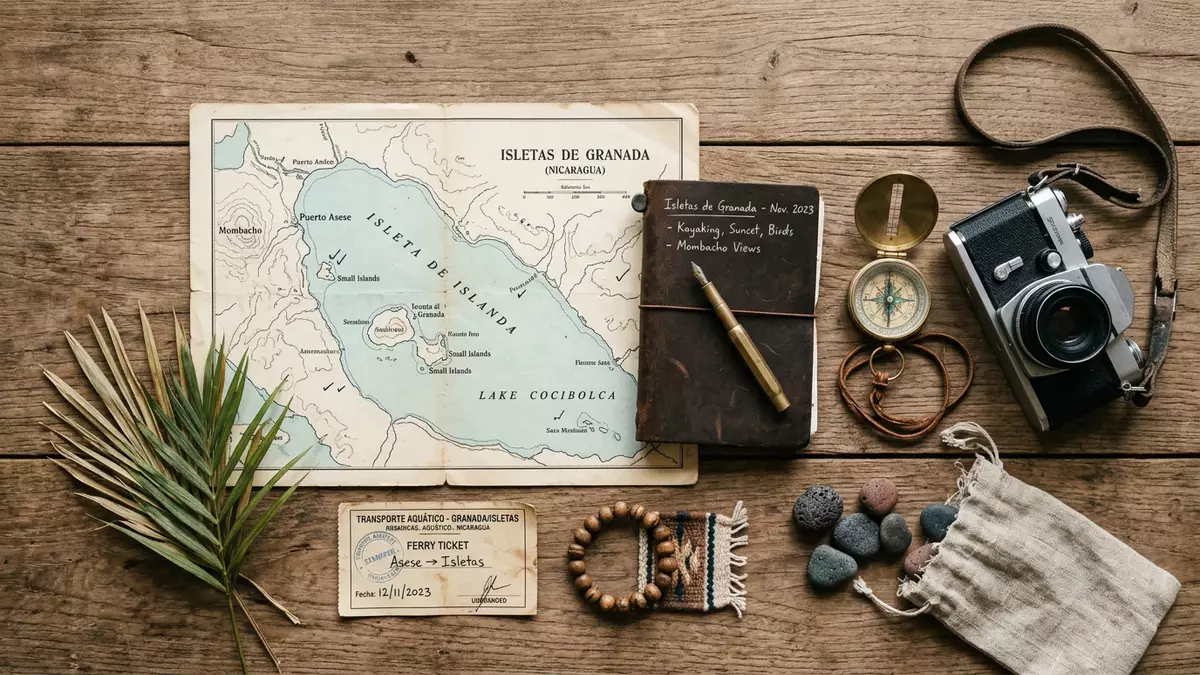
Just southeast of Granada in western Nicaragua, the Isletas de Granada scatter across the surface of Lake Nicaragua as a low-lying archipelago of small islands born from volcanic force in the distant past. With the bulk of Mombacho volcano rising on the lakeshore and the colonial city behind, this cluster of lake islets forms one of Central America’s most distinctive combinations of landscape and human settlement.
A volcanic archipelago beside a colonial city
The Isletas de Granada are a group of small islands in Lake Nicaragua, lying just offshore from the city of Granada and clustered around the Asese peninsula on the lake’s western side.group of small islands The archipelago is of volcanic origin: thousands of years ago nearby Mombacho volcano lost part of its cone, sending rock and earth into Lake Nicaragua and leaving hundreds of fragments protruding above the water.Mombacho volcano blew its cone In local description there is a traditional figure of 365 islands, echoing the days of the year, and many accounts repeat this number as a way of grasping the scale of the archipelago.traditional figure of 365
From the lakeshore near Granada the islets appear as a fringe of green shapes lying low in the water, stretching away from the city towards the open expanse of Lake Nicaragua with Mombacho’s forested slopes behind them.fringe of green shapes The contrast between the lake, the islands and the volcano gives Isletas de Granada a layered setting: freshwater, volcanic rock and colonial architecture share the same horizon, with simple docks and boat routes linking the city to the archipelago.
Shapes, sizes and life on the lake islands
The islands of Isletas de Granada vary in size from pieces of land that barely rise above the water to larger patches that hold houses, trees and small communities.range in size Many are covered by lush vegetation, with overhanging branches and plants meeting the lake surface, and some are edged by floating growth such as water lilies that collect along the shallows.lush vegetation and floating plants The volcanic origin means much of the exposed rock is basalt, and the low elevation of the islands keeps them close to the waterline, so that boats skimming between them move in a narrow band between land and lake.
Human presence on Isletas de Granada takes different forms. Some islands are home to local fishermen and farmers who live on the lake and use its waters for transport and livelihood.home to fishermen and farmers Others are privately owned, carrying houses or holiday properties that look out across the water towards Granada, the Asese peninsula or the more distant shorelines of Lake Nicaragua. Between them lie uninhabited patches of land covered by trees and shrubs, giving passing boats alternating views of built structures and dense greenery as they move among the islands.
Water routes, wildlife and ways of exploring
Isletas de Granada is reached from Granada by travelling down to the lakeside, where docks and small harbours provide starting points for boat trips into the archipelago.boats that tour the islands Public and private boats move along narrow channels between the islands, following routes towards Puerto Asese and other lakeside access points or looping around clusters of islets near the city.routes towards Asese harbour Kayak excursions also operate in the area, taking advantage of the sheltered water among the islands and giving a slower way to move through the archipelago’s channels.kayak across Lake Nicaragua
The lakeside environment supports varied birdlife, and guides often highlight species that inhabit the vegetation, the shallows and the open water around Isletas de Granada.great birdwatching by boat Boat routes pass stands of trees, low rocky points and small jetties, offering changing perspectives on the way human use of the islands and the natural setting sit alongside one another. From some stretches of water the view back towards Granada takes in church towers and tiled roofs, reminding visitors that this lake landscape lies only a short distance from a long-established urban centre.
Visiting Isletas de Granada: what travellers from Western Europe should know
- The Isletas de Granada lie just southeast of Granada on the western shore of Lake Nicaragua, reached from the city by travelling to lakeside docks such as the Granada Tourist Centre, Cabaña Amarilla or Puerto Asese and then continuing by boat on the lake.
- Exploring the archipelago involves time on the water, usually in small motorboats or kayaks, with boarding from simple docks and ramps and movement through narrow channels between low-lying islands.
- The terrain on the islands themselves varies from simple jetties and garden-like plots to more rustic landings; stepping ashore often means walking on uneven ground, with tree roots, stones and occasional simple paths close to the water.
- Isletas de Granada sits in Nicaragua, where the official language is Spanish and the currency is the córdoba.
- Entry requirements depend on your nationality; UK travellers can check the FCDO travel advice at gov.uk/foreign-travel-advice, Irish travellers the Department of Foreign Affairs at ireland.ie.
Searching for Isletas de Granada on social platforms
These links open searches for Isletas de Granada on each platform.
Frequently asked questions about Isletas de Granada
Where are the Isletas de Granada located?
The Isletas de Granada are in Lake Nicaragua, just southeast of the city of Granada in western Nicaragua, clustered around the Asese peninsula.
What can visitors expect on a visit to Isletas de Granada?
Visitors can expect boat or kayak trips among small volcanic islands, views towards Mombacho and Granada, and a mix of vegetation, lake scenery and inhabited islets.
What makes Isletas de Granada distinctive among lake landscapes?
The combination of hundreds of volcanic islands, the presence of Mombacho volcano, varied birdlife and the proximity of a long-established colonial city gives Isletas de Granada a particular character.


