
Isla del Sol, Lake Titicaca’s sacred ridge above Copacabana
Published on 09/08/2026 at 19:09 | Editorial responsibility: Rafael Müller, Editor-in-Chief AD HOC NEWS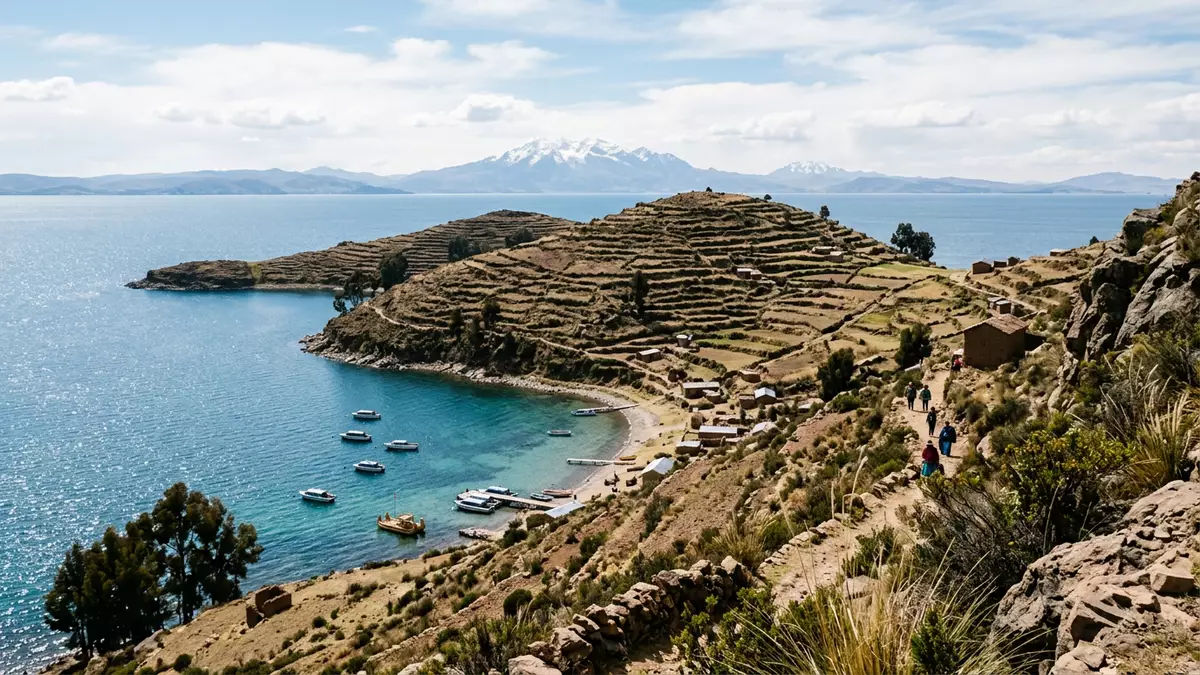
Isla del Sol lifts out of Lake Titicaca off Copacabana in Bolivia as a long, rocky ridge where lake views, terraced slopes and ancient ruins share the same narrow spine. Set within the La Paz Department in the municipality of Copacabana, the island has been a sacred landscape for millennia, and its paths still thread past sites tied to Inca origin legends and earlier Andean cultures.
A high-altitude island shaped by lake and ridge
Isla del Sol lies in the Bolivian sector of Lake Titicaca, in the southern part of the lake a short ferry crossing from the Copacabana peninsula. The island forms part of the Manco Kapac Province and sits within the wider Altiplano, a high plateau of the central Andes where Lake Titicaca stretches between Bolivia and Peru.Bolivian sector of Lake Titicaca At this elevation the water and surrounding slopes share a stark clarity, and the island rises from the lake as a pronounced ridge rather than a low-lying shore.
The landmass itself covers close to 14 km², with the ridge running roughly north–south and dropping in steep terraces towards the lake.rugged terrain and terraces Much of the surface is rocky and hilly, and agricultural terraces step down the slopes, recording centuries of cultivation. Eucalyptus stands and patches of local vegetation line the paths, giving the island a distinctive combination of stone, cropland and scattered trees above the waterline.
Layers of Andean belief and Inca power
The name Isla del Sol, Spanish for “Island of the Sun”, points directly to the island’s long-standing association with solar deities and Andean origin stories. In Inca lore, figures such as Manco Cápac and Mama Ocllo were linked with a temple of the sun here, where they were said to have been sent forth by the sun god to begin the dynasty that ruled from Cusco.Temple of the Sun and Inca founders This connection helped turn the island into an important ritual landscape within the wider Inca realm.
Archaeological work on Isla del Sol has shown that its religious and settlement role reaches far deeper into the Andean past. Material traces demonstrate human occupation from around 2,200 BCE through the Early, Middle and Upper Formative periods, followed by a strong Tiwanaku presence and, later, the fifteenth-century Inca phase whose ruins are now most visible.continuous human occupation More than eighty ruin sites have been recorded across the island, so walking its crest means passing stones set in place over several thousand years.over 80 ruin sites
Ruins, ridge paths and Aymara villages
Isla del Sol combines this deep-time archaeology with the everyday life of small Aymara communities, which are strung along its ridge and bays. Settlements such as Yumani in the south, Cha’lla towards the centre and Challapampa in the north mark out distinct sections of the island, each with its own access to the lake and its own cluster of fields and pathways.Aymara villages along the ridge Ferries from Copacabana land near these villages, and the island’s main ridge path links them, giving a continuous walking route across the length of the island.ridge path between Yumani and Challapampa
Along this path and its side routes stand a series of well-known ruins. On the northern part of the island, the Chinkana complex forms a dense cluster of rooms and passages built into sandstone, sometimes described as a labyrinth.Chinkana sandstone complex Nearby, the Sacred Rock holds particular mythological weight, while on the shore another site, Pillkukayna, preserves an Inca-period palace with stone galleries and windows overlooking the lake.Pillkukayna archaeological site On the southern side, stepped approaches and pre-Columbian fountains at Yumani tie water, movement and ritual together within the island’s topography.
Visiting Isla del Sol: what travellers from Western Europe should know
- Isla del Sol lies off the Bolivian shore of Lake Titicaca and is reached by boat services from the town of Copacabana on the Manco Kapac Peninsula.
- The terrain is steep and stepped, with ridge paths and stone stairways linking the lakeside with the upper villages and archaeological sites, so walking involves sustained ascents and descents at high altitude.
- The island forms part of Bolivia, where the official language is Spanish and the currency is the boliviano.
- Entry requirements depend on your nationality; UK travellers can check the FCDO travel advice at gov.uk/foreign-travel-advice, Irish travellers the Department of Foreign Affairs at ireland.ie.
Searching for Isla del Sol on social platforms
These links open searches for Isla del Sol on each platform.
Frequently asked questions about Isla del Sol
Where is Isla del Sol?
Isla del Sol is an island in the Bolivian part of Lake Titicaca, lying off Copacabana in the La Paz Department within the municipality of Copacabana.
What can visitors expect on Isla del Sol?
Visitors encounter a rocky, terraced ridge with small Aymara villages, ridge paths and a concentration of pre-Columbian and Inca-era ruins overlooking the high-altitude lake.
What makes Isla del Sol distinctive among Lake Titicaca’s islands?
The combination of origin legends tied to Andean sun worship, continuous occupation since deep prehistory and accessible archaeological sites along a single island ridge gives Isla del Sol a particularly layered character.


