
Higashi Chaya-gai: Kanazawa’s preserved wooden teahouse streets
Published on 09/16/2026 at 12:28 | Editorial responsibility: Rafael Müller, Editor-in-Chief AD HOC NEWS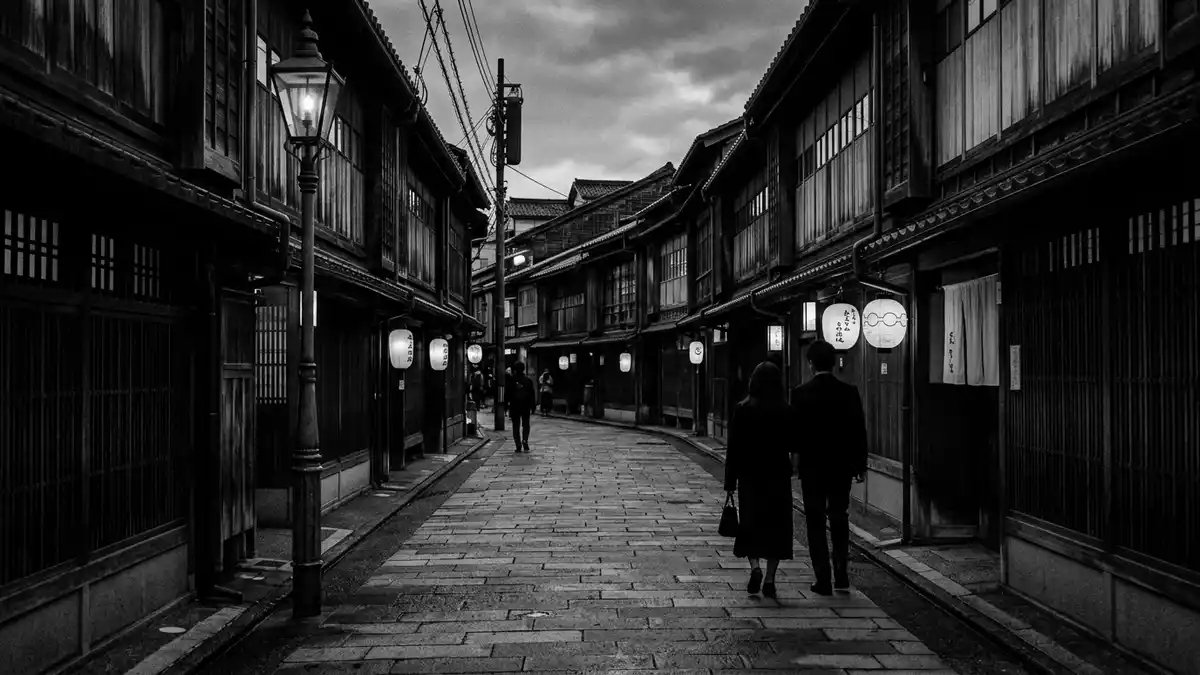
Higashi Chaya-gai in Kanazawa is a historic teahouse quarter where rows of wooden townhouses line narrow lanes on the eastern bank of the Asano River, preserving an Edo-period streetscape within a modern Japanese city.Higashi Chaya-gai in Kanazawa Chartered as an entertainment district in 1820 during the late Edo period, it grew into the largest of Kanazawa’s chaya, or teahouse, quarters where geisha performed for wealthy patrons.Chartered as an entertainment district in 1820
Wooden townhouses and latticework streets
The defining impression of Higashi Chaya-gai is architectural: two-storey wooden townhouses stand shoulder to shoulder along cobbled lanes, their dark timber facades and deep tiled roofs forming a continuous frontage.Two-storied houses with wooden façades These buildings belong to a style known as chaya-kenchiku, or teahouse architecture, in which the ground floor is reserved for preparation spaces and the upper floor for entertainment rooms.A style known as chaya-kenchiku
Along the street, vertical wooden lattice screens called kimusuko cover much of the facades, filtering views between the interior and the lane and giving the quarter its characteristic rhythm of repeating timber panels.Vertical wooden lattice screens called kimusuko Two-storey buildings of this type were a rarity during the Edo period, when most city houses were restricted to a single level, so a street of double-height teahouses formed a distinctive ensemble in Kanazawa.Two story buildings were prohibited during the Edo Period
Geisha entertainment in the Kaga domain
Higashi Chaya-gai took shape as an organised entertainment district in 1820, when the rulers of the Kaga domain, under the Maeda clan, authorised teahouses here and gathered dispersed establishments into three named quarters: Higashi in the east, Nishi in the west and Kazuemachi along the river.Established in 1820 as an entertainment district The name Higashi Chaya-gai itself means “Eastern Teahouse District”, reflecting both its position east of the old castle area and its role in Kanazawa’s entertainment culture during the late Edo period.“Eastern Teahouse District”
In these ochaya, or teahouses, geisha known locally as geigi hosted private banquets for merchants and local elites, performing traditional music and dance in upper-floor rooms linked by sliding panels.Geigi performed traditional arts The district’s layout, with a compact grid of lanes extending between the Asano River and the hillside behind Higashiyama, dates from its founding in 1820 and still frames the sequence of streets and alleys visitors walk through.
Preservation, museums and daily life
The streetscape of Higashi Chaya-gai is protected as an Important Preservation District for Groups of Traditional Buildings, a national designation that anchors the quarter’s timber architecture in law.Important Preservation District for Groups of Traditional Buildings This status, granted in the early twenty-first century, keeps facades largely unchanged from their nineteenth-century proportions, with renovation work required to follow traditional materials and forms.Designated as a National Important Preservation District
Within this framework, the buildings of Higashi Chaya-gai have taken on varied roles: some operate as teahouses, others as restaurants, craft shops and museums, including the preserved geisha house Ochaya Shima with its intact entertainment rooms.Ochaya Shima geisha house museum Two cobbled streets form the core of the district, with side lanes leading towards the river and the slopes of Higashiyama, so a walk through the quarter offers both the formal frontage of teahouse architecture and glimpses of the surrounding residential neighbourhood.Two cobbled streets including Nibancho-dori
Visiting Higashi Chaya-gai: what travellers from Western Europe should know
- Higashi Chaya-gai lies on the eastern bank of the Asano River in the Higashiyama area of Kanazawa, reached from the city’s central district by local buses and taxis.
- The quarter consists of narrow cobbled lanes lined with historic wooden townhouses, so walking involves uneven stone surfaces and occasional steps between streets.
- Kanazawa is in Ishikawa Prefecture in central Honshu; the official language is Japanese and the currency is the yen.
- Entry requirements depend on your nationality; UK travellers can check the FCDO travel advice at gov.uk/foreign-travel-advice, Irish travellers the Department of Foreign Affairs at ireland.ie.
Searching for Higashi Chaya-gai on social platforms
These links open searches for Higashi Chaya-gai on each platform.
Frequently asked questions about Higashi Chaya-gai
Where is Higashi Chaya-gai and what kind of place is it?
Higashi Chaya-gai is a historic teahouse quarter in the Higashiyama area of Kanazawa, on the eastern bank of the Asano River, known for its preserved wooden townhouses.
What should visitors expect when walking through the district?
Visitors encounter cobbled lanes lined with two-storey timber teahouses, latticework facades and a compact grid of streets dating from 1820 that frame museums, shops and working ochaya.
What makes Higashi Chaya-gai distinctive among Japanese historic quarters?
Higashi Chaya-gai combines an Edo-period geisha entertainment heritage with a protected streetscape designated as an Important Preservation District, keeping chaya-kenchiku architecture and kimusuko latticework visible in daily use.


