
Higashi Chaya-gai: Kanazawa’s wooden teahouse streets
Published on 09/14/2026 at 13:05 | Editorial responsibility: Rafael Müller, Editor-in-Chief AD HOC NEWS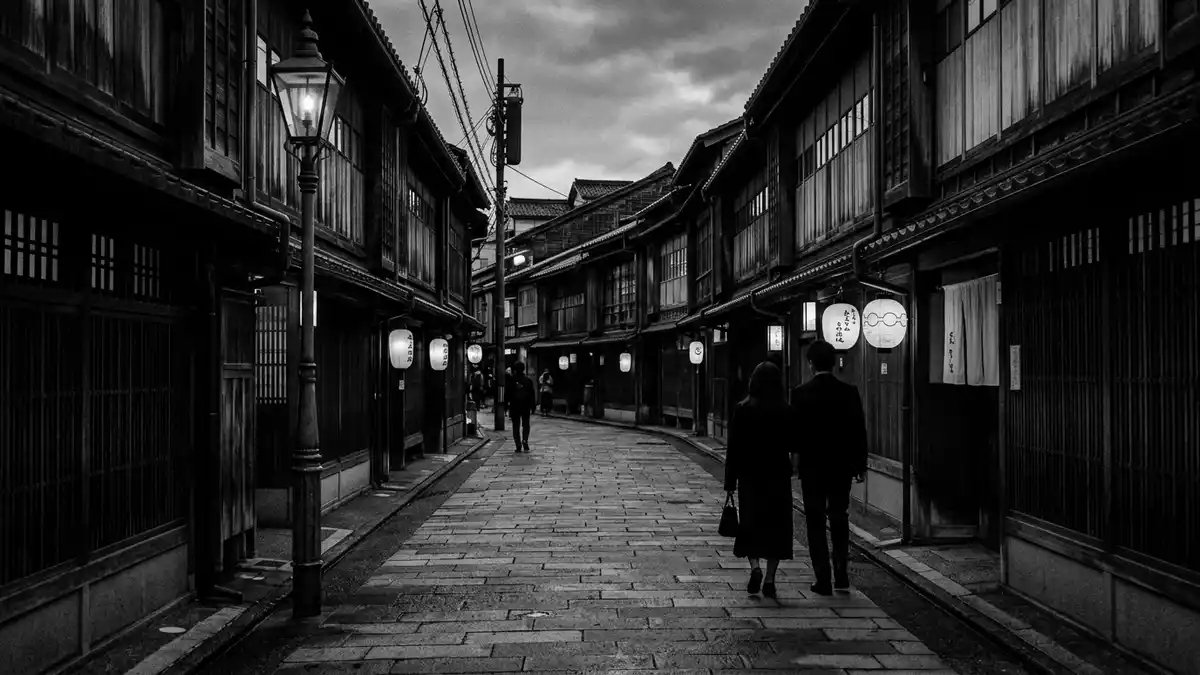
Higashi Chaya-gai in Kanazawa is a traditional teahouse quarter where rows of wooden townhouses line narrow lanes on the eastern bank of the Asano River, preserving an Edo-period streetscape within a modern Japanese city. Established in 1820 as an entertainment district for merchants and local elites during the late Edo period, it remains the largest of Kanazawa’s historic chaya neighbourhoods and a compact window into the townscape of nineteenth-century Japan.
Wooden townhouses and lattice-fronted facades
At street level, Higashi Chaya-gai is defined by its two-storey wooden townhouses, built in the Edo period and early Meiji years, which stand shoulder to shoulder along cobbled lanes. Many of these buildings retain dark cedar cladding and clay tile roofs, and their upper floors look out over the lane behind distinctive wooden lattice screens known as kimusuko. These screens form a repeating pattern along the main streets and were developed to allow occupants to look down to the street while keeping the interior discreet from passers-by.kimusuko lattice fronts The overall effect is a continuous run of timber facades broken only by the entrances of teahouses, shops and small museums.
The district occupies part of the Higashiyama area of Kanazawa and has been formally recognised as an Important Preservation District for Groups of Traditional Buildings, a national designation that protects its historic streetscape.Important Preservation District status Within this protected area, the tight grid of lanes runs roughly north–south and east–west, creating short sightlines where the view is filled almost entirely by traditional wooden fronts. The main street carries most of the larger teahouses, while side alleys branch away between more modest townhouses and smaller shops. Because Kanazawa escaped large-scale bombing in the twentieth century, these rows of buildings survived largely intact and could later be conserved as a single ensemble of historical timber architecture.conserved Edo-period streetscape
A geisha entertainment quarter from the Edo period
Higashi Chaya-gai took shape as an organised entertainment district in 1820, when the rulers of the Kaga domain authorised teahouses here and gathered dispersed establishments into three named quarters: Higashi (eastern), Nishi (western) and Kazuemachi along the river.designation in 1820 by the Maeda clan The name Higashi Chaya-gai itself means “Eastern Teahouse District”, reflecting both its position east of the old castle area and its central role in Kanazawa’s nightlife during the late Edo period. In the teahouses, geisha entertained wealthy patrons with classical music, dance and conversation in tatami-lined rooms tucked behind the screened facades.
Kanazawa grew as the capital of the prosperous Kaga domain under the Maeda clan, whose wealth from rice and other resources supported a lively urban culture of crafts, performance and dining. Higashi Chaya-gai formed part of that culture as a regulated pleasure quarter separated from the business districts and temple zones.entertainment quarter for the Kaga domain capital At its height in the nineteenth century, the eastern district contained many chaya houses spread across a small but densely built area, and performances were booked in advance for private groups. Some teahouses remain in use as licensed venues where geisha appear for pre-arranged banquets, while neighbouring buildings have become restaurants, cafés, crafts workshops and small museums that explain the district’s history.largest of Kanazawa’s three chaya districts
Gold leaf, river light and everyday life
Higashi Chaya-gai stands beside the Asano River, which bends around the eastern side of central Kanazawa and brings reflected light into the district. Short approaches lead from the riverside to the main streets, and from some corners the wooden townhouses can be seen against the open space of the riverbank.location on the eastern bank of the Asano River Beyond the chaya themselves, Higashi Chaya-gai is closely associated with Kanazawa’s gold leaf craft, and several houses are now devoted to gold leaf workshops and shops. In these, visitors can observe decorative techniques or purchase lacquerware, sweets and other pieces finished with thin sheets of gold.
Although Higashi Chaya-gai has a formal preservation status, it remains a lived-in neighbourhood rather than a sealed museum. The upper floors of some townhouses are private homes, and side streets carry small shrines, residential doorways and service alleys alongside the more public teahouse fronts.preserved geisha district with working teahouses The combination of geisha establishments, craft shops and daily routines gives the area a layered character: it is a place where formal entertainment, artisan work and ordinary domestic life all occupy buildings built in the Edo period and maintained within their original timber framework.
Visiting Higashi Chaya-gai: what travellers from Western Europe should know
- Higashi Chaya-gai lies in the Higashiyama area of Kanazawa, on the eastern bank of the Asano River. It can be reached by local bus from Kanazawa Station, with the Hashibacho stop a short walk away.
- The streets are paved and level, but many teahouses and shops use internal staircases between floors. Some historic buildings have relatively narrow passageways and low beams compared with modern construction.
- Kanazawa is in Japan, where the official language is Japanese and the currency is the yen.
- Entry requirements depend on your nationality; UK travellers can check the FCDO travel advice at gov.uk/foreign-travel-advice, Irish travellers the Department of Foreign Affairs at ireland.ie.
Searching for Higashi Chaya-gai on social platforms
These links open searches for Higashi Chaya-gai on each platform.
Frequently asked questions about Higashi Chaya-gai
Where is Higashi Chaya-gai located?
Higashi Chaya-gai is in the Higashiyama area of Kanazawa, Ishikawa Prefecture, on the eastern bank of the Asano River in central Japan.
What can visitors expect on a visit?
Visitors walk through narrow lanes lined with Edo-period wooden townhouses housing teahouses, cafés, gold leaf shops and small museums, with some buildings still used for geisha entertainment.
What makes Higashi Chaya-gai distinctive among Japanese historic quarters?
Higashi Chaya-gai combines a nationally protected ensemble of timber townhouses, an ongoing geisha entertainment tradition and Kanazawa’s gold leaf craft within a compact district dating back to 1820.


