
Helsingin tuomiokirkko and the white terrace above Senate Square
Published on 09/01/2026 at 22:21 | Editorial responsibility: Rafael Müller, Editor-in-Chief AD HOC NEWS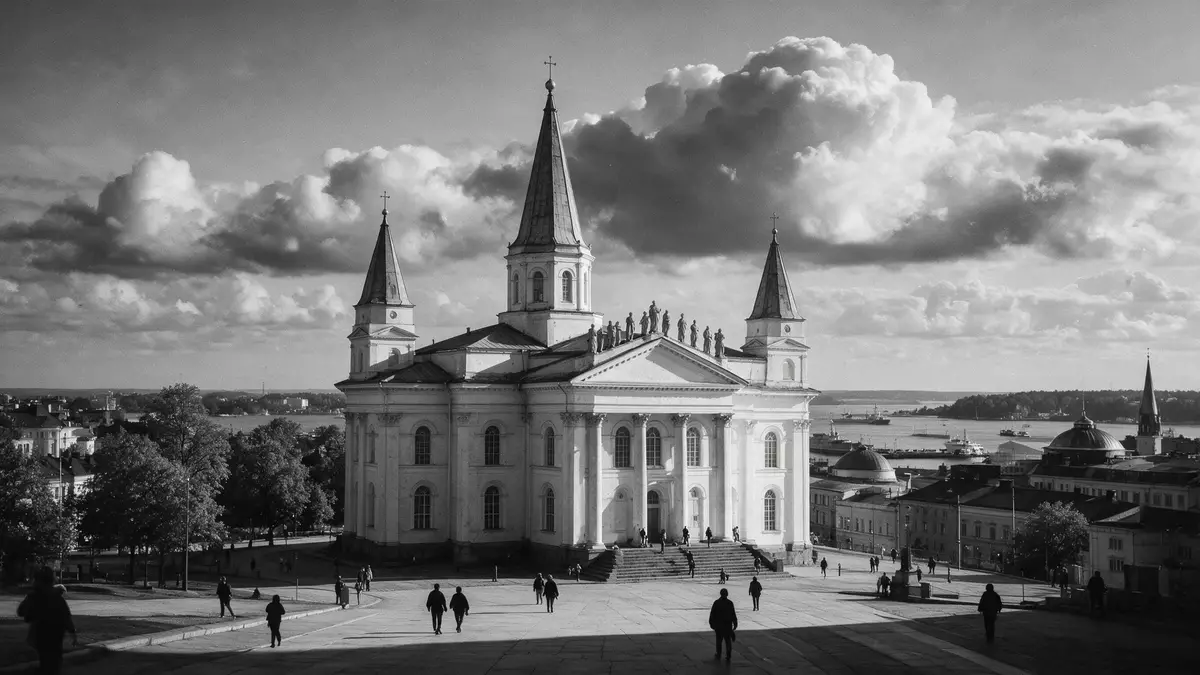
Helsingin tuomiokirkko, known in English as Helsinki Cathedral, rises above Senate Square as a white neoclassical mass of steps, walls and domes that has framed central Helsinki since the nineteenth century. Designed by architect Carl Ludvig Engel and completed in 1852, it serves as the main Evangelical Lutheran cathedral of the Diocese of Helsinki and a visual symbol of the Finnish capital.
A neoclassical cathedral shaped as a cross
Helsingin tuomiokirkko is a Lutheran cathedral with a ground plan laid out as a Greek cross, giving equal length to each arm and emphasising symmetry in every direction.Greek cross plan The central space rises into a large masonry tower that ends in a dome, while smaller domed towers stand around it at the corners of the building’s main volume.domed towers This stepped composition gives the cathedral its distinctive roofline, especially when seen from the harbour or from the far side of Senate Square.
The exterior walls are rendered and painted white, helping the building stand out against the darker roofs and façades of the surrounding streets.white rendered facades On each arm of the Greek cross, tall porticoes project from the main volume, carried on classical columns and topped by pediments that underline the neoclassical style.neoclassical style The overall effect is severe and geometric, with little exterior ornament beyond the rhythm of the columns, the angles of the roofs and the outlines of the domes.
Carl Ludvig Engel’s cathedral above Senate Square
The story of Helsingin tuomiokirkko is closely tied to the re-shaping of Helsinki in the early nineteenth century, when the city became the capital of the Grand Duchy of Finland.Grand Duchy of Finland Architect Carl Ludvig Engel worked with planner Johan Albrecht Ehrenström on a new city centre in the Empire style, and the cathedral forms the northern edge of this composition.Empire-style centre Construction of the church began in 1830, and after Engel’s death the work was overseen and completed by Ernst Bernhard Lohrmann, with the building finished in 1852.built from 1830 to 1852
Originally the cathedral was named after Tsar Nicholas I and was known as Saint Nicholas Church, a reference to the Russian ruler of the time.Saint Nicholas Church name In the twentieth century, after Finland’s independence, the building took on its present name Helsingin tuomiokirkko, indicating its role as the main church of the city’s Lutheran diocese.cathedral of the Diocese of Helsinki The cathedral also serves as the principal church of the Helsingin tuomiokirkkoseurakunta parish, and major civic and academic services are held in its interior.
The white terrace above the harbour city
Helsingin tuomiokirkko stands in the Kruununhaka district at Unioninkatu 29, occupying the northern side of Senate Square in the historic city centre.Unioninkatu 29 address The building is raised on a broad flight of steps that creates a terrace above the square, with the cathedral’s portico looking over the low façades of the surrounding government and university buildings.terrace of steps From this elevated platform, visitors see the ordered grid of Engel’s Empire-style streets and, beyond them, the waters and islands that form Helsinki’s inner archipelago.
The cathedral itself belongs to a wider ensemble of white and light-coloured stone buildings that make up the official centre of Helsinki, including the Government Palace and the main university building.Empire ensemble The way Helsingin tuomiokirkko rises above these neighbours, with its domes and towers clearly visible from surrounding streets and the harbour, has made it a landmark commonly used to represent the city in photographs and illustrations.symbol of Helsinki
Visiting Helsingin tuomiokirkko: what travellers from Western Europe should know
- Helsingin tuomiokirkko stands on Unioninkatu at the northern edge of Senate Square in central Helsinki, within easy walking distance of the harbour quays and nearby tram stops.
- The approach from Senate Square rises over a long flight of outdoor steps, and the cathedral’s interior is reached by climbing these and passing through the main portico.
- The surrounding streets of Kruununhaka are laid out on a gentle slope, with paved surfaces and kerbs, so movement between the cathedral and neighbouring civic buildings involves short gradients and crossings.
- The official language is Finnish and the currency is the euro.
Searching for Helsingin tuomiokirkko on social platforms
These links open searches for Helsingin tuomiokirkko on each platform.
Frequently asked questions about Helsingin tuomiokirkko
Where is Helsingin tuomiokirkko located in Helsinki?
Helsingin tuomiokirkko stands on Unioninkatu in the Kruununhaka district, forming the northern side of Senate Square in Helsinki’s historic centre.
What can visitors expect inside Helsingin tuomiokirkko?
Visitors enter a Lutheran cathedral laid out on a Greek cross plan, with a high central space under the main dome and simpler neoclassical decoration around the nave and galleries.
What makes Helsingin tuomiokirkko distinctive among Helsinki’s churches?
Its white façades, domed towers and broad terrace of steps above Senate Square give Helsingin tuomiokirkko a prominent profile that anchors the Empire-style city centre and is closely associated with Helsinki’s identity.


