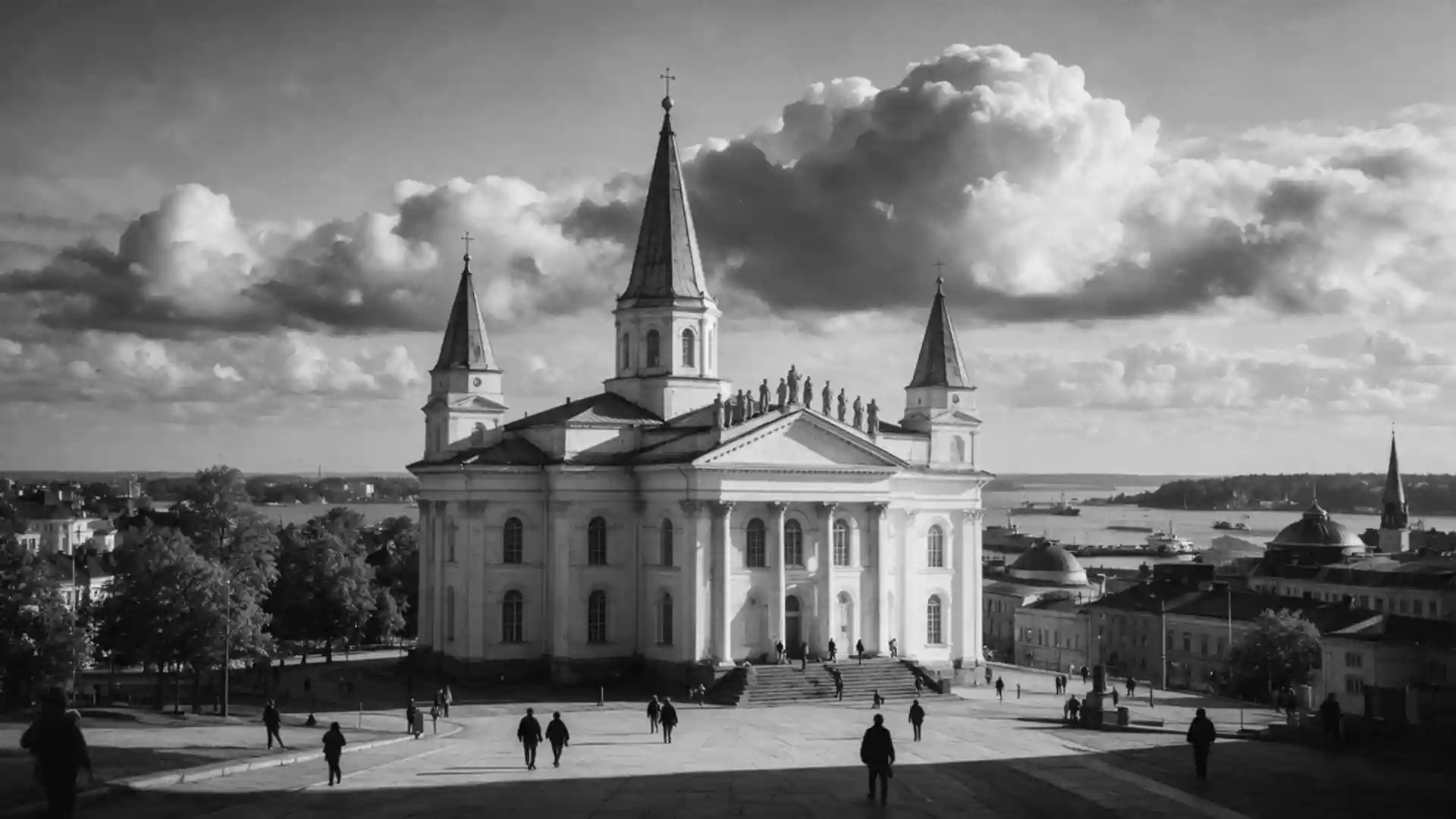
Helsingin tuomiokirkko and the white terrace above Senate Square
Published on 08/21/2026 at 18:32 | Editorial responsibility: Rafael Müller, Editor-in-Chief AD HOC NEWS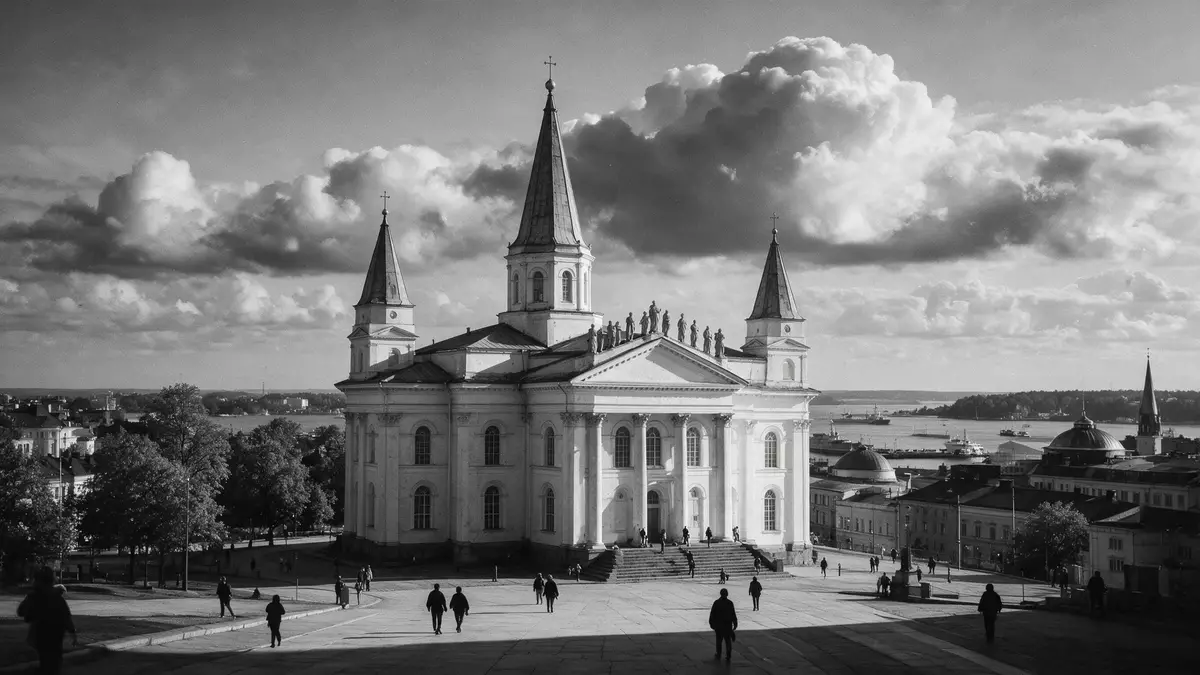
Helsingin tuomiokirkko, known in English as Helsinki Cathedral, rises above Senate Square as a white neoclassical terrace of steps, columns and green domes that has framed central Helsinki since the mid-nineteenth century. Built between 1830 and 1852 as a Lutheran cathedral for the growing capital of Finland, it was designed by the German-born architect Carl Ludvig Engel and later completed by Ernst Bernhard Lohrmann.
A neoclassical cathedral on an urban stage
The cathedral stands at Unioninkatu 29, occupying the northern edge of Senate Square where Engel’s composition gathers the main civic buildings of the period into a single formal ensemble.Unioninkatu address The white rendered facades, tall porticoes and severe pediments align with the surrounding university and government buildings, giving the whole square an Empire-style unity that reflects early nineteenth-century town planning in Helsinki.Empire-style centre of Helsinki
From the cobbles of Senate Square, Helsingin tuomiokirkko appears as a broad flight of stone steps leading up to a high base and a main portico supported by classical columns. Above the roofline rises the central dome, painted green, surrounded by four smaller corner domes that Lohrmann added when he took over the project after Engel’s death in 1840.four smaller domes The effect is of a single architectural stage where religious architecture and civic space meet in one carefully controlled perspective.
From Nicholas Church to Helsingin tuomiokirkko
The first drawings for the cathedral date back to 1818, when Engel was working with town planner Johan Albrecht Ehrenström on a new centre for Helsinki in the years after it became the capital in 1812.first drawings in 1818 Construction of the church began in 1830 and stretched over more than two decades before the building was consecrated in 1852 as a Lutheran cathedral.built from 1830 to 1852
For much of its early history the cathedral carried a different name. In honour of Nicholas I, Grand Duke of Finland and Tsar of Russia, it was initially called Nicholas Church and served both as a tribute to the ruler and as a major Lutheran church in the city centre.Nicholas Church for Nicholas I After Finland’s independence in 1917, the name Suurkirkko, the Great Church, came into use for several decades. When the Diocese of Helsinki was formed in 1959, the church took its present name Helsingin tuomiokirkko and became the cathedral of the diocese.name changes up to 1959
Architecture, interior and the dominant dome
Architecturally, Helsingin tuomiokirkko belongs to the neoclassical movement, with a plan based on a Greek cross and a strong emphasis on symmetry.Greek cross plan The exterior is built from masonry with rendered surfaces painted white, and the main porticoes are lined with tall Corinthian-style columns that carry triangular pediments. The central dome rests on a high drum, and the smaller domes on the corners of the building help define the cathedral in the wider city panorama, making it a clear point of orientation above the lower roofs around Senate Square.white neoclassical dome
Inside, the Lutheran character of the cathedral comes through in the restrained decoration and the focus on the pulpit, altar and organ rather than elaborate side chapels. The nave and cross arms share a unified interior, with light-coloured walls, limited ornament and an emphasis on clear sightlines towards the chancel. Below the main floor a crypt has been adapted and renewed in the late twentieth century, continuing the building’s life as an active place of worship and gathering while respecting the nineteenth-century structure above.crypt renovation
Visiting Helsingin tuomiokirkko: what travellers from Western Europe should know
- Helsingin tuomiokirkko stands above Senate Square in central Helsinki, on Unioninkatu, and is reached on foot from the surrounding streets and tram stops that serve the historic centre.
- The approach to the cathedral from the square involves a long outdoor staircase, and the ascent brings visitors from the cobbled public space up to the terrace level in front of the main portico.
- The cathedral is part of the Lutheran church in Finland, and worship services and religious events take place inside the building while the exterior terrace and steps remain a prominent public meeting place.
- The official language is Finnish and the currency is the euro.
Searching for Helsingin tuomiokirkko on social platforms
These links open searches for Helsingin tuomiokirkko on each platform.
Frequently asked questions about Helsingin tuomiokirkko
Where is Helsingin tuomiokirkko located in Helsinki?
Helsingin tuomiokirkko stands on Unioninkatu at the northern side of Senate Square, in the historic centre of Helsinki’s city core.
What can visitors expect when they climb the steps?
Visitors climb a long staircase from the square to a high terrace in front of a neoclassical portico, with views across Senate Square and access to the cathedral interior.
What makes Helsingin tuomiokirkko distinctive among Helsinki’s churches?
The cathedral combines a white neoclassical exterior, a dominant central dome with four corner domes and a commanding position above Senate Square that shapes the city’s main civic space.