
Hallstatt between lake, mountain and salt history
Published on 08/30/2026 at 13:41 | Editorial responsibility: Rafael Müller, Editor-in-Chief AD HOC NEWS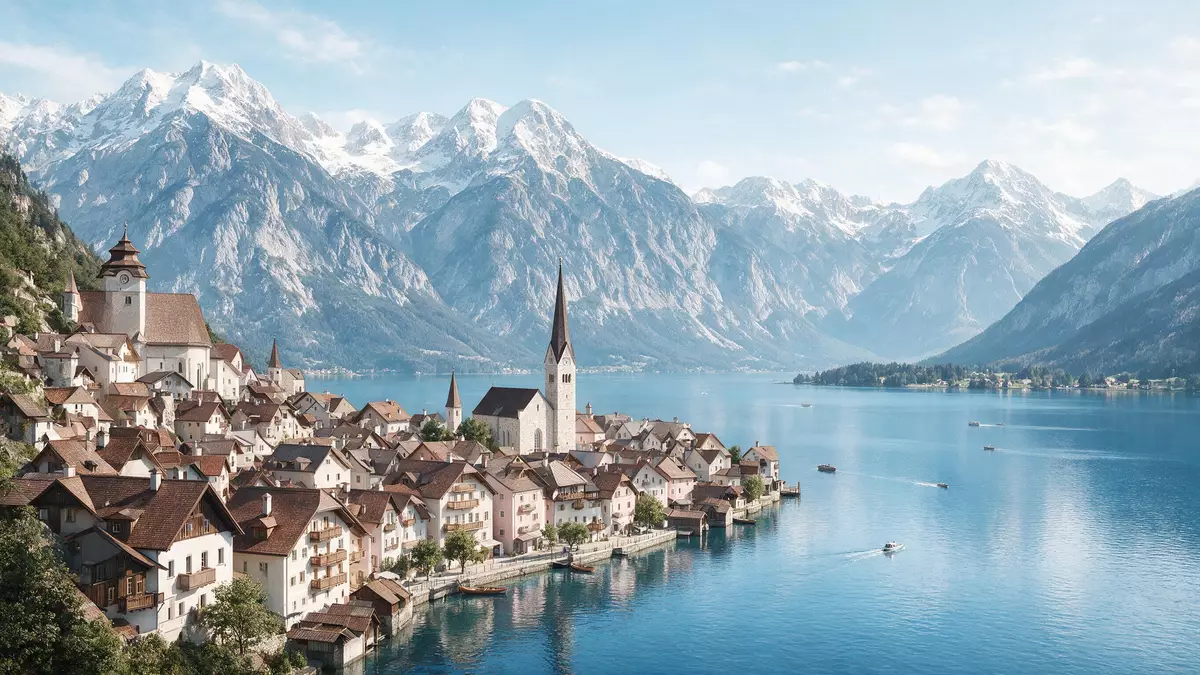
Hallstatt in Austria’s Salzkammergut region occupies a narrow strip of ground between the waters of Lake Hallstatt and the steep limestone slopes of the Dachstein massif, where a lakeside settlement and a mountain salt mine have shaped each other for millennia.
A village suspended between water and rock
Hallstatt is a small town in the district of Gmunden in Upper Austria, set on the western shore of Lake Hallstatt with the lake to one side and rising rock walls immediately behind the houses.Upper Austria location The settlement forms part of the Salzkammergut region, an area of lakes and mountains in the Eastern Alps that includes the Dachstein range towering above the village.Salzkammergut cultural landscape
Hallstatt’s houses, church towers and small squares stand on a belt of level ground pressed between the shoreline and near-vertical slopes, so that streets run close to the water and the roofs appear to lean back against the mountains. Lake Hallstatt itself lies at the northern foot of the Dachstein massif with a long, enclosed form between steep flanks, and the Traun river flows through its basin on the way towards the Danube.Lake Hallstatt setting The combination of narrow shoreline, deep water and high limestone walls gives Hallstatt its distinctive appearance between lake and mountain.
Salt in the mountain and a long mining history
Hallstatt owes its long history to extensive rock salt deposits in the mountain above the village, where organised mining was already well developed during the Bronze Age around 1,300 BC.Bronze Age salt mine Archaeological research indicates that systematic salt extraction in the Hallstatt area began in the Middle Bronze Age, from the sixteenth century BC onwards, and that galleries extended deep into the mountain as mining expanded.prehistoric salt mining
The burial grounds associated with this mining have given their name to the Hallstatt period, a phase of the early Iron Age dating from around 800 to 400 BC that is defined by finds from the cemetery above the town.Hallstatt period burial ground Later, around AD 1311, salt production and brine boiling were placed under state control, and Hallstatt became a market town under a reorganisation attributed to Queen Elisabeth of Bohemia.1311 mining reforms The continuity of salt extraction from prehistory through the medieval period and into the modern era makes Hallstatt one of the best documented salt-mining landscapes in the Alps.
World Heritage cultural landscape around Hallstatt
Hallstatt lies at the heart of the Hallstatt-Dachstein/Salzkammergut Cultural Landscape, recognised as a UNESCO World Heritage Site in 1997 for its combination of long human settlement, salt mining and dramatic alpine scenery.World Heritage inscription in 1997 The designated area covers tens of thousands of hectares of mountains, valleys and lakes where villages such as Hallstatt, Bad Goisern, Gosau and Obertraun are linked by the shared history of salt extraction and transport.Dachstein-Salzkammergut villages
In Hallstatt itself, the cultural landscape is visible in the way the settlement, lake, salt mine and surrounding alpine pastures sit within one relatively compact basin framed by high peaks. The lake forms part of this ensemble, with its deep waters reflecting cliffs and forests, while paths and routes connect the village on the shore with the mining areas higher on the mountain. Together, the built structures, archaeological sites and natural features illustrate a long relationship between human activity and the alpine environment that spans several thousand years.
Visiting Hallstatt: what travellers from Western Europe should know
- Hallstatt is in Upper Austria’s Salzkammergut region on the western shore of Lake Hallstatt, south-east of Salzburg, and is reached by regional rail services to nearby stations such as Bad Goisern and Obertraun followed by local connections.
- The village occupies a narrow band of level ground between deep water and steep slopes, so that walking through the centre involves lanes close to the lake and routes that rise towards the mountains on stepped paths.
- The surrounding terrain includes high limestone peaks of the Dachstein massif, where routes to viewpoints and former mining areas involve noticeable altitude gain and exposed sections typical of an alpine setting.
- The official language in Hallstatt and the wider region is German and the currency is the euro.
Searching for Hallstatt on social platforms
These links open searches for Hallstatt on each platform.
Frequently asked questions about Hallstatt
Where is Hallstatt and what kind of place is it?
Hallstatt is a small lakeside town in the Salzkammergut region of Upper Austria, on the western shore of Lake Hallstatt beneath the Dachstein massif.
What should visitors expect when walking through Hallstatt?
The village runs along a confined shoreline, with lanes close to the lake and paths rising towards steep limestone slopes, so walking often involves short climbs between water and mountain.
What makes Hallstatt distinctive among alpine settlements?
The combination of deep mountain lake, narrow shoreline, long salt-mining history and its role within the Hallstatt-Dachstein/Salzkammergut World Heritage Cultural Landscape makes Hallstatt a distinctive meeting point of water, rock and archaeology.


