Hallstatt and Lake Hallstatt between mountain and water
Published on 08/20/2026 at 06:29 | Editorial responsibility: Rafael Müller, Editor-in-Chief AD HOC NEWS
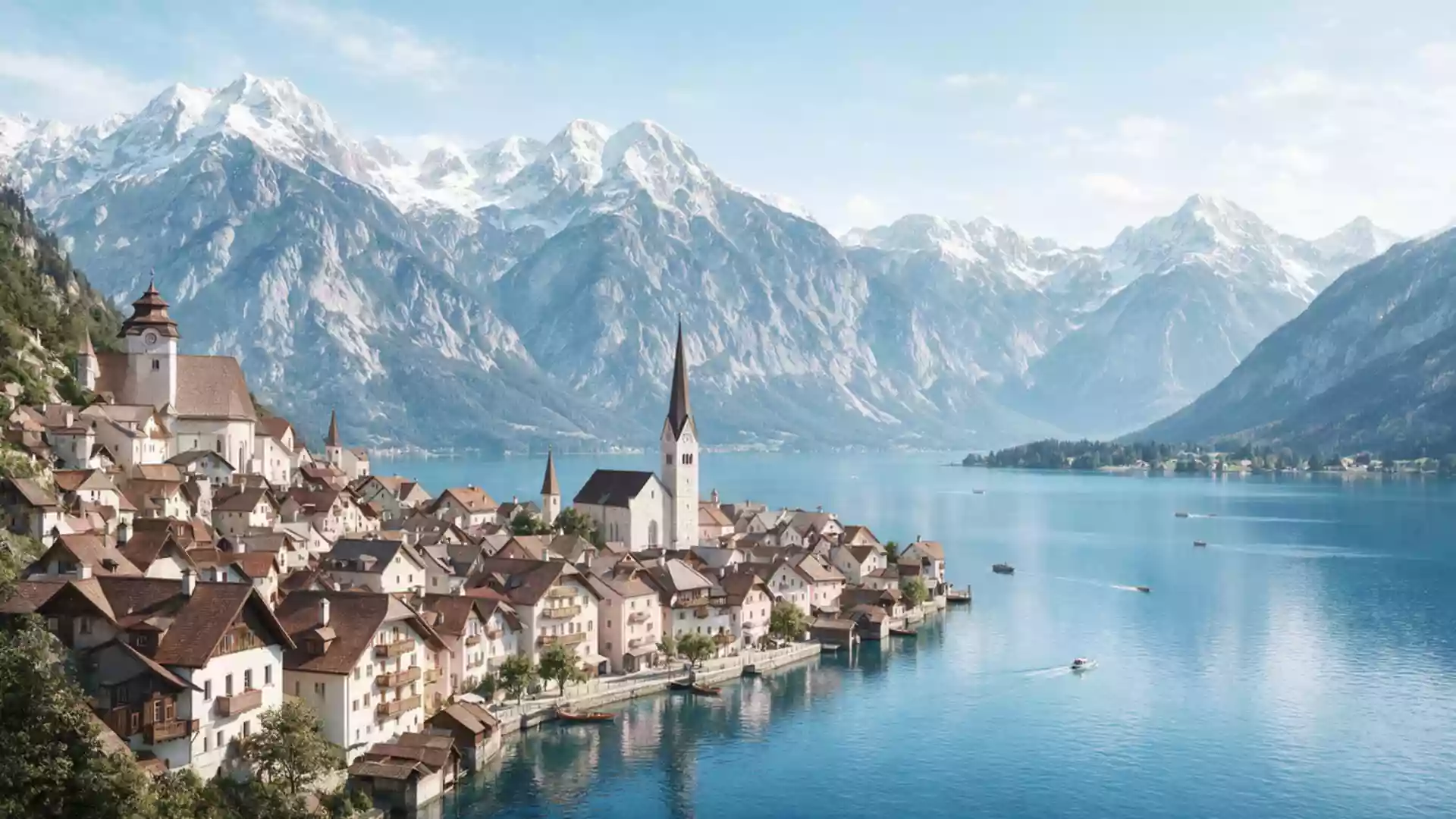
Hallstatt is a small lakeside settlement in the Salzkammergut region of Upper Austria, pressed between steep mountains and the dark waters of Lake Hallstatt. Salt mining has taken place in the surrounding slopes for thousands of years, and the village forms part of the Hallstatt-Dachstein / Salzkammergut cultural landscape recognised by UNESCO in the late twentieth century. The town’s compact centre on the western shore, its relationship with the lake and its long connection to salt combine to give Hallstatt a distinctive character.
A lakeside village on a narrow strip of land
Hallstatt occupies a narrow band of level ground on the western shore of Lake Hallstatt, with water to one side and near-vertical slopes rising immediately behind the houses. The lake itself lies in the Salzkammergut region of Upper Austria at the northern foot of the Dachstein massif, and its surface covers about 8.55 km² (3.30 sq mi), with a maximum depth around 125 m (410 ft).Lake Hallstatt’s size and depth The settlement sits on this confined shoreline, so that many streets and buildings appear to stand directly above the water.
The surrounding peaks rise steeply from the lake’s edge, creating an enclosed valley that opens northwards towards Bad Goisern and the Traun river and southwards towards Obertraun and the higher Dachstein mountains.The lake’s position in the Salzkammergut Limestone dominates the local geology, and the rock walls form a continuous backdrop behind the church tower, traditional houses and lakeside promenade. The setting means that views within Hallstatt are often framed by water on one side and rock on the other, with little flat land between.
Salt mining and the Hallstatt Period
Above the village, on the slopes known as the Salzberg, evidence of salt mining reaches back several millennia. Archaeological findings indicate organised extraction of salt in the Bronze Age, around 1500 BC, and discoveries related to salt working continue into the early Iron Age.Bronze Age salt mining at Hallstatt Finds from burial grounds in the area lend their name to the Hallstatt Period of the older Iron Age, broadly spanning the centuries between 800 and 400 BC.Burial finds defining the Hallstatt Period In this sense, Hallstatt is not only a settlement but also an archaeological reference point for a wider phase of European prehistory.
Salt deposits within the mountain created conditions for continuous mining over thousands of years, and research suggests that salt has been used there over an extended span of time measured in millennia.Long history of salt use The wealth generated by salt in prehistoric and historic periods left traces in grave goods and artefacts, many of which are now associated with the Hallstatt Period. The link between the settlement, the mine and the archaeological finds is central to the town’s identity.
World Heritage cultural landscape
Hallstatt forms part of the Hallstatt-Dachstein / Salzkammergut cultural landscape, a designated World Heritage Site. UNESCO inscribed this alpine region on its World Heritage List in 1997 as a cultural landscape, recognising both the natural setting and the longstanding interaction between human activity and the terrain.1997 World Heritage inscription The protected area extends beyond Hallstatt itself to include the Dachstein mountains and neighbouring communities in the Inner Salzkammergut.
Within this wider landscape, Hallstatt stands as an archaeological centre linked to the world’s oldest known salt mine and to burial sites that define an entire prehistoric period.Hallstatt as archaeological heart of the region The combination of steep alpine scenery, a fjord-like lake basin and evidence of mining across thousands of years underpins the region’s recognition as a cultural landscape.
Visiting Hallstatt: what travellers from Western Europe should know
- Hallstatt lies in Upper Austria’s Salzkammergut region on the western shore of Lake Hallstatt, south-east of Salzburg; regional trains run to nearby Bad Goisern and Obertraun.
- The village centre sits on a narrow lakeside terrace between water and steep slopes, so many paths and lanes include short climbs and stairways.
- The surrounding mountains rise from about 500 m (1,640 ft) at lake level to well over 2,000 m (6,562 ft), and walking routes from the village quickly gain altitude on rocky ground.
- German is the official language and the currency is the euro.
Searching for Hallstatt on social platforms
These links open searches for Hallstatt on each platform.
Frequently asked questions about Hallstatt
Where is Hallstatt?
Hallstatt is in the Salzkammergut region of Upper Austria, on the western shore of Lake Hallstatt in the municipality of Hallstatt.
What characterises a visit to Hallstatt?
A visit combines a compact lakeside village on limited flat ground, steep mountain slopes immediately behind and views along an elongated alpine lake basin.
What makes Hallstatt distinctive?
Hallstatt’s distinction lies in its combination of long salt mining history, burial sites that define the Hallstatt Period and its inclusion in a recognised World Heritage cultural landscape.