
Grote Markt in Brüssel and its gilded guildhalls
Published on 09/12/2026 at 18:47 | Editorial responsibility: Rafael Müller, Editor-in-Chief AD HOC NEWS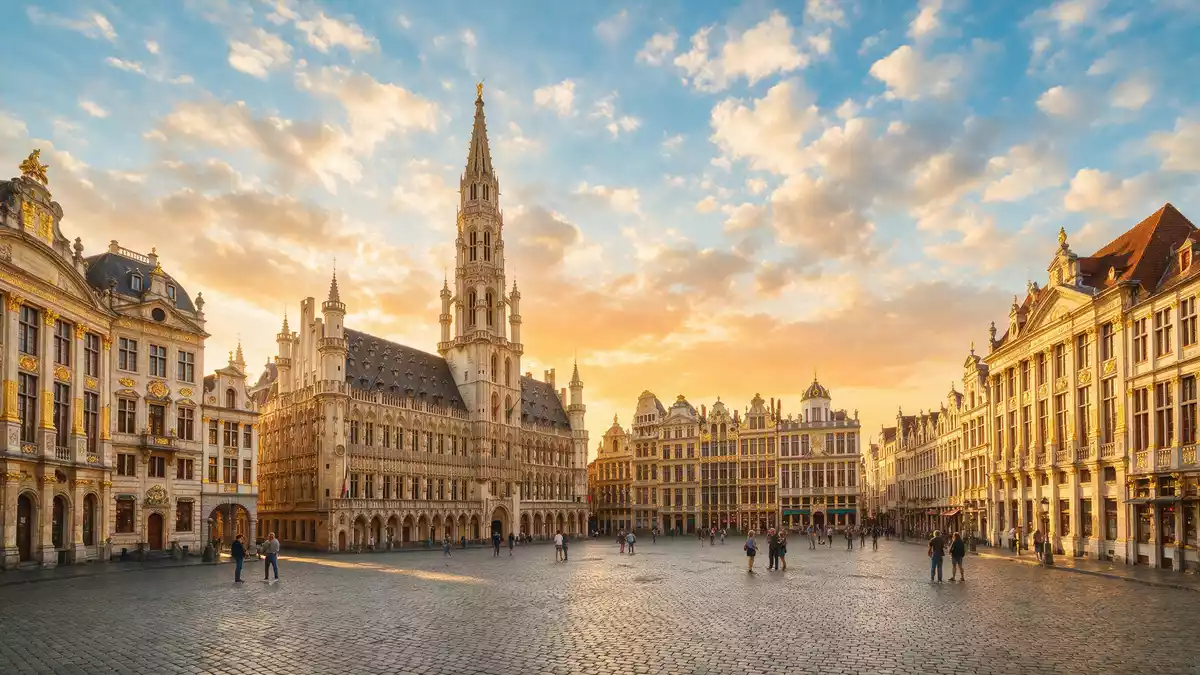
Grote Markt in Brüssel is the historic central square of Belgium’s capital, a paved rectangle framed by ornate guildhalls, the Gothic town hall and the neo-Gothic Maison du Roi. Emerging as a marketplace in the twelfth century and rebuilt in the late seventeenth century after heavy bombardment, it has become a showcase of Brussels’ civic architecture and is recognised as a UNESCO World Heritage site.
A cobbled square shaped by trade and power
Grote Markt lies in the Central Quarter of the City of Brussels and forms a compact paved square whose earliest written mention dates to the twelfth century, when it functioned as the Nedermerckt, or lower market.earliest written reference In that period it developed as a marketplace along important trade routes and near the river Senne, with stalls and halls for meat, bread and textiles lining the edges of the square.medieval market uses
Over time, Grote Markt became the stage for civic authority as well as commerce, with municipal and ducal powers represented in the buildings surrounding the cobbled surface.municipal and ducal powers The square is roughly rectangular and entirely paved, measuring about 110 m (361 ft) by 68 m (223 ft), and seven streets lead into it from the surrounding city fabric, reinforcing its role as a junction for both daily life and ceremonial occasions.dimensions of the square
Guildhalls, town hall and Maison du Roi
The most striking impression on Grote Markt comes from the continuous front of façades that enclose the square, dominated by the town hall with its tall tower on one side and the Maison du Roi, also known as the Bread House, on the opposite side.town hall and Bread House Between them stretch Baroque guildhalls, each once associated with a particular Brussels guild and enriched with sculpted gables, pilasters and decorative motifs that reflect the prosperity of the city’s merchants and craftsmen in the seventeenth century.homogeneous body of buildings
The town hall, begun in the fifteenth century, established Grote Markt as the seat of municipal government, while the Maison du Roi served as the residence and administrative base for ducal and royal power.municipal and royal seats In the nineteenth century the Bread House was rebuilt in a neo-Gothic style and now houses the Brussels City Museum, adding another layer of history to the ensemble while maintaining the architectural rhythm of the square.Brussels City Museum
From seventeenth-century devastation to UNESCO World Heritage
In August 1695, during the War of the League of Augsburg, French artillery under Marshal François de Villeroy heavily bombarded Brussels, and much of the built fabric around Grote Markt collapsed into rubble, leaving primarily the stone structure of the town hall and the Maison du Roi standing.1695 bombardment In the years that followed, property owners and guilds rebuilt their houses along the square, creating the cohesive Baroque façades that define its appearance and represent an eclectic yet harmonious blend of Western European architectural styles.late seventeenth-century reconstruction
This rebuilt ensemble, combining public and private buildings, led to Grote Markt’s inscription on the UNESCO World Heritage List in 1998 as an outstanding example of an eclectic and successful mixing of architectural and artistic styles.UNESCO inscription in 1998 The square also illustrates the achievements of a mercantile city in northern Europe at the height of its prosperity, with bronze UNESCO logo plates now set into the ground along the access routes as a discreet reminder of its international recognition.UNESCO heritage description
Visiting Grote Markt: what travellers from Western Europe should know
- Grote Markt sits in the historic centre of Brussels, within the Central Quarter, and can be reached on foot from Brussels-Central railway station via the narrow streets that lead into the square.
- The square itself is entirely paved with cobbles, with gentle gradients and short approaches; movement across it involves walking over uneven stone rather than formal pavements.
- Several narrow streets and passages connect Grote Markt to surrounding districts, so visiting the square usually involves short stretches on foot between public transport stops and the open space.
- Belgium’s official languages are Dutch, French and German, and the currency is the euro.
Searching for Grote Markt on social platforms
These links open searches for Grote Markt on each platform.
Frequently asked questions about Grote Markt
Where is Grote Markt located in Brüssel?
Grote Markt is the central paved square of the City of Brussels, in the Brussels-Capital Region of Belgium, within the historic Central Quarter.
What can visitors expect when they arrive at Grote Markt?
Visitors encounter a cobbled rectangular market square enclosed by the Gothic town hall, the neo-Gothic Maison du Roi and richly decorated Baroque guildhalls.
What makes Grote Markt distinctive among European city squares?
Grote Markt stands out for its late seventeenth-century rebuilt façades, blending guildhalls and civic buildings in an ensemble recognised as UNESCO World Heritage since 1998.


