
Grote Markt in Brüssel: a stone theatre of guilds and power
Published on 08/31/2026 at 06:11 | Editorial responsibility: Rafael Müller, Editor-in-Chief AD HOC NEWS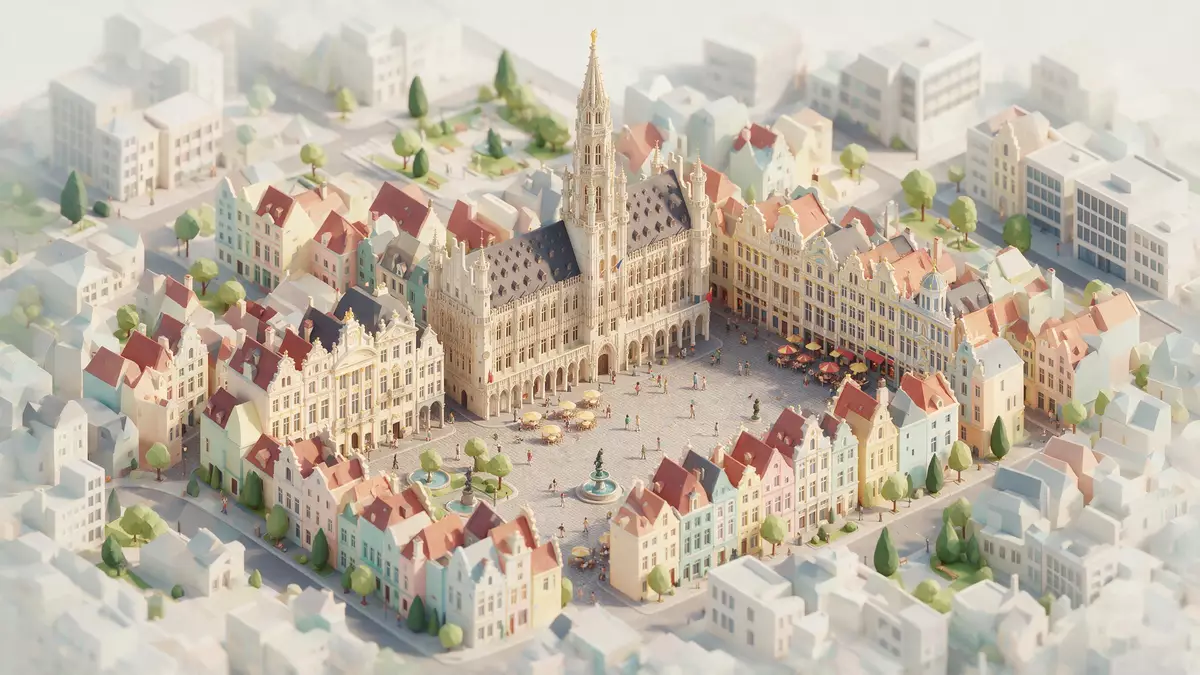
Grote Markt in Brüssel is the central cobbled square of Belgium’s capital, framed by the ornate town hall and rows of guild houses that crystallise the city’s civic life in stone. The ensemble largely dates from the late seventeenth century, yet its origins as a marketplace reach back to the twelfth century, giving visitors a compact lesson in urban history at a single site.
A rectangular stage surrounded by stone façades
Seen from ground level, Grote Markt reads as a paved rectangle enclosed by a continuous ring of richly decorated façades. The square has proportions that are substantial enough for civic ceremonies yet still contained enough that the architectural detail on each building remains legible. Its surface is laid in cobbles, and the absence of any permanent structures in the centre keeps the space clear.
On one side stands the Gothic town hall of the City of Brussels, with a tall tower rising above the roofline and a façade marked by slender tracery and sculpted figures. This building became the political anchor of the square in the fifteenth centuryas a seat of municipal power. Opposite it, the Maison du Roi, also known as the Bread House, presents a neo-Gothic skin reconstructed in the nineteenth century and now houses the Brussels City Museumas part of the square’s cultural role.
From market forum to UNESCO-recognised ensemble
The history of Grote Markt begins when it functioned as a marketplace beside the Senne River, with the earliest written mention dating from 1174 in a papal document that refers to the site as “Nedermerckt” or Lower Marketin reference to its trading role. Wooden market halls and houses once lined the square, but a bombardment in August 1695 during the Nine Years’ War destroyed most of the medieval built fabric, sparing mainly the stone shell of the town halland forcing an extensive rebuilding. The guilds that held premises around the square reconstructed their headquarters in coordinated Baroque forms in the years that followed, creating the largely homogeneous architectural ensemble visible in the square today.
This ensemble gained international recognition when Grote Markt was inscribed on the UNESCO World Heritage List in 1998, under criteria that highlight its architectural coherence and its role as an illustration of a successful mercantile city in northern Europewithin the wider context of Brussels’ heritage. Bronze plaques bearing the UNESCO emblem mark the ground at the entrances to the square, quietly signalling this status to those walking in from surrounding streetsalong the seven access points.
Guild houses and civic life in stone
Walking around the edges of Grote Markt reveals façades that once belonged to guilds representing trades and corporations within the city. These houses stand shoulder to shoulder, each with distinctive ornamentation and gilded details, but together they form a coherent visual band. Some are identified with specific guilds, such as brewers or boatmen, and their sculpted motifs refer to those professions.
The town hall continues to serve as a working municipal building, and the square as a whole retains political and administrative functions alongside its role as a public gathering spacefor civic events and ceremonies. Grote Markt also carries commemorative markers and displays that speak to Brussels’ history as a trading centre and seat of governance. The layering of Gothic, Baroque and neo-Gothic architecture around the square, combined with the open cobbled floor, turns the space into a kind of three-dimensional archive of municipal life across several centuries.
Visiting Grote Markt: what travellers from Western Europe should know
- Grote Markt lies within the historic centre of Brussels, in the Central Quarter of the city’s pentagon; the square itself carries the postal code 1000.
- The square is entirely paved with cobbles, with gentle level changes at its edges, so walking involves continuous movement on uneven stone rather than on smooth surfaces.
- Several narrow streets lead directly into Grote Markt, and their junctions with the square are marked by bronze plaques in the ground that bear the UNESCO World Heritage emblem.
- The surrounding buildings house municipal offices, a museum and other premises, so parts of the perimeter consist of doorways and staircases leading into functioning interiors.
- The official languages of Belgium include Dutch and French, and the national currency is the euro (EUR).
Searching for Grote Markt on social platforms
These links open searches for Grote Markt on each platform.Frequently asked questions about Grote Markt
Where is Grote Markt located within Brussels?
Grote Markt stands in the Central Quarter of Brussels, within the historic inner city pentagon, and serves as the city’s principal central square.
What can visitors expect when they step into the square?
Visitors encounter a cobbled open space surrounded by the Gothic town hall, the neo-Gothic Maison du Roi and richly ornamented guild houses forming a continuous architectural frame.
What makes Grote Markt distinctive among European squares?
The combination of late seventeenth-century guild houses, a fifteenth-century town hall and UNESCO World Heritage recognition in a single, coherent urban square gives Grote Markt a particular architectural and historical density.


