
Grote Markt in Brüssel, a stone square of guildhalls and civic power
Published on 08/25/2026 at 20:23 | Editorial responsibility: Rafael Müller, Editor-in-Chief AD HOC NEWS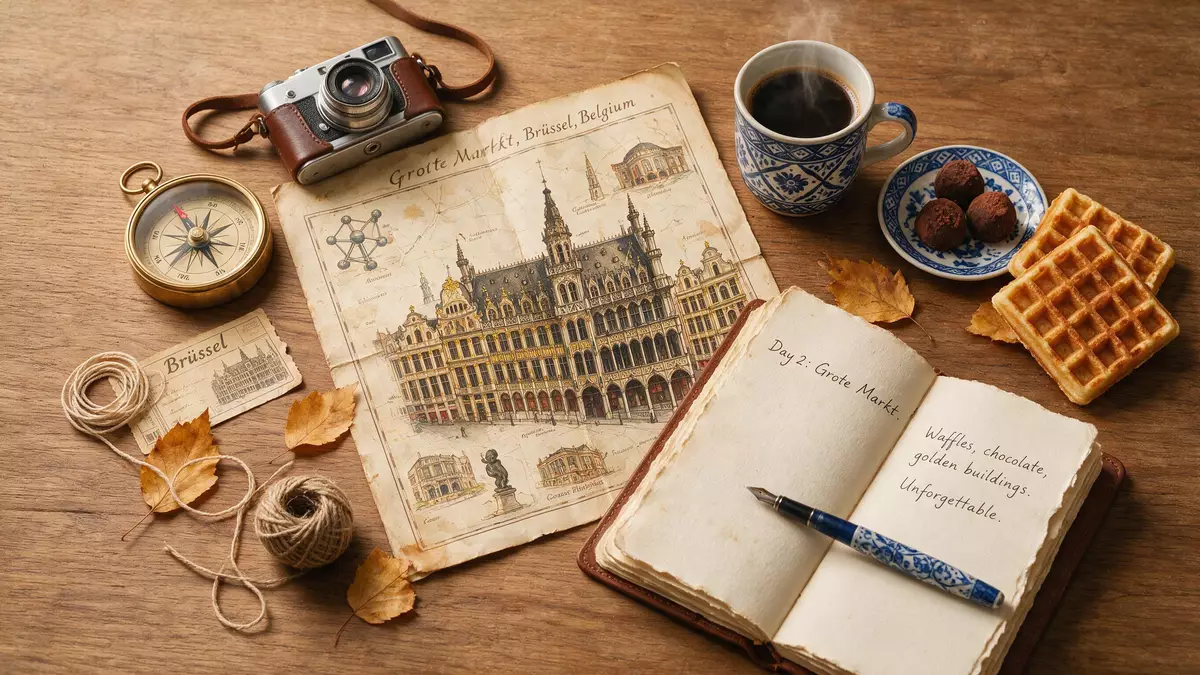
Grote Markt in Brüssel, also known as Grand-Place, is the central cobbled square of the City of Brussels, framed by stone façades that bring civic power and mercantile history into one dense urban space. Its present ensemble of Gothic and Baroque architecture dates mainly from the late seventeenth century, when the houses and halls around the paving were rebuilt after heavy damage, and the square is recognised as a UNESCO World Heritage Site.
A rectangular marketplace shaped by stone façades
Grote Markt is a rectangular paved square whose origins lie in a medieval marketplace beside the River Senne, recorded in documents from the twelfth century under names such as Nedermerckt, or “Lower Market”.earliest written reference Over generations, wooden halls and houses were gradually replaced by stone and brick structures, consolidating the space as the commercial and civic centre of Brussels.late Middle Ages marketplace
The square’s proportions give it a theatrical character, with façades set directly on the paving and little depth between ground floors and the open space. Its dimensions are recorded as about 110 m (360 ft) in length and 68 m (223 ft) in width, defining a compact rectangle that concentrates architectural detail within a limited footprint.paved rectangular square The houses and halls around the perimeter form a continuous ring of stone fronts, punctuated by gables, pilasters and cornices that rise above shops and ground-floor spaces.
Town hall, Broodhuis and guildhalls: an ensemble of power
One side of Grote Markt is occupied by the Brussels Town Hall, a Brabant Gothic building whose construction began in the early fifteenth century, anchoring the square with its tall tower and sculpted façade.Gothic town hall with belfry The town hall still houses municipal offices and ceremonial spaces, and its vertical emphasis provides a counterpoint to the more horizontal rooflines of surrounding buildings.central square of the City of Brussels
Opposite the town hall stands the building known as the Broodhuis in Dutch and Maison du Roi in French, rebuilt in the nineteenth century in neo-Gothic style on a site associated with earlier bread markets and princely jurisdictions.Broodhuis rebuilt in neo-Gothic style The remaining sides of the square are lined with former guildhalls, many rebuilt at the end of the seventeenth century, whose fronts carry statues, reliefs and names that recall trades such as brewers, boatmen and other corporations.guildhalls around the square
From medieval market to World Heritage ensemble
The written history of Grote Markt reaches back to at least 1174, when a papal document mentions the marketplace under its earlier name, and the space grew alongside Brussels as the city expanded its economic and political reach.mention of Nedermerckt in 1174 In the fifteenth century the town hall rose on one side, followed by civic and commercial buildings that increased the concentration of authority and trade around the cobbles.construction of town hall and market halls
The present form of the square is shaped largely by rebuilding carried out at the end of the seventeenth century, after French artillery bombardment in 1695 caused severe damage to the houses and halls around the marketplace.bombardment and late seventeenth-century rebuilding Guilds and city authorities reconstructed façades over a short period, guided by regulatory measures that sought coherence in height and alignment, producing the ensemble of late Baroque and classical fronts that visitors see in its present form.World Heritage inscription in 1998
Visiting Grote Markt: what travellers from Western Europe should know
- Grote Markt lies in the historic centre of Brussels, within the City of Brussels municipality in the Brussels-Capital Region, a short walk from Brussels-Central rail station.
- The square itself is level and fully paved with cobbles, with streets leading into it that pass between closely spaced building fronts.
- The official language in the Brussels-Capital Region includes Dutch and French, and the currency is the euro.
- Nearby streets contain other historic buildings and lead towards districts such as the Galeries Royales Saint-Hubert and the Mont des Arts, which form part of the wider historic core.
Searching for Grote Markt on social platforms
These links open searches for Grote Markt on each platform.
Frequently asked questions about Grote Markt
Where is Grote Markt in Brüssel located?
Grote Markt is the central square of the City of Brussels, in the Brussels-Capital Region of Belgium, situated within the historic core near Brussels-Central station.
What can visitors expect when they step onto the square?
Visitors encounter a paved rectangular space enclosed by the Gothic town hall, the neo-Gothic Broodhuis and a ring of seventeenth-century guildhalls with richly decorated stone façades.
What makes Grote Markt distinctive among European squares?
Grote Markt is distinctive for its coherent ensemble of late seventeenth-century civic and guild buildings, combining Gothic, Baroque and classical elements and recognised as a UNESCO World Heritage Site.


