
Grote Markt and the layered face of Brüssel
Published on 09/10/2026 at 16:53 | Editorial responsibility: Rafael Müller, Editor-in-Chief AD HOC NEWS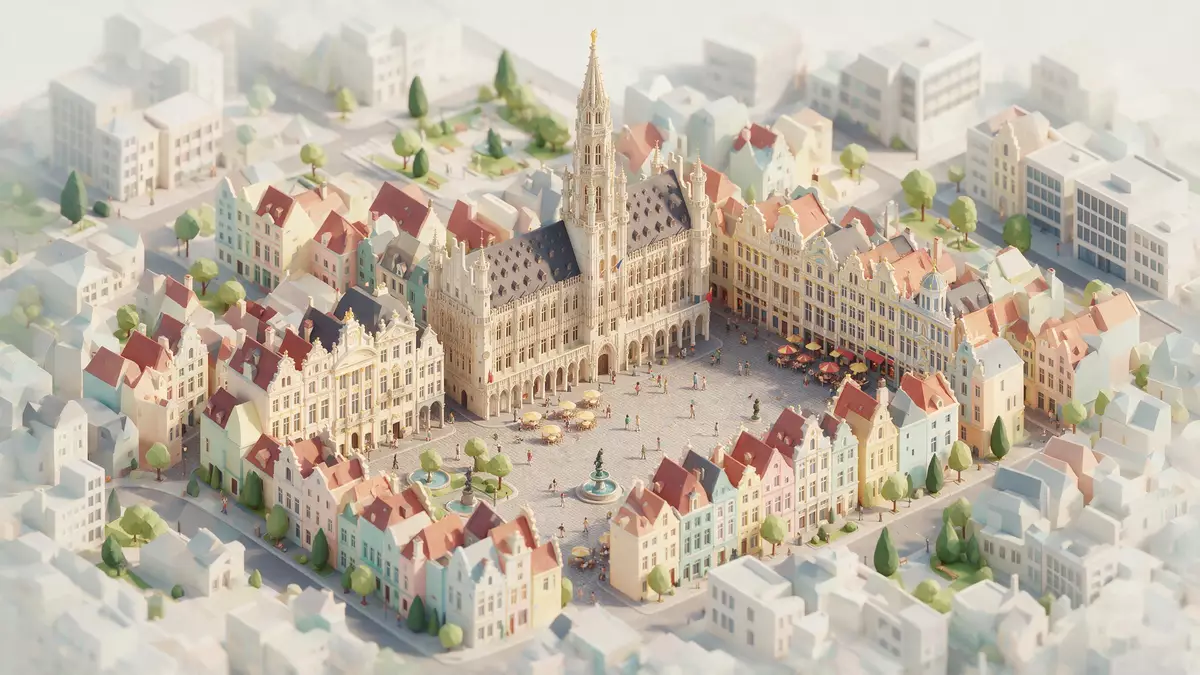
Grote Markt in Brüssel is the city’s central square, and a UNESCO World Heritage site since 1998. Its most arresting feature is the mix of Gothic and Baroque fronts around a rectangular market space.
Grote Markt and the square’s layered streetscape
The square is bordered by the Town Hall, the King’s House and a dense sequence of guild houses. The Town Hall rose in the fifteenth century, and the square’s present ensemble was shaped after the 1695 bombardment of Brussels.
That mix of periods gives Grote Markt a strongly layered appearance. Public authority, civic display and merchant wealth are all legible in the facades facing the open centre.
The place has been tied to Brussels since the twelfth century, when written references to the market square appear. That long civic history helps explain why the square remains a key address in the city centre.
1998 World Heritage site and the central square are the two facts that frame almost everything else here.
Gothic height and Baroque fronts
The Town Hall is the square’s most prominent Gothic building, with a tall tower and an elaborate facade. Around it, the guild houses bring a later, more ornate rhythm to the edge of the square.
That contrast is easy to read at ground level. One side of the square speaks in civic monumentality, while the surrounding houses present a compact sequence of richly detailed fronts.
The UNESCO inscription describes the ensemble as a remarkably homogeneous body of public and private buildings from the late seventeenth century. It also points to the blending of architectural and artistic styles across the square.
late seventeenth century and blending of styles capture the square’s historical character without turning it into a museum label.
Brussels market square through time
Grote Markt began as a market square in the twelfth century, and its history has remained visible in the architecture around it. The square later became a civic centre as well as a commercial one.
The King’s House and the guild houses mark that shift in use and status. Their facades make the square feel less like an empty forecourt and more like an urban room with many owners.
The most useful way to read Grote Markt is to notice how different centuries sit side by side. The result is not a single monumental statement, but a square assembled from successive layers of Brussels history.
twelfth century and guild houses are the safest anchors for understanding the square’s long arc.
Visiting Grote Markt: what travellers from Western Europe should know
- The square lies in central Brüssel, around Grand Place and the surrounding streets. Metro and tram connections serve the city centre, and the area is easy to reach on foot from nearby districts.
- The surface is paved and open, with the Town Hall tower and the surrounding facades visible from the square’s centre. The architecture is best read by walking slowly around the perimeter.
- The official language is Dutch and French, and the currency is the euro.
- Entry requirements depend on your nationality; UK travellers can check the FCDO travel advice at gov.uk/foreign-travel-advice, Irish travellers the Department of Foreign Affairs at ireland.ie.
Searching for Grote Markt on social platforms
These links open searches for Grote Markt on each platform.
Frequently asked questions about Grote Markt
Where is Grote Markt?
Grote Markt is the central square of Brüssel, in the city’s historic core. It sits among the main civic buildings and market streets of the centre.
What should visitors expect?
A paved square surrounded by highly varied facades, including the Gothic Town Hall and the guild houses. The space is open, architectural and dense with detail.
What makes it distinctive?
The combination of a medieval market origin, fifteenth-century civic architecture and late seventeenth-century rebuilding defines the square. That layered cityscape is its strongest feature.


