Gaztelugatxe’s long stone climb between sea and sky
Published on 08/31/2026 at 19:25 | Editorial responsibility: Rafael Müller, Editor-in-Chief AD HOC NEWS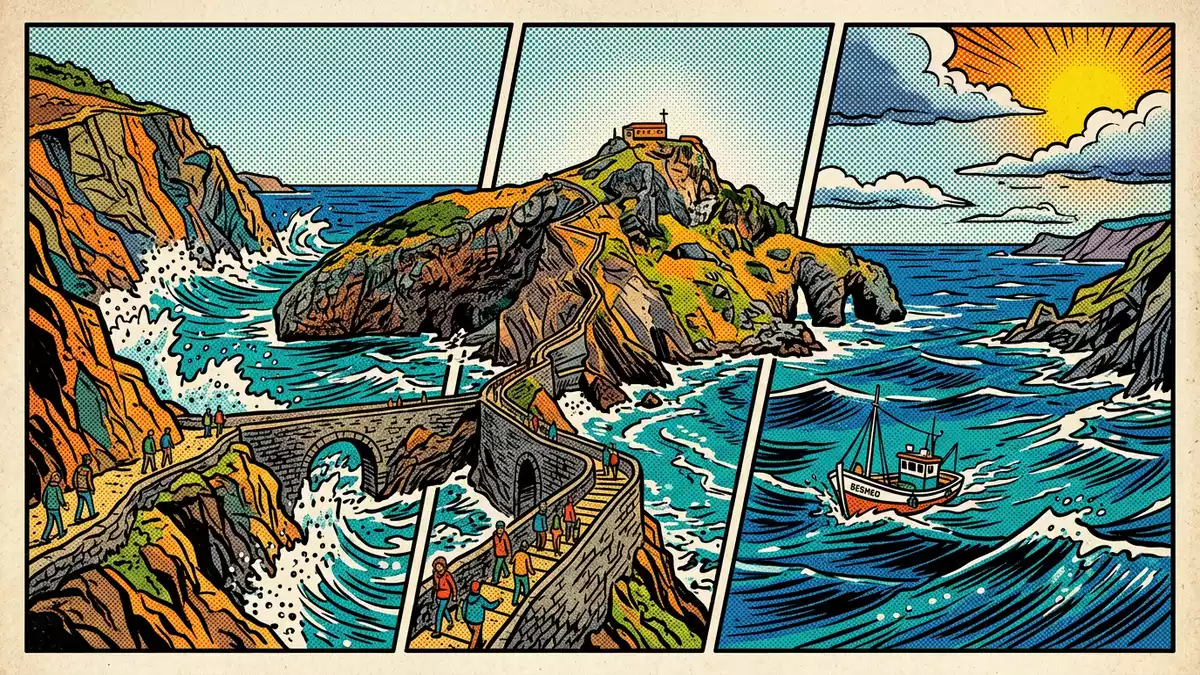
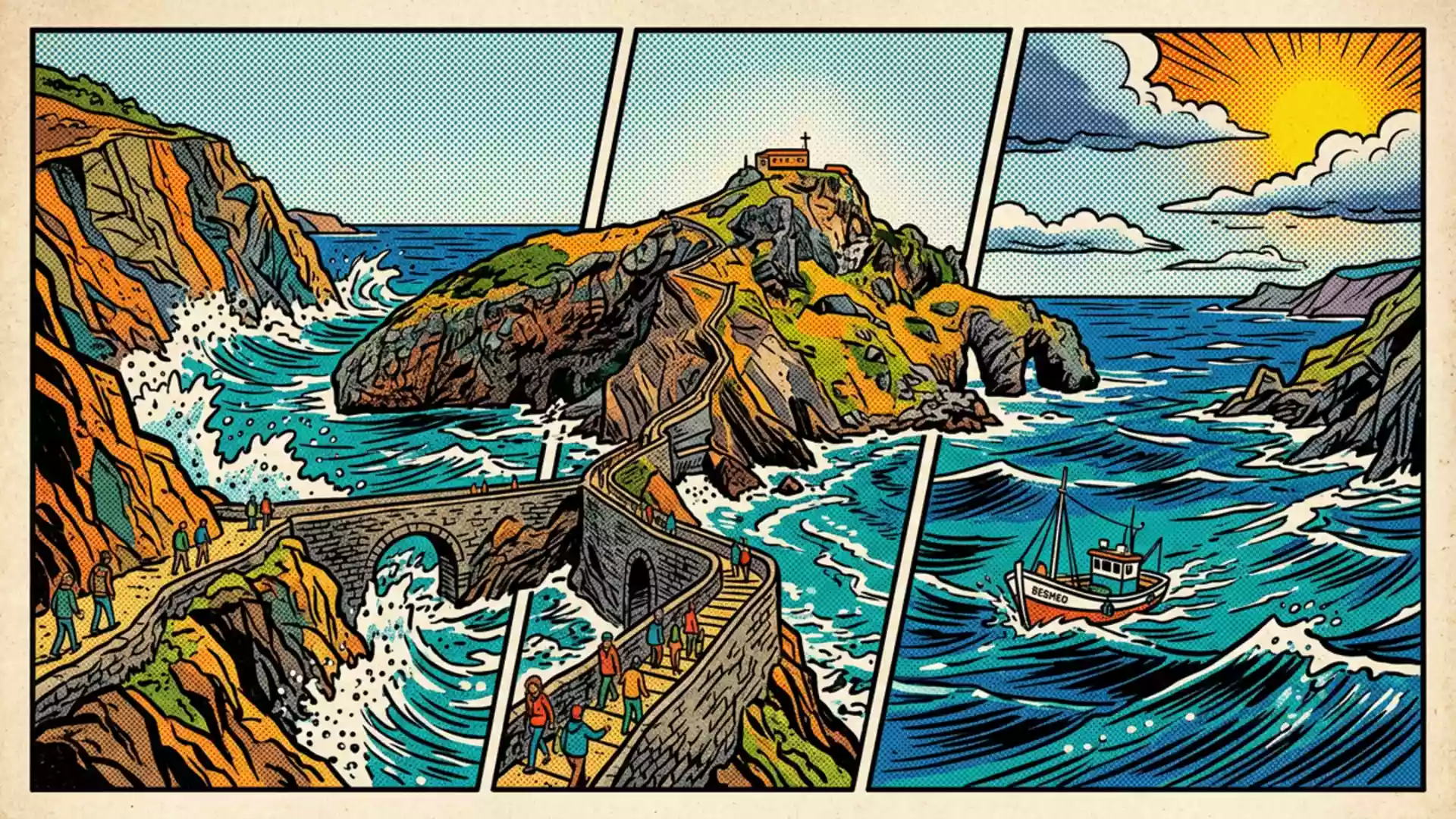
On the Biscay coast near Bermeo in northern Spain, Gaztelugatxe is a steep rocky islet linked to the mainland by a stone bridge and a staircase that climbs hundreds of steps to a small hermitage at the top. The chapel, dedicated to Saint John the Baptist, stands on a terrace high above the waves and is reached only on foot along a path that has become one of the most distinctive approaches to any sanctuary on the Basque coast.
A sanctuary on a sea-bound rock
Gaztelugatxe is part of the municipality of Bermeo in the Basque Country, sitting just off the Bay of Biscay between the town and the seaside village of Bakio. A man-made stone bridge leaves the mainland cliff and spans the water in a series of arches before turning into a paved path that winds up across the back of the rock, linking the shore with the summit terrace.Gaztelugatxe is a small islet off the Biscay coast The approach from the access area involves a pedestrian descent towards this bridge and then the sustained climb of the stairs, so every visitor experiences the sanctuary as the culmination of a long, stepped route.
At the top stands the Hermitage of San Juan de Gaztelugatxe, a small chapel recognised in regional descriptions as having medieval origins, with the building linked to the tenth century and dedicated from an early period to Saint John the Baptist.The shrine dates from the 10th century The hermitage has been rebuilt over the centuries, but its position on the rock, high above the sea and reached by the same fundamental route, gives the whole site a continuous character as a place of devotion, framed by cliffs, surf and open Atlantic water.
The long stone staircase and causeway
The most striking built feature of Gaztelugatxe is the stone route that climbs from the shore to the hermitage terrace. From the mainland a bridge crosses onto the islet and becomes a narrow cobbled path that zigzags upwards, turning back and forth along the rock face and tracing a clear line between sea and sky. Regional tourist descriptions and official Basque tourism material consistently speak of more than 200 steps on this staircase, with several sources giving a figure of 241, making the climb one of the longest continuous outdoor stairways associated with any chapel on this stretch of coast.The path to the hermitage climbs 241 steps
The steps are divided into sections that follow the contours of the rock, with ramps and landings that give alternating views back towards the mainland and out over the ocean. Wayside crosses punctuate the route and underline the ascent as a devotional progression rather than merely a climb to a viewpoint.Small crosses mark points along the staircase Above, the hermitage terrace stands around 80 m (262 ft) above sea level, so the steps connect not just two levels of the site but two quite distinct bands of the coastal landscape: the low zone of arches and breaking surf around the bridge, and the higher, windswept top where chapel, terrace and views out across the Biscay coast come together.
A Basque coastal landscape of cliffs and limestone
Gaztelugatxe forms part of a protected biotope on the Basque coast, with the islet and the nearby rock of Aketze rising from the water in pale limestone that has been carved into ledges, tunnels and sea-cut platforms. Travelling along the coastal road between Bermeo and Bakio, the view opens out to these two rocky forms, with Gaztelugatxe distinguished by its built causeway and chapel at the top.Two rocky islets, San Juan de Gaztelugatxe and Aketze, rise from the coast The surrounding cliffs and coves frame the islet, giving visitors on the road multiple vantage points from which to see the bridge and stairway in profile against the Atlantic.
The combination of natural rock and constructed path is central to the character of Gaztelugatxe. The bridge springs directly from the mainland cliff and continues over large boulders before joining the carved steps, so the line between masonry and natural stone is gradual rather than abrupt.Access to the islet is via a pedestrian path and an imposing staircase Around the base of the rock the sea has eroded tunnels and overhangs, and from the hermitage terrace the cliffs of the Basque coast can be seen running away in both directions, punctuated by headlands, beaches and the outline of the nearby villages.
Visiting Gaztelugatxe: what travellers from Western Europe should know
- Gaztelugatxe lies on the Biscay coast of Spain in the Basque Country, between Bermeo and Bakio; the approach road from Bermeo follows the BI-3101 coastal route towards Bakio, with access points and parking areas signposted for the islet.
- The visit involves a downhill walk from the arrival area along a pedestrian path towards the stone bridge, followed by a long climb on the stone staircase; the route includes steep gradients, many steps and sections without handrails, so it demands stable footing.
- The terrain is rocky Atlantic coastline, with cliffs, exposed sections and sea views; weather on the coast can change during a day, and mist or rain affects how the stone surfaces feel underfoot.
- Gaztelugatxe lies in Spain, where the official language of the surrounding region is Spanish alongside Basque, and the national currency is the euro.
Searching for Gaztelugatxe on social platforms
These links open searches for Gaztelugatxe on each platform.
Frequently asked questions about Gaztelugatxe
Where is Gaztelugatxe and what kind of place is it?
Gaztelugatxe is a small rocky islet off the Bay of Biscay in northern Spain, in the municipality of Bermeo in the Basque Country, crowned by a hermitage.
What should visitors expect on the walk to the hermitage?
Visitors walk down a pedestrian path to a stone bridge and then climb a long staircase of more than 200 steps on a paved, stepped route that follows the rock up to the chapel terrace.
What makes Gaztelugatxe distinctive among Basque coastal sites?
The combination of steep limestone rock, a man-made stone bridge and a multi-hundred-step staircase leading directly to a medieval hermitage sets Gaztelugatxe apart from other stretches of the Biscay coast.