
Gamcheon Munhwa Maeul, Busan’s terraced art village
Published on 08/31/2026 at 08:51 | Editorial responsibility: Rafael Müller, Editor-in-Chief AD HOC NEWS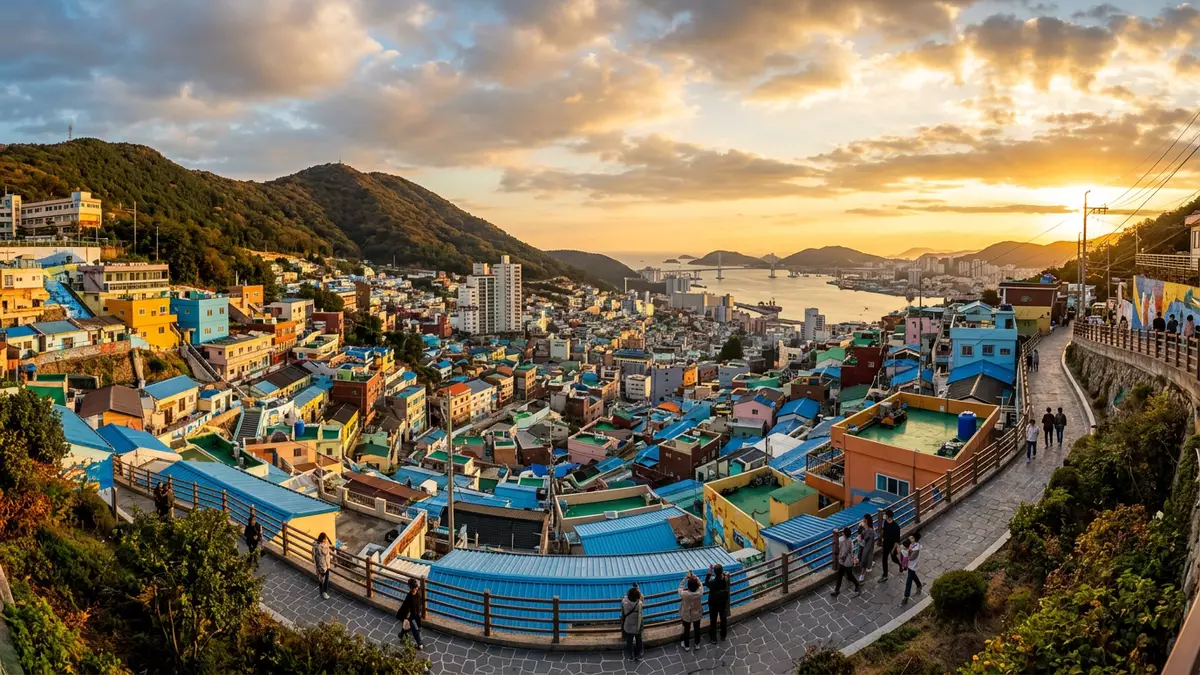
Gamcheon Munhwa Maeul in Busan climbs the flank of a coastal hill as dense terraces of small houses, lanes and stairways that have become an open-air art village. In the mid-twentieth century, during and after the Korean War of 1950–1953, refugees settled on this steep slope in Gamcheon-dong and built modest homes in stepped rows above the harbour. Later, in 2009, a community art initiative brought artists and residents together to cover the neighbourhood with murals, sculptures and installations, turning Gamcheon Munhwa Maeul into one of Busan’s most recognisable hillside districts.
From wartime hillside settlement to cultural village
Gamcheon Munhwa Maeul sits in Gamcheon-dong in the Saha District on the western side of Busan, rising up from the foothills of a coastal mountain toward views of the port and the sea.Gamcheon-dong in Saha District The settlement took shape in the 1950s, when people displaced by fighting during the Korean War needed housing and built compact dwellings along narrow lanes on the hillside.refugees of the Korean War
The houses were arranged in terrace fashion so that roofs and upper floors formed staggered levels rather than blocking one another, creating a stepped effect up the slope.terraced rows of small houses Over time the hillside district developed into a tightly packed neighbourhood with small one- and two-storey homes, simple facades and a web of passages linking the rows, giving Gamcheon Munhwa Maeul its characteristic amphitheatre-like form above the harbour.
Colour, murals and the Village Art Project
A major change came in 2009 with a programme known as the Village Art Project, which involved local artists, students and residents in reimagining Gamcheon Munhwa Maeul as a cultural village.Village Art Project in 2009 Empty houses were converted into themed spaces and small galleries, and outdoor walls were painted with characters, patterns and scenes that now line many of the lanes. Sculptures, installations and signboards mark out informal routes through the maze of stairways and alleys, so that the older fabric of the village doubles as a setting for contemporary art.
The transformation has given Gamcheon Munhwa Maeul a distinct colour palette, with many buildings painted in soft blues, greens, pinks and other pastel tones.murals and sculptures created by residents Official tourism descriptions and local guides sometimes compare the stacked houses to stepped settlements elsewhere, but the visible character in Busan comes from the way painted facades, rooftop outlines and artworks share the same compact hillside stage. Walking through the village, the contrast between bare concrete surfaces and brightly coloured pieces of art remains one of the clearest traces of the 2009 project.
Hillside layout, alleys and viewpoints
Gamcheon Munhwa Maeul is laid out along the contours of the mountain foothill, with rows of houses following the slope and stairways cutting across them to connect different levels.pastel terraced houses on a steep hillside Because the plots are small and close together, the lanes are narrow and sometimes stepped, with occasional small squares where paths meet or widen. From various points in the village there are views down toward the harbour and across to other parts of Saha District, framed by the angular lines of rooftops and the colours of painted walls.
The main entrance area lies near Gamnae 2-ro at the lower edge of the hillside, where information for visitors and signposts for routes through the lanes are concentrated.203 Gamnae 2-ro, Saha-gu, Busan Within the village, small galleries, themed houses and art pieces occupy different corners, often adapted to the tight spaces between buildings or perched above stairways. The compact layout means that changes in level are frequent, and many routes involve climbing or descending staircases rather than following long, straight streets.
Visiting Gamcheon Munhwa Maeul: what travellers from Western Europe should know
- Gamcheon Munhwa Maeul is in Gamcheon-dong in Saha District in west Busan, on the slope above the port; visitors usually reach it by local buses from Toseong Station on Metro Line 1.
- The village sits on a steep hillside and many routes involve stairways and stepped lanes, so walking around requires tackling repeated climbs and descents on narrow paths.
- Within the district, small art spaces and galleries are housed in former residential buildings along the terraces, and viewpoints over the harbour are integrated into the existing lanes and rooftops.
- The official language is Korean and the currency is the South Korean won.
- Entry requirements depend on your nationality; UK travellers can check the FCDO travel advice at gov.uk/foreign-travel-advice, Irish travellers the Department of Foreign Affairs at ireland.ie.
Searching for Gamcheon Munhwa Maeul on social platforms
These links open searches for Gamcheon Munhwa Maeul on each platform.
Frequently asked questions about Gamcheon Munhwa Maeul
Where is Gamcheon Munhwa Maeul located in Busan?
Gamcheon Munhwa Maeul is in Gamcheon-dong in Saha District in western Busan, on the hillside above the harbour and near Gamnae 2-ro in the coastal foothills.
What should visitors expect when walking through the village?
Visitors encounter compact terraces of small houses, narrow lanes and stairways, with murals, sculptures and themed art spaces fitted into the tight urban fabric along the slope.
What makes Gamcheon Munhwa Maeul distinctive among Busan’s neighbourhoods?
Its origin as a Korean War refugee settlement and its 2009 Village Art Project have combined dense hillside housing with extensive outdoor artworks, giving the district a recognisable terraced art landscape.


