
Gamcheon Munhwa Maeul: Busan’s terraced art village
Published on 08/28/2026 at 08:32 | Editorial responsibility: Rafael Müller, Editor-in-Chief AD HOC NEWS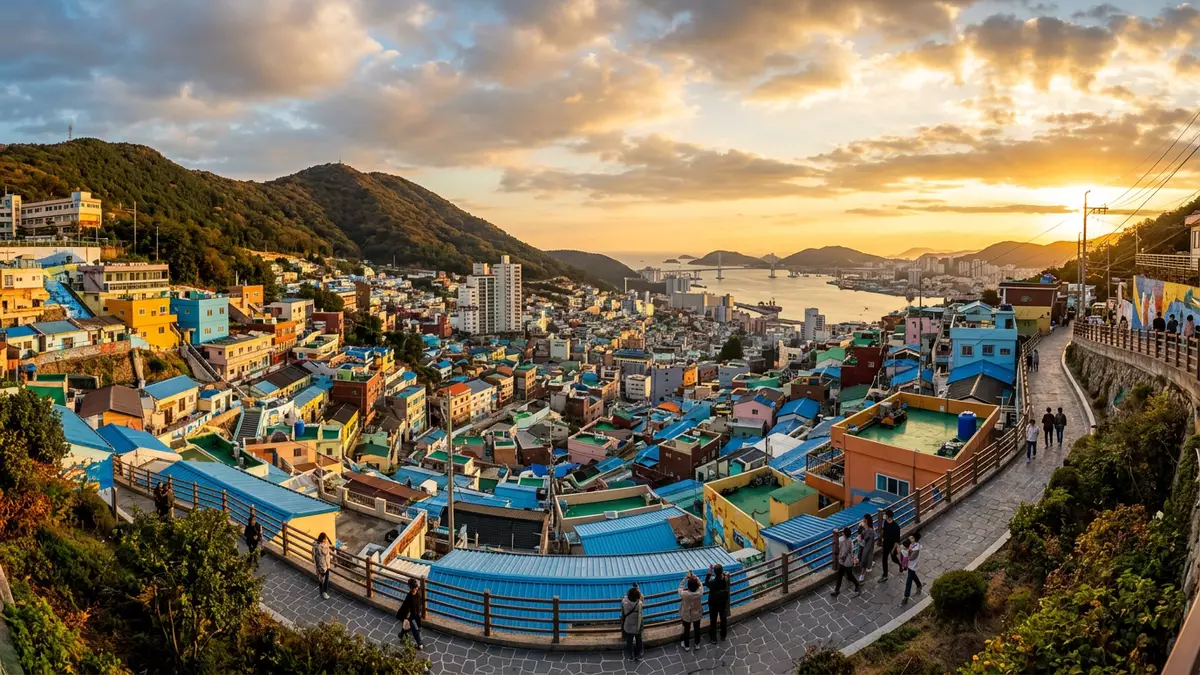
Gamcheon Munhwa Maeul in Busan rises up a steep hillside as a tightly packed terrace of small houses, lanes and stairways that has been turned into an outdoor art village. The district took shape in the mid?twentieth century during and after the Korean War, when refugees settled on the slope above the harbour and built modest homes in stepped rows.
A hillside village shaped by war and faith
Gamcheon Munhwa Maeul occupies the slopes of Busan’s Saha District, looking down towards the port and the lower city. The settlement’s modern history is closely tied to the Korean War of 1950–1953, when Busan served as a refuge for people displaced from other parts of the peninsula who needed a place to live and work.Refugees settled in Gamcheon Village during the Korean War Many of those who arrived built simple dwellings on the steep ground, creating a dense hillside neighbourhood with narrow passages between the houses.The village was originally built in the 1950s when Korean War refugees settled on the steep hillside
Religious communities gave the village an additional layer of identity. Members of Taegeukdo, an ascetic movement that is part of the wider Jeungsanism tradition, formed a sizeable presence here in the mid?twentieth century and helped shape everyday life in the neighbourhood.Taegeukdo, a branch of Jeungsanism, became established in Gamcheon Village Houses were added in tiers up the slope so that the dwellings behind kept access to daylight, producing the stepped, almost amphitheatre?like form that still defines Gamcheon Munhwa Maeul.A stepped village was created so that the houses behind would not lose sunlight
From hillside shanty town to open?air gallery
For decades Gamcheon Munhwa Maeul was a working?class neighbourhood of simple houses and narrow alleys, sometimes described as a shanty town because of its improvised structures and limited resources. In the early 2000s Busan’s authorities and local organisations began to focus on the area’s potential, seeing the terraced layout and views over the port as a distinctive setting for cultural projects.An ambitious renovation programme for Gamcheon began in the 2000s
A turning point came in 2009 with a community art initiative known as the Village Art Project, which invited artists, students and residents to work together on murals, sculptures and installations in the lanes and on the facades.In 2009 students, artists and residents decorated the village as part of the Village Art Project Vacant houses were turned into themed spaces and small galleries, and the village’s pastel?coloured buildings acquired painted details, characters and signboards that mark out art trails through the maze of passages.Ten artists from Busan converted empty houses into artistic spaces with different themes
Terraces, colour and views over Busan
Seen from a distance, Gamcheon Munhwa Maeul appears as a patchwork of low, box?like houses stepping down the hillside, their roofs and walls painted in varied colours that make the terraces stand out against the surrounding slopes.Terraced pastel-coloured houses line the mountain slope Inside the neighbourhood, lanes twist between these buildings, sometimes meeting stairways that rise in long flights, sometimes opening onto small platforms where artworks and viewing points share space with residential doorways.
The topography means that many streets sit above one another, with retaining walls and stepped approaches linking the levels. From some terraces the view runs out across Saha District towards the harbour and the urban core of Busan, while other vantage points look into the tight weave of roofs, alleys and painted facades inside the village itself. Along the way, visitors encounter murals on house walls, sculptural pieces installed beside staircases and small cultural spaces inside former homes that mark Gamcheon Munhwa Maeul’s transformation into a recognised art village.Community art projects have turned the neighbourhood into a hillside residential art village
Visiting Gamcheon Munhwa Maeul: what travellers from Western Europe should know
- Gamcheon Munhwa Maeul lies in Busan’s Saha District on a hillside inland from the main port, and is reached by local buses that run from central areas such as Busan Station and Toseong Station.
- The terrain inside the village is steep, with staircases of many steps, narrow alleys and changing levels between terraces, so moving around the neighbourhood involves frequent climbs and descents on foot.
- The official language is Korean and the currency is the South Korean won.
- Entry requirements depend on your nationality; UK travellers can check the FCDO travel advice at gov.uk/foreign-travel-advice, Irish travellers the Department of Foreign Affairs at ireland.ie.
Searching for Gamcheon Munhwa Maeul on social platforms
These links open searches for Gamcheon Munhwa Maeul on each platform.
Frequently asked questions about Gamcheon Munhwa Maeul
Where is Gamcheon Munhwa Maeul located?
Gamcheon Munhwa Maeul is a hillside neighbourhood in the Saha District of Busan, South Korea, overlooking parts of the port and the lower city.
What can visitors expect when walking through the village?
Visitors encounter terraces of small houses, narrow lanes, long staircases and a range of murals, sculptures and themed spaces created as part of community art projects.
What makes Gamcheon Munhwa Maeul distinctive among Busan’s districts?
Its combination of Korean War refugee history, stepped hillside layout and colourful artworks embedded in an everyday residential setting gives the neighbourhood a character that is closely associated with Gamcheon Munhwa Maeul.


